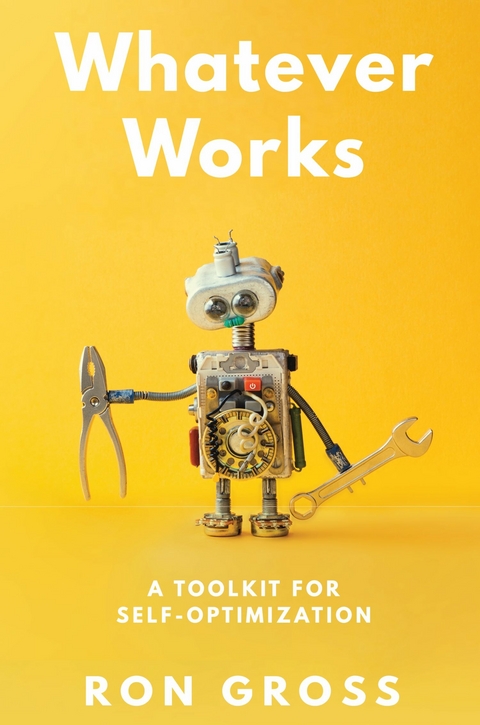
Whatever Works (eBook)
256 Seiten
Ballast Books (Verlag)
978-1-966786-13-9 (ISBN)
Ron Gross is dedicated to the convergence of technology, self-improvement, and community-driven innovation. With an MSc in computer science from the Technion, Ron has extensive experience in both tech and leadership, primarily in small startups, but also in corporate life at Google. An early adopter of Bitcoin and a cryptocurrency advocate since 2011, Ron has long been passionate about decentralization, transparency, and open-source technologies. He co-founded the Israeli Bitcoin Association and served as the executive director of the Mastercoin Foundation, leading the first ever ICO. Today, Ron focuses on leading Fredo.ai, a Whatsapp productivity bot, while exploring practical tools for optimizing life, enhancing productivity, and nurturing meaningful relationships. Connect with Ron at ripper234.com.
A set of powerful tools designed to enhance your life and achieve your goals. Have you lost your creative spark? Feel too distracted to be productive? Struggling to find your purpose or improve your relationships? Developed with input from friends and professionals who share a passion for expanding their lives, Whatever Works offers practical insights for living a life of purpose and happiness without relying on expensive programs from gurus or corporations. Each chapter focuses on one of six key areas Productivity, Relationships, Therapy, Body, Mind, and Spirit with curated recommendations for further exploration. Accompanied by a podcast and an online community, this book is a springboard for deeper reflection and conversation, whether on your own or with others.
Few, if any, of us get through the day feeling as though there is nothing that could have been improved. The desire to make things better is an essential element of being human, and most of us actively wish that aspects of our lives were better in some way. Sometimes it’s the little things that bother us, like a smartphone distracting us with beeps or dings while we’re trying to have a face-to-face conversation. At other times, we wrestle with larger problems, such as an inability to resolve a conflict with our partner. In between, we may wish we were in better shape, want our memory to be sharper, desire more refreshing sleep, or strive for a sense of connection with something greater than ourselves. There are all sorts of ways we could improve our lives . . . if only we had the tools to do so.
Most of us, however, are not used to thinking about self-improvement in these terms. We may resist the idea that we need to use a tool to achieve the results we seek. Perhaps applying the concept of tools to sensitive parts of our lives, such as our psyches, seems mechanical and inhuman, or we resist the connotation that there is something wrong with us that needs to be fixed. The tools in this book, however, are not necessarily meant to repair anything or anyone, or even imply that anyone is broken. They are simply processes, methods, and techniques that offer the possibility of better outcomes tomorrow than we can achieve today.
Life Is Complex
The sheer complexity of life can create chaotic situations and plenty of stress. None of us are perfect. We are all works in progress, evolving in our own ways and directions.
We are all working on numerous projects and activities, both in our work and our personal lives. Professional, romantic, and familial relationships require our time and attention, each of them coming with their own obligations and responsibilities. It’s a lot to juggle and manage, and it’s impossible to do everything perfectly all the time, which is why finding methods—or tools—to improve and grow in each of these areasis sometimes necessary to carve out order from the chaos and ease the stress.
Even when things are going well, most of us can still find ways to optimize some aspects of our lives. The software in our phones and computers is constantly being updated to improve its performance. In the same way, we can seek to update our behavior. And when we do, we may discover deeper levels of productivity and ease, whether at work or at play. We learn we can indeed have more satisfying relationships and better mental, emotional, and physical health.
Yet the plethora of available tools can feel as mind-boggling as life itself. If you regularly engage in self-improvement, you may already be familiar with the sense of being overwhelmed that can ensue from attempting to parse this complex field. Amazon lists more than ninety thousand books in the “self-improvement” category. Choosing the most effective tool can be so confusing that it feels like it’s not worth the effort.
It doesn’t have to be that way.
Grab Your Tools
For many years, I’ve been curating tools for my personal use. The ones compiled in this book represent those I’ve found most effective, and I hope that you will experiment by applying them to your life and optimizing whatever areas you feel can be improved. Beyond providing you with individual techniques and concepts that you find useful, this book’s meta-goal is to teach tool-based thinking, encouraging you to discover and develop your own set of tools. You are also invited to contribute suggestions and new tools back to the community online at whateverworks.me.
In some chapters, I’ve designated one tool as a Pillar because it has impacted me greatly and I use it on a day-to-day basis. These Pillar tools, marked with the symbol , are more comprehensive than others, consisting of more detailed concepts and instructions for their use. They are:
Getting Things Done
Nonviolent Communication
Meditation
Jordan Peterson’s Twelve Rules for Life
All the tools are grouped into six different chapters, except for one, which falls under the heading of “Meta Tool: Seek Continuous Improvement.” It’s listed this way because it forms the principle that underpins every other tool and thereby deserves to be considered uniquely. After the Meta tool, you’ll find the rest separated into specific chapters. Categorizing the tools was a challenge in itself because several could have fit into more than one chapter. I’ve placed them where I think they make the most sense and fit in most seamlessly with other tools. Some tools are loosely related to others. In those instances, you’ll find a note cross-referencing the location of the connected tool.
Each tool opens with a description of the motivation for utilizing it. This is important—otherwise, why bother? Below this, I’ve provided a short summary of the key benefits of learning and applying the tool, along with the accompanying challenges. Below these sections, you’ll find the application, which discusses how to practice the tool and/or provides examples of it in practice. Finally, if there is further reading that can provide more information, it is listed at the end.
This book serves as a compendium. All told, there are almost a hundred tools here. For the simplest tools, the application section provides enough information to begin using the tool immediately. In some cases, however, whole books have been written about one tool alone, and space doesn’t allow me to go into that level of depth. For these more detailed tools, the application section merely presents the method. In these cases, if you think a tool will work for you, you’ll want to do a deep dive into the references provided so you can learn how to implement the tool fully.
Don’t be scared by the number of tools. There’s no need to aspire to apply every one. The purpose is to provide you with a selection from which you can pick and choose, discovering the tools that are most applicable to you (more on this later).
The chapters are as follows.
Productivity
Here you’ll find tools that can help you better manage your time, attention, workflow, and projects. In this category, you’ll find the Pillar tool Getting Things Done (GTD)—a comprehensive methodology for stress-free Productivity. There are also tools to help you keep distractions at bay and make better decisions. And because being productive often requires you to work effectively with others, there are tools to encourage cooperation and focus in a team setting. Finally, there are tools that help you rest from productivity. You cannot be productive all the time; you must allow your mind and body to rest and recharge.
Relationships
In the second chapter, you’ll discover multiple tools aimed toward improving Relationships and communication and opening up channels of understanding. The Pillar tool Nonviolent Communication (NVC) can help you form, maintain, and repair heart-to-heart authentic connections with others and yourself and also help you get more of everyone’s needs met. The relationship tools apply to group settings, as well as to one-on-one situations in just about any type of relationship. There are also tools you can use to help you express your emotions and be more empathetic to yourself and to others.
Therapy
The third chapter contains tools that can assist you in getting the most out of Therapy in whatever form you receive it, whether your therapy takes place with a professional therapist or counselor or if you are walking a path of self-help. These tools also include methods for handling conflict and ways to connect with other people, providing a safe place where everyone can bring their whole selves to a conversation. Also included are methods for dealing with and managing difficult emotions. Jordan Peterson’s Twelve Rules for Life are presented as the Pillar tool, as they offer some keys for leading a meaningful, authentic life (e.g., Rule 2: Treat yourself like you are someone you are responsible for helping).
Body
The second half of the book focuses on three areas: Body, Mind, and Spirit. In the Body chapter, you’ll find tools centered on physical health and well-being. We all understand the importance of eating right and exercising, but neither strategy is always easy, pleasant, or even effective. The collection of tools in this chapter discusses various options for properly taking care of your body, including sports, exercise, diet, and supplements. You’ll also read hacks intended to cut through resistance or lethargy and make it easier to stick to a particular nutritional plan or eating regimen. As usual, this book won’t prescribe a specific course of action. It will instead present various options from which you can pick and choose, tailoring them to your specific needs.
Mind
Tools in the Mind chapter are dedicated to helping you remember things you’ve read or heard or people you’ve met. They’re relevant to many aspects of the mind’s functioning and should empower you to think critically, engage your creativity, and expand your openness to new ideas. You will find tools aimed at helping you improve your memory, address your fears, and relax your buzzing brain so that you can sleep more deeply. In combination, the tools in this chapter should improve your thinking and...
| Erscheint lt. Verlag | 25.3.2025 |
|---|---|
| Sprache | englisch |
| Themenwelt | Sachbuch/Ratgeber ► Beruf / Finanzen / Recht / Wirtschaft |
| ISBN-10 | 1-966786-13-1 / 1966786131 |
| ISBN-13 | 978-1-966786-13-9 / 9781966786139 |
| Informationen gemäß Produktsicherheitsverordnung (GPSR) | |
| Haben Sie eine Frage zum Produkt? |
 EPUB (Ohne DRM)
Größe: 2,3 MB
Digital Rights Management: ohne DRM
Dieses eBook enthält kein DRM oder Kopierschutz. Eine Weitergabe an Dritte ist jedoch rechtlich nicht zulässig, weil Sie beim Kauf nur die Rechte an der persönlichen Nutzung erwerben.
Dateiformat: EPUB (Electronic Publication)
EPUB ist ein offener Standard für eBooks und eignet sich besonders zur Darstellung von Belletristik und Sachbüchern. Der Fließtext wird dynamisch an die Display- und Schriftgröße angepasst. Auch für mobile Lesegeräte ist EPUB daher gut geeignet.
Systemvoraussetzungen:
PC/Mac: Mit einem PC oder Mac können Sie dieses eBook lesen. Sie benötigen dafür die kostenlose Software Adobe Digital Editions.
eReader: Dieses eBook kann mit (fast) allen eBook-Readern gelesen werden. Mit dem amazon-Kindle ist es aber nicht kompatibel.
Smartphone/Tablet: Egal ob Apple oder Android, dieses eBook können Sie lesen. Sie benötigen dafür eine kostenlose App.
Geräteliste und zusätzliche Hinweise
Buying eBooks from abroad
For tax law reasons we can sell eBooks just within Germany and Switzerland. Regrettably we cannot fulfill eBook-orders from other countries.
aus dem Bereich