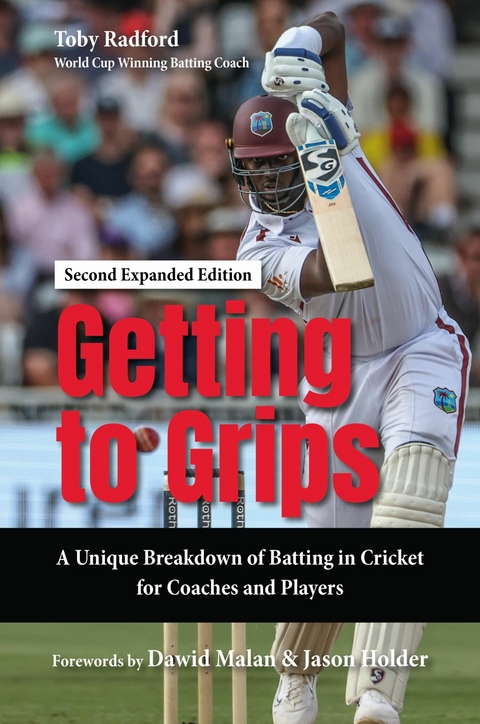
Getting to Grips (eBook)
152 Seiten
Meyer & Meyer Fachverlag und Buchhandel GmbH
978-1-78255-559-9 (ISBN)
Toby Radford is widely regarded as one of the best batting coaches in the game. Toby was head coach when Middlesex was crowned English T20 Champions in 2008, and batting coach when the West Indies won the T20 World Cup in Sri Lanka in 2012. Following a successful spell as an England and Wales Cricket Board (ECB) national coach, Toby launched the Middlesex Cricket Academy. In 2010 Toby set up the West Indies High Performance Centre in Barbados. After 10 years of coaching in the Caribbean, Toby was recently head of performance for Bangladesh Cricket (BCB) and a batting consultant for Pakistan Cricket (PCB). Passionate about developing the coaches of the future, Toby has written and delivered several batting modules for the ECB's advanced coaching program and has also mentored several coaches for the game's governing body. He is currently batting consultant for Kent County Cricket Club.
Getting to Grips is a unique publication for cricket coaches and players of all ages. It offers skills, drills, and practical solutions to common batting problems. Author Toby Radford uses his experience as an international batting coach to offer invaluable insight into what makes the world's best players so successful. He describes the Five Fundamentals of Batting - the basis of good batting - and uses an innovative mix of images and notes to clearly describe highly complex batting techniques and movements. This second expanded edition includes new technical analysis of international and county batsmen and offers practical guidance for players preparing for, and managing, their innings as well as how to cope with any unwanted yet inevitable runs of poor form. For coaches, there is a new and detailed breakdown of how to structure a one-to-one session with a batsman to quickly improve and maximize their potential. The effective techniques, skills, and drills are those Toby uses with the world's top batsmen in the West Indies, in Bangladesh, and with the ECB, and are all offered here to help take your playing or coaching to the next level.
The Set-Up
How a batsman sets up, and especially his position at ball release, is crucial. So many batting issues arise from a set-up that hinders effective movement and a consistent bat path to the ball. The shots themselves are not difficult to play, but they are if players are unable to move quickly into the appropriate, balanced position to play them. It is important that coaches acknowledge and accept individual differences between players. No two players play the same way, and neither should they. Individuality and flair are what makes sport compelling viewing. Consider Virat Kohli’s poetic cover drive, Viv Richard’s trademark flick over square leg or Robin Smith’s blistering square cuts.
Dig a little deeper beneath the glossy exterior of these fine players and other world-class batsmen, and what do we find?
Whether it is Steve Smith, Babar Azam, Kane Williamson, Ben Stokes or Marnus Labuschagne, each has his individual ‘go to’ shots and favours scoring in slightly different parts of the field.
They also meet five key fundamentals, which form the basis and technical foundation of their batting:
1.The head is close to off-stump / middle and off-stump at ball release.
2.The hands and bat are kept close to the body at ball release, and the top hand dominates the backswing and bat path.
3.The head and body align towards the bowler’s stumps at ball release (RH bat v RH bowler), and the body is in a dynamic position (knees slightly bent) to enable quick movement forward or back.
4.The batsman tracks the ball in early flight and moves to the finishing line.
5.Contact with the ball is made close to the body (near the head) and from a stable base.
Flashy alloys and glistening paint are only added to a Ferrari once a strong chassis is in place. Batting is no different. Flair and funk are only added when a solid technical foundation and the key fundamentals are in place.
Position at Ball Release
Some batsmen prefer to stand still at release, while others will get there following a ‘trigger’ or pre-delivery movement, which gets their feet and body ready to spring into action. Whatever movement comes before the position at ball release is very much a personal choice.
It is crucial, though, that the position at ball release enables quick movement forward and back and easy access to all lines of delivery. The current trend with the world’s best batsmen (RH bat v RH bowl or LH bat v LH bowl) is to position their head close to off-stump at ball release. This helps them to judge more easily whether to play or leave deliveries pitching in and around the off-stump channel.
Against real pace, anything outside the eye line can be left, and the feet and body are already in position for those directed straighter. With the head and back foot already close to the off-stump channel – the ‘business area,’ where most top bowlers bowl – crucial time is saved from moving across the crease to get into line against deliveries travelling at speeds of up to 95 mph at the top end of the game.
Steve Smith and Marnus Labuschagne were highly successful using this method against the pace of Jofra Archer in the 2019 Ashes Series. Between them, they amassed 1127 runs, which included 3 hundreds and 7 fifties. Smith struck 774 runs at an average of 110.57 and Labuschagne 353 at an average of 50.
Pakistan’s Babar Azam currently averages 42.5 in Test matches and 56 in One Day Internationals (ODIs). Until recently he was rated number one Twenty20 (T20) player in the world. Ben Stokes, another who positions his head at off-stump at ball release, averages 37 in Tests and 40 in ODIs.
The top players make subtle adjustments to this positioning based on the conditions they play in and the bowlers they face. They bring their guard back a little so that their head finishes closer to middle stump at ball release when coping with excess and late lateral movement - especially in conditions like those often witnessed early season in the county championship in England, where quality bowling on damp, green pitches and a proud-seamed Dukes ball make batsmen battle hard for every run.
Many of the world’s best batsmen – such as Babar Azam, Steve Smith, Ben Stokes, AB de Villiers, Marnus Labuschagne and Darren Stevens – have their heads close to off-stump at ball release and align their bodies to the bowler’s stumps so that they can judge off-stump easily and access all lines of delivery. They ‘open’ their front foot slightly and focus on their head staying forward and not drifting outside off-stump when the ball is released. This helps them to play straight to any deliveries that swing, seam or angle back at the stumps.
Babar Azam (Pakistan)
Babar Azam – ranked number-one batsman in the world in ODIs, third in T20 and tenth in Test Cricket – has a wonderful position at ball release:
•His head is close to off-stump.
•His hands are close to his body and under his head.
•His head and shoulders face the bowler’s stumps.
•His feet are slightly open to help access all lines of delivery.
Marnus Labuschagne (Australia and Glamorgan CCC)
Ranked third highest in the world, Marnus Labuschagne, is another top-class batsman who keeps his head close to off-stump at ball release. He is seen in the photo during his innings of 77 for Glamorgan against Northamptonshire in Cardiff. His head is still, hands are under his head, and he creates an imaginary straight line from his head through his hands to his feet for wonderful balance and easier control of the bat.
Harry Brook
Harry Brook is another world-class batsman who keeps his head close to off-stump – the ‘business area’ – at ball release.
•His back foot is on off-stump to limit unnecessary movement at release, enabling him to have his head near off-stump.
•He dips his head and front shoulder forward to create the backswing and keeps the toe of the bat high for a fluent swing and to get on top of the bounce.
•He keeps his hands under his head and creates a straight line – from his head through his hands to his feet – for excellent balance and to help him transfer his weight quickly and easily.
I spent two great days working with England and Kent batsman Sam Billings as he prepared to fly out to the KFC Big Bash League with Brisbane Heat. We focused on good balance and alignment of the shoulders and hips at ball release and the head moving directly to the finish line of the ball. I worked with Mahaaz Ahmed from the SACA Academy. Initially, his head was well outside his feet at ball release which caused him to play across straight deliveries. With a straighter back and a little more weight over his front foot, he was able to get his head over his feet at ball release and inside off stump. Consequently, he could then access all lines of delivery with a full face of the bat.Tom Cullen (Glamorgan CCC)
Glamorgan batsman Tom Cullen working hard to get his head, hands and feet to line up to improve his balance and ease of movement.
Pre-Delivery Movement (Trigger)
Most international batsmen have some form of movement prior to ball release to fire up the muscles and get the feet ready to access all lines and differing lengths of delivery. Tennis players adopt a similar movement – a shuffling of their feet and bodyweight when looking to return fast serves.
The timing of a trigger is important. If it is late – just at, or after, ball release – the player is often rushed to get into position. Balance and stability are not created at contact, so control and power are lost in the shot. If a trigger is too early – well before ball release – the benefit of it ‘firing up the system’ to move is lost.
Ideally, any movement should be made just as the pace bowler bounds (jumps) and takes the ball up in his gather.
There are many different types of triggers. Some players feel comfortable with a forward press, while others take their back foot towards off-stump, and many like to move both feet, either forward or back.
Whatever movement a batsman adopts, it needs to be comfortable, consistent and effective. If the movement does not create a balanced position for good judgment at ball release and enable quick and easy movement forward and back to all lines of delivery, then it is not an effective trigger. It is a batting hindrance, not a help.
I appreciate and welcome a player’s personal preferences with his movements, but I have found the most successful players tend to make smaller movements (reducing the chance of errors), move earlier rather than later (to avoid being rushed), maintain a steady head position at ball release and are well aligned to move up and down the wicket and access all lines of delivery easily.
Common problems that occur when performing the trigger:
•Moving too early and losing the benefit.
•Moving too late and rushing the stroke, resulting in a lack of balance or control.
•Not aligning well at ball release – hips, feet and shoulders not facing towards bowler’s stumps.
•Putting weight on the back leg at release, thereby...
| Erscheint lt. Verlag | 1.4.2025 |
|---|---|
| Sprache | englisch |
| Themenwelt | Sachbuch/Ratgeber ► Sport ► Ballsport |
| ISBN-10 | 1-78255-559-5 / 1782555595 |
| ISBN-13 | 978-1-78255-559-9 / 9781782555599 |
| Informationen gemäß Produktsicherheitsverordnung (GPSR) | |
| Haben Sie eine Frage zum Produkt? |
 EPUB (Adobe DRM)
Kopierschutz: Adobe-DRM
Adobe-DRM ist ein Kopierschutz, der das eBook vor Mißbrauch schützen soll. Dabei wird das eBook bereits beim Download auf Ihre persönliche Adobe-ID autorisiert. Lesen können Sie das eBook dann nur auf den Geräten, welche ebenfalls auf Ihre Adobe-ID registriert sind.
Details zum Adobe-DRM
Dateiformat: EPUB (Electronic Publication)
EPUB ist ein offener Standard für eBooks und eignet sich besonders zur Darstellung von Belletristik und Sachbüchern. Der Fließtext wird dynamisch an die Display- und Schriftgröße angepasst. Auch für mobile Lesegeräte ist EPUB daher gut geeignet.
Systemvoraussetzungen:
PC/Mac: Mit einem PC oder Mac können Sie dieses eBook lesen. Sie benötigen eine
eReader: Dieses eBook kann mit (fast) allen eBook-Readern gelesen werden. Mit dem amazon-Kindle ist es aber nicht kompatibel.
Smartphone/Tablet: Egal ob Apple oder Android, dieses eBook können Sie lesen. Sie benötigen eine
Geräteliste und zusätzliche Hinweise
Buying eBooks from abroad
For tax law reasons we can sell eBooks just within Germany and Switzerland. Regrettably we cannot fulfill eBook-orders from other countries.
aus dem Bereich