Soccer Training (eBook)
352 Seiten
Meyer & Meyer Fachverlag und Buchhandel GmbH
978-1-78255-543-8 (ISBN)
Joseph A. Luxbacher has more than three decades of experience in highly competitive athletics. He holds a PhD in Health, Physical and Recreation Education from the University of Pittsburgh. A former professional player in the North American Soccer League (NASL) and Major Indoor Soccer League (MISL), he still holds the University of Pittsburgh men's soccer scoring records for most career goals, most career points, most hat tricks, and most goals scored in one game. Luxbacher has earned the 'A' Coaching License of US Soccer and is a member of the United Soccer Coaches Association. He served as head men's soccer coach at the University of Pittsburgh from 1985 to 2015 when he retired from collegiate coaching. In 2023, he was inducted into the University of Pittsburgh Athletic Hall of Fame. He has authored more than a dozen books and numerous articles on the topics of soccer and peak athletic performance. His various soccer books have sold more than 250,000 copies and have been translated into several languages.
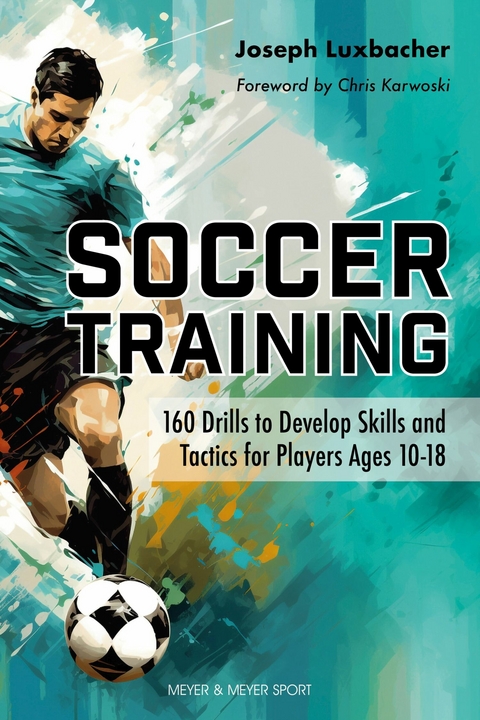
Soccer Training: 160 Drills to Develop Skills and Tactics for Players Ages 10-18 provides coaches and players with a wide variety of drills designed to improve skill and tactical awareness. Each of the 160 drills focuses on a specific skill or set of skills and keeps participating players active and involved. Field players will improve their ability to pass, receive, dribble, shoot, and head the ball as well as learn how to best apply those skills in game situations. A series of fundamental drills are also offered for goalkeepers, the one true specialist on the soccer team. The goalkeeper drills are designed to introduce aspiring netminders to the unique skills and demands associated with the position. The drills are generally appropriate for youth through high school level competition and can be adapted to accommodate players of various ages and ability levels. Each drill is illustrated and provides specific instructions for setting up and performing the activity. The drills are organized into sections, focusing on warm-up activities, dribbling and tackling skills, passing and receiving skills, shooting and finishing, and more. Soccer Training provides an effective and enjoyable pathway to learn, improve, and ultimately excel at the world's most popular game.
SECTION 1
WARM-UP ACTIVITIES
Players should undergo a warm-up prior to each training session and match. Warm-up activities serve the important function of preparing players, both physically and mentally, for more vigorous activity by increasing muscle temperatures, promoting increased blood flow, improving reflex time, and minimizing next-day soreness. Warm-up activities should be of sufficient intensity and duration to induce sweating, an indicator that muscle temperatures have elevated. This process can take anywhere from 15 to 30 minutes, depending on the ambient temperature, humidity, and general environmental conditions.
Most players and coaches generally prefer warm-up activities that are soccer-specific; in other words, related to playing the game of soccer. A soccer-specific warm-up consists of activities that involve the actual skills, movements, and mobility required of players in a soccer match. The warm-up drills described in this section are intended to provide a variety of options for team (group) warm-up while preparing players for the physical challenges to follow.
DRIBBLE IN, PASS OUT
OBJECTIVE
- Warm-up activity leading into a training session that focuses on passing and receiving skills
SETUP
- Play within the center circle (or similarly sized area of the field).
- Three or four players are positioned inside the circle, each with a soccer ball.
- The remaining players spread themselves along the perimeter of the circle.
- Players on the perimeter of the circle do not have a ball.
PROCEDURE
- On the coach command, players dribble freely within the circle, avoiding all other dribblers.
- At their discretion the dribblers pass their ball to a teammate of their choice positioned along the perimeter of the circle and switch places with that player.
- The player receiving the ball uses their first touch on the ball to take them inside the circle where they are free to dribble and at their discretion pass to a teammate stationed along the perimeter of the circle and switch places with that player.
- Continue the dribble-in and pass-out activity for 10 minutes at a high pace.
COACHING TIPS
- This warm-up activity is appropriate for almost any age group.
- Players can work to improve their first touch, dribbling, and passing skills.
DRIBBLE FREEZE TAG
OBJECTIVE
- To improve dribbling skills when performing in restricted space and with limited time to make decisions
SETUP
- Position markers to create a playing area 20 yards square.
- Each player has possession of a ball except for two players who are designated as the taggers.
- The taggers position themselves outside of the area to begin.
- All other players, each with a ball, position within the area.
PROCEDURE
- Players begin to dribble randomly within the area, keeping close control of their ball.
- On coach command, the taggers enter the area to chase after and tag the dribblers.
- Dribblers who are tagged are frozen and must stand stationary with one foot on the ball.
- A player can be unfrozen by a teammate who dribbles near and tags her or him.
- Play for two minutes or until all dribblers are frozen, then change taggers and repeat.
COACHING TIPS
- Encourage the use of dribbling maneuvers coupled with sudden changes in speed and direction while maintaining close control of the ball.
3 STATION WARM-UP
OBJECTIVE
- To prepare players for a training session focused on passing and dribbling skills
SETUP
- Divide the team into groups of four to six players.
- Place two markers 15 to 20 yards apart for each group.
- For each group, two or three players are positioned at opposite markers facing one another.
- One (1) ball is required per group.
PROCEDURE
- Perform three 5-minute stations.
- Station 1. The player with the ball dribbles to the opposite line of players, exchanges the ball with the first player in that line, and remains there. The player receiving the ball does likewise in the opposite direction.
- Station 2. The player with the ball passes to the first player in the opposite line and follows the pass to that group. Receiving player does likewise in the opposite direction.
- Station 3. Double Pass Combination (for more advanced players). The player with the ball passes to the first player in the opposite line, moves forward to receive a return pass, and then passes the ball to the next player in the opposite line who repeats process in the opposite direction.
** Players follow their pass to the end of the opposite line.**
COACHING TIPS
- Encourage players to use only two touches, if possible, to receive and pass the ball (first touch to prepare, second touch to pass).
HIT OR MISS
OBJECTIVE
- To rehearse passing and dribbling skills in a large group warm-up exercise
SETUP
- Mark off an area of 20 by 25 yards.
- Require that a ball be available for each player as needed.
- Three players (passers) begin with possession of a ball and are positioned along the perimeter of the area.
- Place remaining balls outside the area.
- Players without a ball (dodgers) scatter throughout the grid area.
PROCEDURE
- On the coach command the passers dribble into the grid and attempt to pass their ball so that it contacts dodgers below the knees.
- Passers must use the inside of the foot for all passes–shooting is not permitted!
- The dodgers use sudden changes in speed and direction to avoid being hit by a passed ball.
- A dodger who is contacted below the knees with a passed ball collects a ball from the extra balls placed outside the area and joins the passers.
- Play continues until there are only three dodgers remaining.
- Those players become passers for the next round.
COACHING TIPS
- This exercise requires players to dribble and get their heads up to make a pass.
- Adjust the area size to match the age, passing ability, and number of players involved.
GROUP PASS OR DRIBBLE
OBJECTIVE
- To rehearse passing and dribbling skills in a warm-up exercise
SETUP
- Divide the group into two teams of equal numbers.
- Designate one team as the passing team, and the other as the dribbling team.
- Play within a 30-yard square area.
- The passing team has possession of one ball.
- Each player on the dribbling team has possession of a ball.
PROCEDURE
- Dribbling team players dribble randomly within the area while maintaining close control of their ball and performing various dribbling moves.
- At the same time, passing team players circulate a ball among themselves as they move throughout the area.
- Passing team players should avoid contacting dribblers with a passed ball.
- After 5–6 minutes of continuous play, teams switch roles and repeat.
COACHING TIPS
- All players should be in constant movement (dribbling or passing) throughout the entire warm-up period.
MINNOWS AND SHARKS
OBJECTIVE
- To incorporate passing and dribbling skills in a group warm-up activity
SETUP
- Use markers to outline a channel area 20 yards wide by 30 yards long with a safety zone 3 yards deep at each end.
- Station three sharks in the center of the channel, each with a ball.
- The remaining players (i.e., minnows), each with a ball, are stationed in the safety zone on one end of the field facing the sharks.
PROCEDURE
- On coach command, the minnows attempt to dribble the length of the channel past the sharks to the opposite safety zone.
- Sharks can capture minnows by contacting them below the knees with a passed ball.
- All passes must be made with the inside or outside surface of the foot; no shooting is permitted.
- A minnow contacted below the knees with a passed ball is considered captured and joins the sharks for the next round.
- Minnows who reach the opposite safety zone without being contacted with a passed...
| Erscheint lt. Verlag | 1.9.2024 |
|---|---|
| Sprache | englisch |
| Themenwelt | Sport ► Ballsport ► Fußball |
| ISBN-10 | 1-78255-543-9 / 1782555439 |
| ISBN-13 | 978-1-78255-543-8 / 9781782555438 |
| Informationen gemäß Produktsicherheitsverordnung (GPSR) | |
| Haben Sie eine Frage zum Produkt? |
 EPUB (Adobe DRM)
Kopierschutz: Adobe-DRM
Adobe-DRM ist ein Kopierschutz, der das eBook vor Mißbrauch schützen soll. Dabei wird das eBook bereits beim Download auf Ihre persönliche Adobe-ID autorisiert. Lesen können Sie das eBook dann nur auf den Geräten, welche ebenfalls auf Ihre Adobe-ID registriert sind.
Details zum Adobe-DRM
Dateiformat: EPUB (Electronic Publication)
EPUB ist ein offener Standard für eBooks und eignet sich besonders zur Darstellung von Belletristik und Sachbüchern. Der Fließtext wird dynamisch an die Display- und Schriftgröße angepasst. Auch für mobile Lesegeräte ist EPUB daher gut geeignet.
Systemvoraussetzungen:
PC/Mac: Mit einem PC oder Mac können Sie dieses eBook lesen. Sie benötigen eine
eReader: Dieses eBook kann mit (fast) allen eBook-Readern gelesen werden. Mit dem amazon-Kindle ist es aber nicht kompatibel.
Smartphone/Tablet: Egal ob Apple oder Android, dieses eBook können Sie lesen. Sie benötigen eine
Geräteliste und zusätzliche Hinweise
Buying eBooks from abroad
For tax law reasons we can sell eBooks just within Germany and Switzerland. Regrettably we cannot fulfill eBook-orders from other countries.
aus dem Bereich