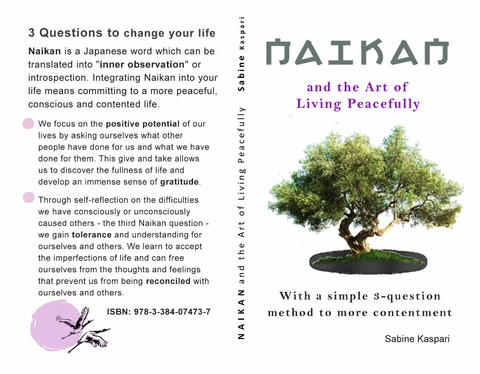
Naikan and the Art of Living Peacefully (eBook)
180 Seiten
tredition (Verlag)
978-3-384-07473-7 (ISBN)
Sabine Kaspari, born 1960 in Munich (capital city of Bavaria, South Germany). She has three adult sons, learned about Naikan in 2002 as part of her training as a Naikido Shiatsu practitioner, practicing her first Naikan Retreat in 2003 with her teacher Josef Hartl in Austria. Two years later, Naikan helped her over a serious personal crisis and she began her training as a Naikan guide in 2006 with Franz Ritter and Prof. em Akira Ishii. Since 2007 she has been accompanying a few hundred participants in their Naikan Retreats. In 2012 she moved her center to the edge of National Park Bavarian Forest. Her greatest passion is to provide the Naikan experience and with it a tool to inner peace accessible to as many people as possible.
Sabine Kaspari, born 1960 in Munich (capital city of Bavaria, South Germany). She has three adult sons, learned about Naikan in 2002 as part of her training as a Naikido Shiatsu practitioner, practicing her first Naikan Retreat in 2003 with her teacher Josef Hartl in Austria. Two years later, Naikan helped her over a serious personal crisis and she began her training as a Naikan guide in 2006 with Franz Ritter and Prof. em Akira Ishii. Since 2007 she has been accompanying a few hundred participants in their Naikan Retreats. In 2012 she moved her center to the edge of National Park Bavarian Forest. Her greatest passion is to provide the Naikan experience and with it a tool to inner peace accessible to as many people as possible.
First Naikan Exercises
Applying the three questions to one day is a good way to start your first experience with Naikan. Soon you will be able to continue using the daily Naikan towards people and topics or work with larger periods of time.
Naikan towards the present day
"Even the longest journey begins with the first step," says a Chinese proverb, and you can take that step today. Once you've read the introductory sections of this book, you can basically get started right away. Allow yourself some time and have writing materials ready. You should be able to let your mind wander for at least 10-20 minutes without being disturbed. If this is not possible now, wait until the children are in bed and your partner is at sports. Or make sure that your retreat to a quiet place is respected.
There are several ways in which you can begin to practice the Naikan method. One of them is to review the day with the help of the three questions. First, think about what it was like this morning when you woke up. Did the alarm clock ring, did you wake up on your own, or did someone wake you up? Did you get up right away, or did you indulge for a moment in the warmth of your bed? Who from the family was there, were you alone and could you enjoy undisturbed the friendly voice on the radio or the soothing silence? Whom did you meet on the way to work, whom did you talk to?
EXAMPLE OF NAIKAN ON A DAY
Thursday, Sept. 15, 2016
1. What did someone do for me today?
The friendly voice of the radio host woke me up. S. got me a breakfast board from the shelf and the butter from the fridge. Everyone put away their own breakfast dishes. F. fed the cat. Someone had already opened the garage door, so I could leave right away. A car driver let me join the queue. A woman held the door open for me. A little boy smiled warmly at me. A colleague picked up a piece of paper that I had dropped. A colleague brought me coffee from the vending machine. The cashier at the supermarket kindly wished me a pleasant evening. The children helped with the cooking and cleared the table after dinner. P. turned on the washing machine. M. called to inform me of an interesting event. The neighbor brought me a bowl full of beans. Everyone helped clean and cut the beans. P. read to me while I cooked.
2. What did I do for someone today?
I cleaned up the leftovers from breakfast and wiped the table. I let a pedestrian cross the street. I helped a colleague write an email. I comforted a colleague. I
threw a coffee mug in the trash that had fallen beside it. I bought ice cream for dessert. I let a woman go ahead of me at the cash register. I hung out laundry. I cooked for the family. I brought P. a glass of wine. I stifled an ironic remark to F.
3. What trouble have I caused today?
P. was woken up by my alarm clock. The children had to fix breakfast. I asked F. to feed the cat, although he would have done it on his own. The cars behind me had to wait because I let the pedestrian cross the street. I made disparaging remarks about the appearance of a colleague. I scolded P. for having to do laundry today of all days. I ate two servings of dessert. I snapped at F. when he switched between programs while watching TV. I interfered in a discussion between the children. I was in a bad temper in the evening and spoiled everyone's mood.************************
And so on. Try to remember as many details as possible, and as you review the day, ask yourself the three questions:
1. What did someone do for me today?
2. What did I do for someone today?
3. What difficulties/troubles did I cause today?
After about 10 - 20 minutes, in which you have looked at your day in detail and assigned the experiences to the three questions, you are done for today. If you can't think of an answer to a question, that's okay as well.
Especially the 3rd question is a challenge for many at the beginning.
Naikan has a long term effect
That's completely unspectacular, isn't it? Almost boring? Do not underestimate the long-term effect of this exercise. Especially if you do this exercise every day, you will soon notice that you pay more attention to certain things. You will be more aware of your day. And the third question is not so bad either, if you just stick to the facts. That is the difficulty, but also the great art of Naikan - to see the simple facts without interpreting and judging.
Of course, you may be tempted to throw this book in the corner even before you finish your first exercise. You may be thinking, "What nonsense, why should I consider whom I caused trouble to? What about the trouble I had with my kids, boss, co-workers, etc. today?" You are absolutely right - from your point of view. Except that it doesn't help to insist on it. Because everyone else you are dealing with also feels they are right - from their point of view. This point of view is one-sided and subjective, i.e. colored by moods, expectations and wishes, and does not get you anywhere.
No one accused me
Suddenly I was no longer the poor victim of others' mistakes, as I often thought before. Suddenly I was the grateful person who had experienced a great deal of love and affection in her life story. Also, I was not just the ungrateful egoist that I thought I was. And I recognized with a light heart my mistakes and weaknesses, my small and big cruelties that I did to my loved ones. The emphasis is on "with a light heart", because no one accused me, I recognized it all from the perspective of others, from the outside. Except that the others weren't there. They couldn't judge me at all - and neither could I judge myself. Jasmina W.
Therefore, try to ignore and overcome the resistance to the question about the difficulties you are causing. You will see, especially the third question brings the most important insights and will help you to develop more serenity towards yourself and others in the long run.
Change focus and hold on
The goal is to integrate Naikan and the three questions into daily life. However, this requires a certain routine that only time can bring. To make it easier for you to persevere, you can change the focus of your contemplation after some time. When you have been using daily Naikan for two to four weeks, you can look at the day in terms of your partner, your children or your work, for example. Finally, you can break away from the daily structure and examine yourself in relation to specific people or topics in larger periods of time. It is important, however, that in addition to the daily time of reflection, you also devote a sufficient period of time to each topic over several days or weeks. And do not jump from one to the other.
Deeper Naikan on a day
So now, in a next step, you can deepen your daily Naikan. Test yourself with the three questions towards a certain person you deal with frequently.
Daily Naikan towards the partnership
Our respective partner and life companion occupies a special position in our daily lives. On the one hand, because we have a very intimate relationship, on the other hand, because there are many points of friction with him or her. These range from the small aspects of everyday life to major life planning. Therefore, it is worthwhile to focus attention on this person. Ask yourself the three questions in the following way:
1. What did my partner do for me today?
2. What did I do for him/her?
3. What difficulties/troubles did I cause her/him today?
Again, make sure you focus only on facts and avoid any interpretation or judgment. If you keep a diary, write your answers in it as usual. An example of a daily Naikan towards your partner can be found on the following page. Such a Naikan is very helpful if you feel that your partnership could use some momentum again. Or if you are just curious what insights the contemplation will bring. In any case you will bring some order and clarity into your partnership and your feelings.
In case of serious relationship problems and partner conflicts, however, you should seek the professional help of appropriate therapists and/or complete a Naikan retreat.
Several times I was able to witness that relationship-weary people came to a Naikan week with the firm intention to separate from their partner. Towards the end of the week, they could hardly wait to go home to rebuild and revive the relationship.
EXAMPLE OF A DAILY NAIKAN ON YOUR PARTNER
Peter, March 15, 2018
1. What did he do for me today? He brought me coffee in bed. He built a fly screen for my study window. He made roasted vegetables for lunch. He accompanied me to a Greenpeace event and bought a DVD for me…
2. What did I do for him today? I measured his blood pressure. I hung up the laundry and emptied the dishwasher. I helped him put in the fly screen…
3. What trouble did I cause him? When I got up in the morning, I ran into the door, and he woke up.
Instead of helping him to build the fly screen, I went for a walk with my neighbour. I made him choose to accompany me to Deggendorf at short notice…******
If you really can't think of anything for one question or another, write "found nothing" and read the section "I can hardly find answers - what to do?".
Naikan and your children
When you apply the daily Naikan on your children, the same rules are valid as before: observe the day in a contemplative way for at least 10 - 20 minutes, assign the incidents...
| Erscheint lt. Verlag | 29.11.2023 |
|---|---|
| Verlagsort | Ahrensburg |
| Sprache | englisch |
| Themenwelt | Sachbuch/Ratgeber ► Gesundheit / Leben / Psychologie ► Esoterik / Spiritualität |
| Sachbuch/Ratgeber ► Gesundheit / Leben / Psychologie ► Lebenshilfe / Lebensführung | |
| Geisteswissenschaften ► Psychologie ► Persönlichkeitsstörungen | |
| Sozialwissenschaften ► Pädagogik | |
| Schlagworte | change of perspective • emotional skills • introspection • leadership skills • Resilience • Social Skills |
| ISBN-10 | 3-384-07473-4 / 3384074734 |
| ISBN-13 | 978-3-384-07473-7 / 9783384074737 |
| Informationen gemäß Produktsicherheitsverordnung (GPSR) | |
| Haben Sie eine Frage zum Produkt? |
 EPUB (Wasserzeichen)
DRM: Digitales Wasserzeichen
Dieses eBook enthält ein digitales Wasserzeichen und ist damit für Sie personalisiert. Bei einer missbräuchlichen Weitergabe des eBooks an Dritte ist eine Rückverfolgung an die Quelle möglich.
Dateiformat: EPUB (Electronic Publication)
EPUB ist ein offener Standard für eBooks und eignet sich besonders zur Darstellung von Belletristik und Sachbüchern. Der Fließtext wird dynamisch an die Display- und Schriftgröße angepasst. Auch für mobile Lesegeräte ist EPUB daher gut geeignet.
Systemvoraussetzungen:
PC/Mac: Mit einem PC oder Mac können Sie dieses eBook lesen. Sie benötigen dafür die kostenlose Software Adobe Digital Editions.
eReader: Dieses eBook kann mit (fast) allen eBook-Readern gelesen werden. Mit dem amazon-Kindle ist es aber nicht kompatibel.
Smartphone/Tablet: Egal ob Apple oder Android, dieses eBook können Sie lesen. Sie benötigen dafür eine kostenlose App.
Geräteliste und zusätzliche Hinweise
Buying eBooks from abroad
For tax law reasons we can sell eBooks just within Germany and Switzerland. Regrettably we cannot fulfill eBook-orders from other countries.
aus dem Bereich