Zum Hauptinhalt springen
Nicht aus der Schweiz? Besuchen Sie lehmanns.de

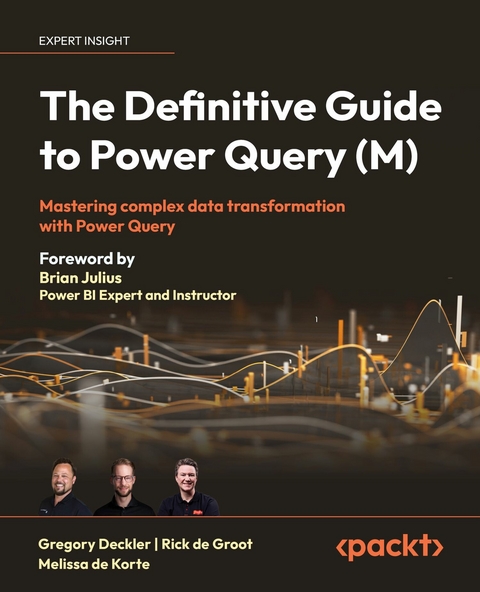
Definitive Guide to Power Query (M) (eBook)

Mastering complex data transformation with Power Query
eBook Download: EPUB
2024
760 Seiten
Packt Publishing (Verlag)
978-1-83508-616-2 (ISBN)

Lese- und Medienproben

Definitive Guide to Power Query (M) -  Greg Deckler,  Rick de Groot,  Melissa de Korte
Systemvoraussetzungen
29,99 inkl. MwSt
(CHF 29,30)
Der eBook-Verkauf erfolgt durch die Lehmanns Media GmbH (Berlin) zum Preis in Euro inkl. MwSt.
  • Download sofort lieferbar
  • Zahlungsarten anzeigen

Data transformation is a critical step in building data models and business intelligence reports. Power Query is an invaluable tool for anyone who wants to master data transformation, and this book will equip you with the knowledge and skills to make the most of it.
The Definitive Guide to Power Query (M) will help you build a solid foundation in the Power Query M language. As you progress through the chapters, you'll learn how to use that knowledge to implement advanced concepts and data transformations. This will set the stage for an uncompromisingly thorough exploration of the Power Query M Language.
You'll also get to grips with optimizing performance, handling errors, and implementing efficient data processing techniques. As this is a hands-on guide, the practical examples in the chapters will help you gain the skills to apply Power Query to real-world problems and improve your data analysis capabilities.
By the end of this book, you will be able to leverage all of Power Query's remarkable capabilities for data transformation.


No detailed description available for "e;The Definitive Guide to Power Query (M)"e;.

Contents


  1. Preface
    1. Who this book is for
    2. What this book covers
    3. To get the most out of this book
    4. Get in touch
    5. Making the Most Out of This Book – Get to Know Your Free Benefits
  2. Introducing M
    1. The history of M
    2. Who should learn M?
    3. Where and how is M used?
      1. Experiences
      2. Products and services
    4. Why learn M?
    5. M language basics
      1. The let expression
    6. The characteristics of M
      1. Formal classification
      2. Informal characteristics of M
    7. Summary
  3. Working with Power Query/M
    1. Technical requirements
    2. Touring the Power Query Desktop experience
      1. A brief tour
        1. Header
        2. Formula bar
        3. Ribbon
        4. Queries pane
        5. Query Settings pane
        6. Preview pane
        7. Status Bar
      2. Your first query
      3. Options and data source settings
        1. Options
        2. Data source settings
    3. Editing experience-generated code
    4. Creating custom columns
      1. Adding an index column
      2. Adding columns with examples
      3. Math operations
      4. Adding custom m code columns
    5. Using the Advanced Editor
    6. Summary
  4. Accessing and Combining Data
    1. Technical requirements
    2. Accessing files and folders
      1. File.Contents
      2. Text/CSV
      3. Excel
      4. Folder
      5. PDF
      6. XML
        1. Xml.Tables
        2. Xml.Document
      7. Azure Storage
      8. Additional file formats
    3. Retrieving web content
    4. Investigating binary functions
      1. Lines functions
    5. Accessing databases and cubes
      1. Cube functions
    6. Working with standard data protocols
    7. Addressing additional connectors
      1. Popular software systems
      2. Identity functions
    8. Combining and joining data
      1. Table.Combine
      2. Table.NestedJoin and Table.Join
      3. Table.FuzzyNestedJoin and Table.FuzzyJoin
    9. Summary
  5. Understanding Values and Expressions
    1. Introducing the types of values
      1. Binary values
        1. Structure
        2. Related functions
        3. Special considerations
      2. The Date/Time family of values
        1. Date values
        2. Time values
        3. DateTime values
        4. DateTimeZone values
        5. Duration values
      3. Logical values
        1. Structure
        2. Related Functions
        3. Special considerations
      4. Null values
        1. Structure
        2. Related functions
        3. Special considerations
      5. Number values
        1. Structure and examples
        2. Related functions
        3. Special considerations
      6. Text values
        1. Structure
        2. Related functions
        3. Special considerations
      7. List values
        1. Structure
        2. Related functions
        3. Special considerations
      8. Record values
        1. Structure
        2. Related functions
        3. Special considerations
      9. Table values
        1. Structure
        2. Related functions
        3. Special considerations
      10. Function values
        1. Structure
        2. Related functions
        3. Special considerations
      11. Type values
    2. Operators
    3. Expressions
      1. Nesting let expressions
      2. Coding best practices for expressions
    4. Control structures
    5. Enumerations
    6. Summary
  6. Understanding Data Types
    1. What are data types?
      1. The type system
      2. Columns with mixed types
      3. Column data type versus value type
    2. Importance of types
      1. Clarity and consistency
      2. Data validation
      3. Other reasons
    3. Data types available in M
      1. Primitive types
        1. Abstract primitive types
        2. Nullable primitive types
        3. Using primitive types for data filtering
      2. Custom types
        1. List type
        2. Record type
        3. Table type
        4. Function Type
    4. Type detection
      1. Retrieving data types from a data source
        1. Automatically detecting types
    5. Data type conversion
      1. Converting value types
      2. Converting column types
      3. Avoiding data loss during conversion
      4. Effect of locale/culture
    6. Facets
      1. Type Claims
        1. Available Type Claims
        2. Converting values using type claims
        3. Inspecting Type Claims
    7. Ascribing types
      1. What is ascription?
      2. Functions that support ascribing types
        1. Ascribing types when creating records
        2. Ascribing types when creating tables...

Erscheint lt. Verlag 12.4.2024
Vorwort Brian Julius
Sprache englisch
Themenwelt Sachbuch/Ratgeber Freizeit / Hobby Sammeln / Sammlerkataloge
ISBN-10 1-83508-616-0 / 1835086160
ISBN-13 978-1-83508-616-2 / 9781835086162
Informationen gemäß Produktsicherheitsverordnung (GPSR)
Haben Sie eine Frage zum Produkt?
EPUBEPUB (Ohne DRM)

Digital Rights Management: ohne DRM
Dieses eBook enthält kein DRM oder Kopier­schutz. Eine Weiter­gabe an Dritte ist jedoch rechtlich nicht zulässig, weil Sie beim Kauf nur die Rechte an der persön­lichen Nutzung erwerben.

Dateiformat: EPUB (Electronic Publication)
EPUB ist ein offener Standard für eBooks und eignet sich besonders zur Darstellung von Belle­tristik und Sach­büchern. Der Fließ­text wird dynamisch an die Display- und Schrift­größe ange­passt. Auch für mobile Lese­geräte ist EPUB daher gut geeignet.

Systemvoraussetzungen:
PC/Mac: Mit einem PC oder Mac können Sie dieses eBook lesen. Sie benötigen dafür die kostenlose Software Adobe Digital Editions.
eReader: Dieses eBook kann mit (fast) allen eBook-Readern gelesen werden. Mit dem amazon-Kindle ist es aber nicht kompatibel.
Smartphone/Tablet: Egal ob Apple oder Android, dieses eBook können Sie lesen. Sie benötigen dafür eine kostenlose App.
Geräteliste und zusätzliche Hinweise

Buying eBooks from abroad
For tax law reasons we can sell eBooks just within Germany and Switzerland. Regrettably we cannot fulfill eBook-orders from other countries.

Mehr entdecken
aus dem Bereich
New Banking Concept Framework

von Aslam Mohamed Haneef

eBook Download (2025)
Publishdrive (Verlag)
CHF 16,80