


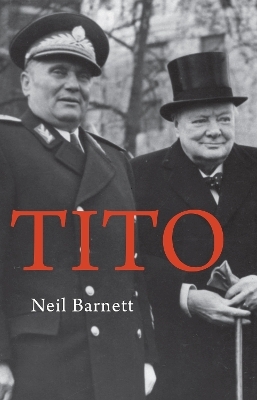
Tito
Seiten
2022
Haus Publishing (Verlag)
978-1-913368-41-8 (ISBN)
Haus Publishing (Verlag)
978-1-913368-41-8 (ISBN)
As Neil Barnett shows in this short but engaging biography, The charismatic, near-mythological figure of Josip Broz Tito was many things: an inspirational partisan leader and scourge of the Germans during their occupation of Yugoslavia in the Second World War; a doctrinaire communist but an ever-present thorn in Moscow's side.
The charismatic, near-mythological figure of Josip Broz Tito was many things: an inspirational partisan leader and scourge of the Germans during their occupation of Yugoslavia in the Second World War; a doctrinaire communist but an ever-present thorn in Moscow's side; an oppressor, a dictator, a reformer, and a playboy. He managed Yugoslavia's internal tensions through personality, force of will, and political oppression. It was only after his death in 1980 that the true scale of this feat was understood; the country's institutions and politicians were then revealed as rudderless, and the country created by Tito - a Croat turned Yugoslav - collapsed into a bloody and at times genocidal civil war. These ethnic conflicts were Tito's nightmare, yet, as Neil Barnett shows in this short but engaging biography, they were in many ways the result of his own myopic egomania.
The charismatic, near-mythological figure of Josip Broz Tito was many things: an inspirational partisan leader and scourge of the Germans during their occupation of Yugoslavia in the Second World War; a doctrinaire communist but an ever-present thorn in Moscow's side; an oppressor, a dictator, a reformer, and a playboy. He managed Yugoslavia's internal tensions through personality, force of will, and political oppression. It was only after his death in 1980 that the true scale of this feat was understood; the country's institutions and politicians were then revealed as rudderless, and the country created by Tito - a Croat turned Yugoslav - collapsed into a bloody and at times genocidal civil war. These ethnic conflicts were Tito's nightmare, yet, as Neil Barnett shows in this short but engaging biography, they were in many ways the result of his own myopic egomania.
Neil Barnett was a journalist specialising on the Balkans and wrote on the region for the Guardian and the Spectator. Today he is the chief executive of Istok Associates, a corporate intelligence and investigations consultancy.
Introduction // 2
Historical background of Yugoslavia // 5
Origin // 15
From imperial soldier to Bolshevik // 22
Return to the Balkans // 30
The ambitious revolutionary // 39
Invasion, Resistance & Revolution // 49
My Enemy's Enemy // 62
Victory // 74
The break with Stalin // 82
Liberalisation? // 94
Non-Alignment // 107
The Fall of Ranković // 116
Structural cracks // 125
The Twilight // 136
Legacy // 147
Notes // 152
Chronology // 154
Further Reading // 168
Acknowledgements // 171
Picture Sources // 172
Index // 173
| Erscheinungsdatum | 21.03.2022 |
|---|---|
| Zusatzinfo | 32 b/w illustrations, 1 map |
| Verlagsort | London |
| Sprache | englisch |
| Maße | 129 x 198 mm |
| Themenwelt | Literatur ► Biografien / Erfahrungsberichte |
| Sachbuch/Ratgeber ► Geschichte / Politik | |
| Geschichte ► Allgemeine Geschichte ► Zeitgeschichte | |
| ISBN-10 | 1-913368-41-6 / 1913368416 |
| ISBN-13 | 978-1-913368-41-8 / 9781913368418 |
| Zustand | Neuware |
| Informationen gemäß Produktsicherheitsverordnung (GPSR) | |
| Haben Sie eine Frage zum Produkt? |
Mehr entdecken
aus dem Bereich

aus dem Bereich
die großen Jahre der Soziologie 1949-1969
Buch | Hardcover (2025)
Klett-Cotta (Verlag)
CHF 39,20
eine Deutschlandreise im Jahr 1958
Buch | Hardcover (2024)
C.H.Beck (Verlag)
CHF 29,90


