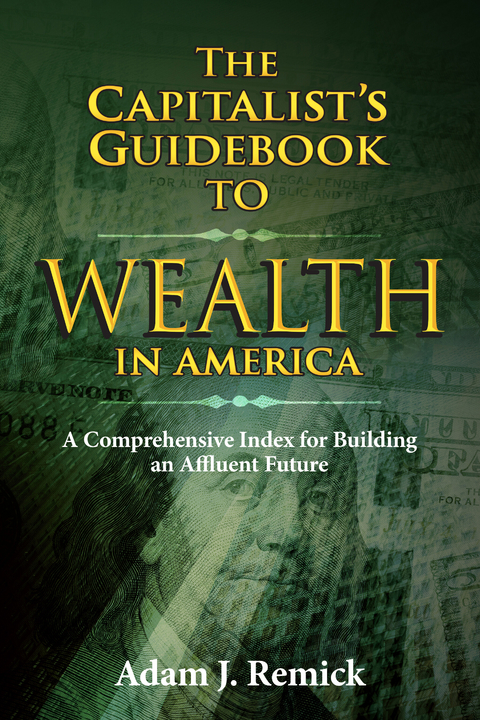
Capitalist's Guidebook to Wealth in America (eBook)
150 Seiten
Bookbaby (Verlag)
978-1-0983-6126-6 (ISBN)
Capitalism has the ability to create wealth. We live in a capitalistic society throughout most of the world and it has reduced poverty year after year. Despite this strong system that allows the market to decide what is needed, some people seem to utilize the free market better than others. Why is it that the rich stay rich and the poor stay poor? This question is deceiving as it assumes people in the bottom 20% stay at the bottom, when it's actually about 1-5% who stay poor while the rest move up to the middle or even the upper class. The better question is... what makes an individual move up the wealth mountain? In The Capitalist's Guidebook to Wealth in America: A Comprehensive Index for Building an Affluent Future, author and pharmacist Adam Remick dives into the behavior and lifestyles of those who have successfully become wealthy without a "e;million dollar idea."e; Instead of immediately presenting the investment techniques described later in the book, he asserts the importance of the behaviors first. Dividing this book into three parts, he first describes behaviors he labels as "e;required,"e; cultivating an understanding of the importance of these behaviors accompanied by studies validating them. Along the same theme and style as part one, part two consists of behaviors that are labeled as "e;optional,"e; which he addresses that many have succeeded without these, but they are very helpful. He then presents practical and instructional descriptions of common and alternate ways of developing wealth. A mix of behavioral criticism and actionable ways to invest, The Capitalist's Guidebook takes the reader on a journey through personal stories to data backed by peer-reviewed literature, and gives the reader books related to the content to learn more about ways to develop wealth from a more in depth source. The Capitalist's Guidebook is an indispensable guide to anyone asking themselves, "e;Where do I start?"e;
Chapter 1: Be an Observer
“It was said in the old days that every year Thor made a circle around Middle-earth, beating back the enemies of order. Thor got older every year, and the circle occupied by gods and men grew smaller. The wisdom god, Odin, went out to the king of the trolls, got him in an armlock, and demanded to know of him how order might triumph over chaos.”
“Give me your left eye,” said the king of the trolls, “and I’ll tell you.”
Without hesitation, Odin gave up his left eye. “Now tell me.”
The troll said, “The secret is, watch with both eyes!”
—“Odin and the Troll Story” from On Moral Fiction by Josh Gardner
What can we learn from this troll, or Odin? There will be people who may help us only to get whatever they want, even if their help will be useless after you give them what they want. Although the actions of the troll in this story were to deceive, I’d like to think humans actually would have a reason for themselves rather than just to deceive us. Our goal is not to be Odin in this story. By not observing and seeing only what is in front of us, we miss what is happening around us. Having a goal to reach is good, but it’s wise to look around for obstacles before they hit in your journey. We will go into a specific example later in Chapter 14 when looking at a company stock.
Life is full of contradictions that lead to the need for complex thinking to be able to grasp what really is going on. Ever heard of the phrase “For the greater good”? It is commonly used to justify a means to an end; however, the counterargument will always be if the means was worth it in the end, or if it is morally worse to reach the end goal with that strategy. Many times, the “greater good” sacrifices the individual (or a few individuals) for the sake of the collective. What I think is important here is who is deciding the sacrifice: the individual or someone else? I could venture a bet that the individual sacrificing himself has thought more complexly than if some lazy leader was to sacrifice himself for this “greater good.” This is the individual’s life, and he would have tried to think of every possible way to avoid this sacrifice. The lazy leader doesn’t need to think that complex because the simple sacrifice can be chalked up to being “for the greater good” and can move to the next issue. If we keep our minds on a one-way solo thinking path, there is no way we can solve the complex and contradictory problems that life throws at us. A simple explanation is the idea of taxing the rich more to pay for a government project. Where are the rich putting that money currently? Possibly investments into a new company to supply more jobs, charity, or a hospital—all within the community. If you tax them more for a government-driven project, you may be indirectly reducing job growth, taking food from the homeless, or preventing the funding for a new pediatric hospital wing.
In Part I of his three-part collection of essays, titled “The Crack Up,” F. Scott Fitzgerald knew this observation all too well as he wrote, “The test of a first-rate intelligence is the ability to hold two opposed ideas in the mind at the same time and still retain the ability to function.” Let us all try to function this way. This observation alone is enough to get us to stop and think about how far down we have to dig to accomplish this, but his very next sentence delivers the message I believe every American should hold on to: “One should, for example, be able to see that things are hopeless and yet be determined to make them otherwise.”
Let’s take a look at millennials, which include the author of this book. I graduated college a couple of years after the greatest recession since the Great Depression. Depending on the field of study, options for work were still limited, but still growing. We went back to school and acquired more debt or we got into the workforce knowing it will be a lot more sacrifice than originally planned for the things we were promised with a college education. These sacrifices could include buying a house or starting a family later. We finally get to 2020 and are starting to feel the benefits of our labor, then a pandemic hits. A government-mandated recession knocks us off our feet, and we are left with doubt and hopelessness. The question that one would ask, of course, is if it will ever get better? The answer is simple and has been the same since 1776: It’s up to us. It’s in our values as Americans to make the situation better despite everything telling us how hopeless a situation is. It always has been.*
In the final book of The New World series Those Who Remain, G. Michael Hopf writes “Hard times create strong men. Strong men create good times. Good times create weak men. And, weak men create hard times.” In our individual lives—regardless of the economy or anything macro—we fall into hard times and good times. It is up to us, our character, to use those hard times to make us stronger and the good times to develop our insights in order to prepare us to take advantage of subsequent hard times that are yet surely to come.
Get Perspective from Different Angles
One of the best things for someone to do is to listen and analyze a situation from another’s perspective. Assume no evil intent, and you may find common ground. Founding Fathers John Adams and Thomas Jefferson disagreed on where power should lie within our budding country; however, they knew where the other was coming from and respected each other’s stance even if they believed them to be flawed. Adams wanted a strong central government to unite the country, while Jefferson didn’t want the states to be controlled by another “monarch” from a distant location (Washington D.C., or at the time, Philadelphia). It doesn’t matter who you agree with more; both of the arguments have merit. It’s also oddly calming to know we’ve had the same logical disagreements and debates throughout the life of this country. I would say I lie somewhere in the middle where I think the states should have full autonomy when it comes to policies and enforcement of their local laws in respect to the constitution, while the central government needs to be depended upon for military responses and epidemic guidance with military-like mobilization of equipment, supplies, and resources.
We all have ways of getting to goals, but others may have different ideas on how to get there. They may seem worse, but alternatively they could help you skip steps or avoid learning lessons the hard way. What is your perspective? Let’s look at the following three quotes essentially seeing the same thing:
- Blessed is he who expecteth nothing, for he shall not be disappointed.
—Alexander Pope
- Blessed is he who expecteth nothing, for he shall be gloriously surprised.
—G. K. Chesterton
- Blessed is he who expecteth nothing, for he shall enjoy everything.
—St. Francis of Assisi
All three of these quotes are helpful in understanding expectations. They are all great advice, and they are essentially saying the same thing, but let’s look at these one by one. The first quote can be used in a rather cynical outlook. Not expecting anything out of anyone or any effort will lead not to disappointment. You are avoiding an upsetting result by expecting nothing. The second quote is hinting that there is positivity on the other side, and you may be “gloriously surprised.” In the third quote, we turn to enjoying every result; if you expect nothing from life, you will enjoy life itself—even failure.
What good is this? Well, is failing a good result? Not exactly. Is it something you can enjoy? Likely not. However, looking back at failure, you are probably glad it happened. Ask any successful person if they have learned more from their successes or failures. In the words of the great inventor Thomas Edison, “I have not failed. I’ve just found 10,000 ways that won’t work.” That’s one heck of a perspective! Attempt to enjoy some of your failures so you can learn from them! I once started an e-commerce store literally to learn how to fail. Together, I spent about $50. What did I learn? I learned how to develop a website, promote ads, manage transactions, and document for taxes as a sole proprietor. To me, that “failure” was a successful hands-on lesson. Ok, maybe I didn’t start the store with the intention to fail, but I was realistic. I knew I was just starting out and putting myself out there to gain knowledge. With all of what I learned, I was able to develop an e-commerce site for my wife as a present. Whether or not the website is still up by the time this book is published, it doesn’t matter; I was able to create a gift that had potential to make money, and my wife could indulge in her love for travel, maps, and the world.
Review Your Finances Regularly
What does “reviewing your finances” mean? It means to audit yourself. Every week I take a look at what I will be spending and what goes into investing for the next paycheck. I have a calendar that has my paydays and my due dates for monthly recurring expenses (credit cards, student loans, life insurance, rent, and any other recurring payments). By doing this, you may notice if you have developed unhealthy spending habits. By observing my finances, I am wiser about spending and less surprised by expenses. Are you using that Netflix enough to warrant three screens? Do you...
| Erscheint lt. Verlag | 23.4.2021 |
|---|---|
| Sprache | englisch |
| Themenwelt | Sachbuch/Ratgeber ► Beruf / Finanzen / Recht / Wirtschaft |
| ISBN-10 | 1-0983-6126-1 / 1098361261 |
| ISBN-13 | 978-1-0983-6126-6 / 9781098361266 |
| Informationen gemäß Produktsicherheitsverordnung (GPSR) | |
| Haben Sie eine Frage zum Produkt? |
 EPUB (Ohne DRM)
Größe: 1,2 MB
Digital Rights Management: ohne DRM
Dieses eBook enthält kein DRM oder Kopierschutz. Eine Weitergabe an Dritte ist jedoch rechtlich nicht zulässig, weil Sie beim Kauf nur die Rechte an der persönlichen Nutzung erwerben.
Dateiformat: EPUB (Electronic Publication)
EPUB ist ein offener Standard für eBooks und eignet sich besonders zur Darstellung von Belletristik und Sachbüchern. Der Fließtext wird dynamisch an die Display- und Schriftgröße angepasst. Auch für mobile Lesegeräte ist EPUB daher gut geeignet.
Systemvoraussetzungen:
PC/Mac: Mit einem PC oder Mac können Sie dieses eBook lesen. Sie benötigen dafür die kostenlose Software Adobe Digital Editions.
eReader: Dieses eBook kann mit (fast) allen eBook-Readern gelesen werden. Mit dem amazon-Kindle ist es aber nicht kompatibel.
Smartphone/Tablet: Egal ob Apple oder Android, dieses eBook können Sie lesen. Sie benötigen dafür eine kostenlose App.
Geräteliste und zusätzliche Hinweise
Buying eBooks from abroad
For tax law reasons we can sell eBooks just within Germany and Switzerland. Regrettably we cannot fulfill eBook-orders from other countries.
aus dem Bereich