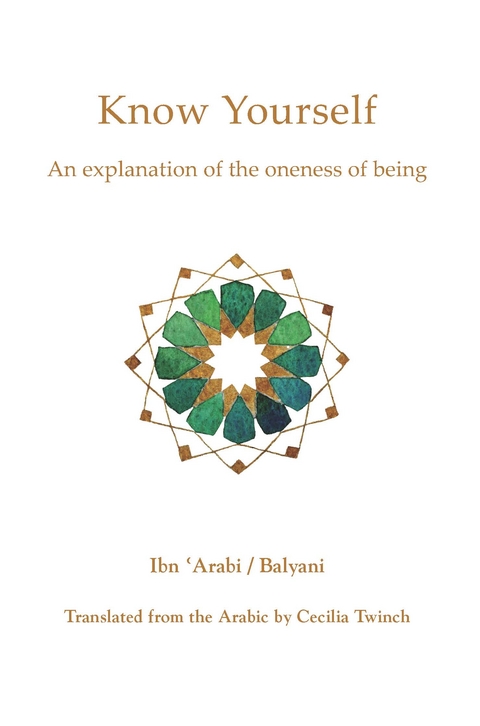
Know Yourself (eBook)
92 Seiten
Beshara Publications (Verlag)
978-0-904975-67-3 (ISBN)
This is a new translation of a 13C work attributed to Ibn 'Arabi and more recently to Balyani. The translator, Cecilia Twinch is a Senior Research Fellow of the Muhyiddin Ibn ʿArabi Society, Oxford, UK, and has lectured on Ibn ʿArabi worldwide. Published works include an early work of Ibn ʿArabi’s Contemplation of the Holy Mysteries.
This short text on the unity of existence directly addresses the relationship a human being may encounter – whether in solitude, in the extent of the natural world, or in the social framework – between their known self and their eternal origin. It explains that to realize your essential oneness with reality it is not necessary to eliminate your ‘separate’ self or ego because that illusory self never existed. Rather, it is necessary to know your true self to realize your oneness with all being. Nothing essentially changes. When you know yourself ‘ignorance disappears’ and ‘When the secret of an atom is discovered, the secret of all created things is made clear’. The person for whom this relationship becomes alive is indeed fortunate. This edition of Know Yourself is intended to be as accessible as possible to people with no knowledge of Arabic and who may not have knowledge of the cultural context of the book.
The text uses the vocabulary of Sufism, but the issues confronted are common to people everywhere. An earlier translation (by T.H. Weir in 1901) was instrumental in making Ibn ‘Arabi ( 1165-1240) and his work known in the West over the last century, even though the author of the book is now considered by many scholars to be Awhad al-din Balyani (died 1287), a near contemporary, who may well have been influenced by his thought. It was a translation of the first complete work attributed to Ibn ‘Arabi to appear in a western language.
This is a new translation by Cecilia Twinch, Senior Research Fellow of the Muhyiddin Ibn ‘Arabi Society in Oxford, UK. This translation was first published in 2011. Cecilia Twinch’s other published works include an English translation of one of Ibn ‘Arabi’s earliest works, Contemplation of the Holy Mysteries. The translator has also provided useful background information, references, translator’s notes on the text and bibliography. This short book introduces a view of the world which is very different to that held by many people. For some, it may serve a purpose in shattering preconceived notions and presenting an entirely new perspective which opens up a compassionate and responsive universe. It reflects an ardent desire to reach beyond the peripheral uncertainties of everyday life and discover for ourselves a certainty in the oneness of being which constantly flows through everything that is. This is a new translation of the first complete work attributed to Ibn ʿArabi (1165-1240) to appear in a western language. The earlier translation has been instrumental in making Ibn ʿArabi’s name known again in the West over the last century, even though the author of the book is now considered by many scholars to be Balyani, a near contemporary, who may well have been influenced by his thought. The translation has been made using several Arabic manuscripts from libraries in the UK, Turkey and Syria. The sheer quantity of manuscripts available shows how popular this book has remained for more than seven centuries and how many times it has been copied and recopied by hand. It should be borne in mind, however, that each time a manuscript is copied a few mistakes, alterations and added notes by the copyist may creep in. So although the text remains basically the same, there are often many minor variations on the general theme. In particular, there are also variations on the title and the author to whom the work is attributed. The most popular title for the book is the Treatise on Unity (Risalat al-ahadiyya), which is similar to the title of a work which is definitely by Ibn ʿArabi, The Book of Unity (Kitab al-ahadiyya) or The Book of Alif. This may explain some of the confusion that has arisen over the authorship of the work.
Ibn ‘Arabi is most famous for his teachings on the oneness of being (wahdat al-wujud) and human perfection. Ibn ʿArabi describes the world as the exteriorization of a single hidden reality. All that we see as creation is a divine self-revelation which is constantly renewed in different forms at every moment. Every human being has the potential to become a complete mirror to Reality, therefore integrating all aspects of life in a balanced and appropriate way. Above all, the movement of existence is the movement of love for the sake of the revelation of beauty. Ibn ʿArabi remains one of the most influential figures in the Islamic world. As S.H. Nasr has said: ‘It would not be an exaggeration to say that Ibn ʿArabi is the most influential intellectual figure in the Islamic world during the past seven centuries, if the whole world is considered.’ Today, his work is once again becoming increasingly well known in the West where he was born, due to the universal aspect of his thought. There is now a wealth of information about his life and work.
Awhad al-din Balyani (died 1287), also known as Abu ʿAbdallah Balyani, was a Sufi Shaykh from the region of Persia known as Shiraz. Very little is known about him for certain and his name is currently only heard of within academic or Sufi circles.
Cecilia Twinch is a Senior Research Fellow of the Muhyiddin Ibn ʿArabi Society, Oxford, UK, and has lectured on Ibn ʿArabi worldwide. Her published works include an English translation, with Pablo Beneito, of one of Ibn ʿArabi’s earliest works, Contemplation of the Holy Mysteries. The translation is based on a representative selection of Arabic manuscripts held in several national libraries, some attributed to Ibn ʿArabi and some to Balyani. The sheer quantity of manuscripts available demonstrates the enduring popularity of this book over the last seven centuries. This translation was first published in 2011. The translator also provides useful background information, references, translator’s notes on the text and bibliography.
The Cover was designed by Marijke van Basten Batenburg and the cover image artwork is by Hiroko Nagato-Apthorp.
| Erscheint lt. Verlag | 1.3.2021 |
|---|---|
| Übersetzer | Cecilia Twinch |
| Verlagsort | Cirencester |
| Sprache | englisch |
| Themenwelt | Sachbuch/Ratgeber ► Gesundheit / Leben / Psychologie ► Esoterik / Spiritualität |
| Geisteswissenschaften ► Philosophie ► Metaphysik / Ontologie | |
| Geisteswissenschaften ► Psychologie ► Psychoanalyse / Tiefenpsychologie | |
| Geisteswissenschaften ► Religion / Theologie | |
| ISBN-10 | 0-904975-67-3 / 0904975673 |
| ISBN-13 | 978-0-904975-67-3 / 9780904975673 |
| Informationen gemäß Produktsicherheitsverordnung (GPSR) | |
| Haben Sie eine Frage zum Produkt? |
 EPUB (Adobe DRM)
Kopierschutz: Adobe-DRM
Adobe-DRM ist ein Kopierschutz, der das eBook vor Mißbrauch schützen soll. Dabei wird das eBook bereits beim Download auf Ihre persönliche Adobe-ID autorisiert. Lesen können Sie das eBook dann nur auf den Geräten, welche ebenfalls auf Ihre Adobe-ID registriert sind.
Details zum Adobe-DRM
Dateiformat: EPUB (Electronic Publication)
EPUB ist ein offener Standard für eBooks und eignet sich besonders zur Darstellung von Belletristik und Sachbüchern. Der Fließtext wird dynamisch an die Display- und Schriftgröße angepasst. Auch für mobile Lesegeräte ist EPUB daher gut geeignet.
Systemvoraussetzungen:
PC/Mac: Mit einem PC oder Mac können Sie dieses eBook lesen. Sie benötigen eine
eReader: Dieses eBook kann mit (fast) allen eBook-Readern gelesen werden. Mit dem amazon-Kindle ist es aber nicht kompatibel.
Smartphone/Tablet: Egal ob Apple oder Android, dieses eBook können Sie lesen. Sie benötigen eine
Geräteliste und zusätzliche Hinweise
Buying eBooks from abroad
For tax law reasons we can sell eBooks just within Germany and Switzerland. Regrettably we cannot fulfill eBook-orders from other countries.
aus dem Bereich