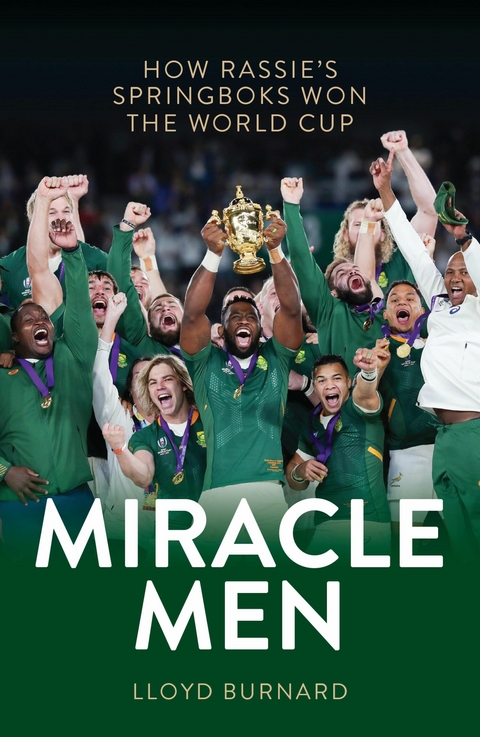
Miracle Men (eBook)
335 Seiten
Jonathan Ball Publishers (Verlag)
978-1-77619-043-0 (ISBN)
LLOYD BURNARD has worked as a journalist for more than a decade. He is a former sports editor of The Witness newspaper in KwaZulu-Natal and currently an award-winning senior journalist at Sport24. He has been covering the Springboks extensively since 2015, culminating in their 2019 Rugby World Cup triumph, and has reported on numerous other major sporting events including the 2010 FIFA World Cup, the 2016 Olympic Games in Rio de Janeiro and the 2019 Cricket World Cup in England. This is his first book.
When Rassie Erasmus took over as coach of the Springboks in 2018, few thought they had a chance of winning the Rugby World Cup. The Boks had slipped to seventh in the world rankings and lost the faith of the rugby-loving public. Less than two years later, jubilant crowds lined the streets of South Africa's cities to welcome back the victorious team. Sportswriter Lloyd Burnard takes the reader on the thrilling journey of a team that went from no-hopers to world champions. He examines how exactly this turnaround was achieved. Interviews with players, coaches and support staff reveal how the principles of inclusion, openness and focus, as well as careful planning and superb physical conditioning, became the basis for a winning formula. The key roles played by Rassie Erasmus and Siya Kolisi shine through. There were ups and downs along the way: beating the All Blacks in Wellington during the Rugby Championship was a high point, but then came Kolisi's injury, while in Japan the distractions of a volatile support base sometimes shook the players' focus. Miracle Men is filled with marvellous anecdotes and sharp insights. It is also inspiring testimony to what can be achieved when a group of South Africans from all backgrounds come together as a team.
Chapter 1
Celebrating unity
The Springboks, once banished to the dark, lonely halls of international isolation, had won their third Rugby World Cup. If it wasn’t clear before the final at International Stadium Yokohama, on 2 November 2019, that this was the win South Africans so desperately needed, it was revealed in abundance in the days and weeks that followed as millions came together to celebrate a rugby team that had conquered the world.
Given how far the Boks had fallen towards the end of the Allister Coetzee era in 2017, their commanding 32–12 win over Eddie Jones’ England was a sporting miracle.
The win meant the Boks had drawn level with New Zealand as the most decorated side in the tournament’s 32-year history, but this had become about so much more than rugby. The Boks had won the contest long before referee Jérôme Garcès blew the final whistle. They had been dominant in all facets, and while their defences had been tested, they had rocked England for most of the contest. When flyhalf Handre Pollard kicked the ball deep into the Yokohama night sky to bring the final to an end, the feeling of release and relief was tangible.
Some, like Cheslin Kolbe, could only collapse in disbelief. Others danced around the Yokohama turf, unable to contain the thrill of a lifetime. Pollard embraced his childhood hero, Frans Steyn. Up in the stands, President Cyril Ramaphosa hugged England’s Prince Harry. Captain Siya Kolisi was gracious in victory, shaking the hands of the distraught Englishmen first. It was a killer blow for the favourites, who a week earlier had provided one of the great World Cup performances with their 19–7 semi-final win against the defending champion All Blacks.
None of that mattered to South Africans. Back at home, the earth shook.
At Gqalane Tavern in Zwide, where a 16-year-old Kolisi had watched the Springboks win the World Cup in 2007, there was delirium.
‘There was so much emotion in that tiny, cramped little tavern,’ recalls Sunday Times journalist Jeff Wicks, who was there that day. ‘It was something I will never forget. Guys were on tables, there was beer spraying everywhere, people were hitting the ceiling with their fists. They didn’t stop singing.’
‘You asked me to do it. You asked us to do it. We did it,’ Kolisi told journalist Elma Smit, who fell into the skipper’s arms on the pitch in Yokohama, sobbing, in a captured moment that was as raw and beautiful as any in the immediate aftermath.
Politically, racially and socially, a divided South Africa was united.
‘I could not think of a nation that needs it more than you guys right now,’ Prince Harry relayed to the victorious Boks in their change room in the aftermath.
The party was under way, but those words provided a dose of perspective. This win was different to the others, and the scenes that unfolded in South Africa over the course of the next week confirmed exactly that.
It was not the first time the Springboks had won the Rugby World Cup, but it was the first time they had done so with a side that demographically represented their country. For the first time, the Boks had black African heroes in their World Cup-winning side, and one of them was the leader.
‘People in the taverns, people in the shebeens, people on the farms, homeless people, people in rural areas … thank you so much,’ Kolisi said at his pitch-side interview.
With his final words, the soft-spoken South African captain summed up exactly what this moment meant to South Africans.
‘We can achieve anything if we work together as one.’
It was a message that hit home in a country that, 25 years after the advent of democracy, had not reached its potential. State capture, corruption, poverty, racial division, dysfunctional leadership, gender-based violence, crime, unemployment … South Africa’s troubles painted a picture of a country nowhere near realising Nelson Mandela’s dream of a thriving ‘rainbow nation’.
In the 1995 final, the Boks had stunned New Zealand and the world with a Joel Stransky drop goal that instantly became one of rugby’s most iconic moments. That 15–12, extra-time win at Ellis Park, in South Africa’s first World Cup appearance, injected hope into a newborn democratic society. As Mandela and Francois Pienaar stood side by side in lifting the Webb Ellis Cup, they symbolised a nation that was ready to heal.
Then, in 2007, Jake White’s Boks waltzed through the competition undefeated, dominant from start to finish. That they avoided meeting the All Blacks and Australia on the way to the title was a talking point that some believe watered down the success, but it could not detract from the achievement of a side that was as clinical as any Bok outfit that came before or after.
Both of those victories helped the Boks carve out a reputation for themselves as a global giant of the game. While the social significance of 1995 was naturally immense, it was fundamentally different to 2019. The win in 1995 told a new nation that the future together was bright, but the win in 2019 came at a time when, for many, the fairy tale had lost its wonder. Japan 2019 showed, both on the field and off, what South Africa could achieve through inclusion, but it also provided a crushing reminder that the country had not come as far as it should have.
On 24 June 1995 – the day of the Johannesburg final against the All Blacks – Chester Williams was the only player of colour in the squad of 21. On 20 October 2007, Bryan Habana and JP Pietersen were the only players of colour to line up against England in Paris. Before 2019, a total of 42 South Africans had been included in World Cup final squads. Thirty-nine of them were white.
In Yokohama on 2 November, the Boks fielded Kolisi, Lukhanyo Am, Makazole Mapimpi, Tendai Mtawarira, Bongi Mbonambi, Damian de Allende and Cheslin Kolbe in their starting line-up – a total of seven players of colour in the starting XV.
For years, transformation in sport and quotas at international level had caused more division than unity in South Africa. In 2019, there was no space for such conversation because every single member of this victorious squad – black or white – proved that he belonged on this stage. It was South Africa’s first real sporting example of how things can be, where the country’s best play together in a racially representative side where nobody is picked on the basis of anything other than merit.
Never before had a South African sporting success so clearly illustrated what the country was capable of in its unity, and because of that the story of the Rugby World Cup 2019 triumph transcended sport.
When the Boks arrived back in South Africa on 5 November as champions of the world, they could not have known the eruption that awaited them.
At OR Tambo International Airport, all three tiers surrounding the arrivals hall were packed for hours before the Boks touched down. Young and old, black and white, male and female … this celebration was for everybody. Some had arrived as early as 9 am, meaning the wait for Kolisi and the trophy had lasted for around 11 hours by the time the skipper emerged, to a rapturous reception.
The Gautrain offered free trips to and from the airport for anyone wearing a Springbok jersey – not that fans needed any added incentive.
Kolisi and Erasmus, along with Pollard, were due to arrive in the first batch but their flight was delayed. It didn’t dampen the energy one bit. There was singing, dancing, a South African Police Service brass band and media from every corner of the country waiting to catch a glimpse of the men who had done the unthinkable.
Deafening waves of ‘Shosholoza’ echoed throughout the terminal building and flowed out into the parking areas.
Then, finally, security and police began to scurry. The Boks had arrived and the waiting was over.
Damian de Allende was the first player through the sliding glass doors, pumping up the crowd with two raised fists. Scrumhalf Faf de Klerk was greeted with high-pitched screaming. This would be the case throughout the country on the five-day trophy tour that followed. Images of him in the change room on the night of the final, sporting briefs adorned with the South African flag, had gone viral, and De Klerk’s long, blond locks made him easy to spot on the celebration tour that started on that magical evening in Johannesburg.
Frans Steyn high-fived his way through a mob that was pushing security to its limits, while a special cheer was reserved for final heroes Am, Mapimpi and Kolbe.
But the moment Johannesburg was waiting for was when Kolisi and the Webb Ellis Cup came home.
As he looked upward to the two overflowing tiers of support above him, a smile of bewilderment washed over Kolisi’s face. When he lifted the trophy over his head and pumped his fists in celebration, the crowd roared on behalf of a nation.
It was only the beginning.
On Thursday 7 November, just two days after arriving home from a near two-month stay in Japan, the Boks embarked on a trophy tour that will be remembered forever by everyone who witnessed it.
Over five days, aboard open-topped buses, the Boks visited Johannesburg, Durban, East London, Port Elizabeth and Cape Town. They made their way through city centres and surrounding communities as the country showed off its finest qualities of national pride and unity.
It was this celebration that revealed the significance of what the Boks had achieved...
| Erscheint lt. Verlag | 1.9.2020 |
|---|---|
| Verlagsort | London |
| Sprache | englisch |
| Themenwelt | Literatur ► Biografien / Erfahrungsberichte |
| Literatur ► Romane / Erzählungen | |
| Sachbuch/Ratgeber ► Sport ► Ballsport | |
| Schlagworte | All Blacks • Bokke • Boks • England • Japan • jonathan ball publishers • Lloyd Burnard • Miracle Men • Rassie Erasmus • Rugby • rugby world cup • Siya Kolisi • South Africa • springboks |
| ISBN-10 | 1-77619-043-2 / 1776190432 |
| ISBN-13 | 978-1-77619-043-0 / 9781776190430 |
| Informationen gemäß Produktsicherheitsverordnung (GPSR) | |
| Haben Sie eine Frage zum Produkt? |
 EPUB (Adobe DRM)
Kopierschutz: Adobe-DRM
Adobe-DRM ist ein Kopierschutz, der das eBook vor Mißbrauch schützen soll. Dabei wird das eBook bereits beim Download auf Ihre persönliche Adobe-ID autorisiert. Lesen können Sie das eBook dann nur auf den Geräten, welche ebenfalls auf Ihre Adobe-ID registriert sind.
Details zum Adobe-DRM
Dateiformat: EPUB (Electronic Publication)
EPUB ist ein offener Standard für eBooks und eignet sich besonders zur Darstellung von Belletristik und Sachbüchern. Der Fließtext wird dynamisch an die Display- und Schriftgröße angepasst. Auch für mobile Lesegeräte ist EPUB daher gut geeignet.
Systemvoraussetzungen:
PC/Mac: Mit einem PC oder Mac können Sie dieses eBook lesen. Sie benötigen eine
eReader: Dieses eBook kann mit (fast) allen eBook-Readern gelesen werden. Mit dem amazon-Kindle ist es aber nicht kompatibel.
Smartphone/Tablet: Egal ob Apple oder Android, dieses eBook können Sie lesen. Sie benötigen eine
Geräteliste und zusätzliche Hinweise
Buying eBooks from abroad
For tax law reasons we can sell eBooks just within Germany and Switzerland. Regrettably we cannot fulfill eBook-orders from other countries.
aus dem Bereich