


World Trade and Investment Law Reimagined (eBook)
278 Seiten
Anthem Press (Verlag)
978-1-78308-974-1 (ISBN)
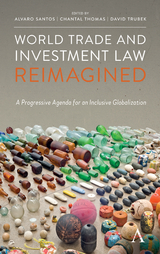
In a time of turmoil in international economic law, experts from 10 countries suggest ideas for a new and progressive trade and investment regime in ‘World Trade and Investment Law Reimagined’ that would help sustain growth, facilitate development and ensure that gains are shared and losses compensated.
World trade and investment law is in crisis: new and progressive ideas are needed. Rules that facilitated globalization and supported global economic growth are being challenged. A system of global governance that once seemed secure is now at risk as the United States ignores the rules while developing countries struggle to escape restrictions. Some want to tear global institutions and agreements down while others try desperately to maintain the status quo. Rejecting both options, a group of trade and investment law experts from 10 countries, South and North, have joined hands to propose ideas for a new world trade and investment law that would maintain global growth while distributing costs and benefi ts more fairly. Paying special attention to those who have suffered from trade dislocation and to restrictions that have hampered innovative growth strategies in developing countries, they outline a progressive trade and investment law agenda in World Trade and Investment Law Reimagined.
lt;p>Alvaro Santos is Professor of Law and Faculty Director of the Center for the Advancement of the Rule of Law in the Americas at Georgetown University Law Center, USA.
Chantal Thomas is the Radice Family Professor of Law at Cornell Law School, USA, and Director of its Clarke Initiative for Law and Development in the Middle East and North Africa.
David Trubek is the Voss-Bascom Professor of Law and Dean of International Studies Emeritus at the University of Wisconsin-Madison, USA, and Senior Research Fellow at Harvard Law School, USA.
Acknowledgments; List of Contributors; Part I: Introduction and Overview, David Trubek, Chantal Thomas and Alvaro Santos; Part II: Rethinking the Political Economy of Trade: Comments on Dani Rodrik’s ‘Straight Talk on Trade’, Chantal Thomas, Kevin P. Gallagher, Gregory Shaffer, Alvaro Santos and Dani Rodrik; Part III: Setting the Stage for a Progressive Vision: Emerging Issues in World Trade and Investment Law; Section I: Mapping the New Context for Trade and Investment Law; The End of Trade and Investment Law As We Know It: From Singularity to Pluralism, Poul F. Kjaer; Heterodox Market Orders in the Global Trade System, Andrew Lang; Embedded Neoliberalism and Its Discontent: The Uncertain Future of Trade and Investment Law, Sonia E. Rolland and David Trubek; Rethinking the Rcep in the Third Regionalism: Paradigm Shifts in World Trade Law?, Pasha L. Hsieh; Beyond Normal Trade Law, Robert Wai; Section II: Dealing with Major Changes in the World Economy; Trade, Distribution and Development under Supply Chain Capitalism, Dan Danielsen; The Global Rise and Regulation of Platform Firms and Markets, Jason Jackson; How Should We Think About a Global Market in Legal Cannabis?, Antonia Eliason and Rob Howse; Section III: Framing a More Equitable Investment Law Regime; Bilateral Investment Treaties: Has South Africa Chartered a New Course?, Dennis. M. Davis; Rethinking the Right to Regulate in Investment Agreements: Reflections from the South African and Brazilian Experiences, Fabio Morosini; Making Local Communities Visible: A Way to Prevent the Potentially Tragic Consequences of Foreign Investment?, Nicolás M. Perrone; Section IV: Supporting Development; Bargaining over Policy Space in Trade Negotiations, Gregory Shaffer; Trumping the IMF: Trade and Investment Treaties and the Regulation of Cross-Border Financial Flows, Kevin P. Gallagher; Section V: Reinforcing Social Protection: Spreading the Benefits of Trade, Dealing with Losses and Exploring the Trade-Immigrant Nexus; Trade Agreements in the 21st Century: Rethinking the Trade–Labor Linkage, Kerry Rittich; The New Frontier in Labor and Trade, Alvaro Santos; Restoring Trade’s Social Contract in the United States, Frank J. Garcia; Re-embedding Liberalism: Introducing ‘Passporting Fees’ for Free Trade, Thomas Streinz; Irregular Migration and International Economic Asymmetry, Chantal Thomas; Index.
| Erscheint lt. Verlag | 28.6.2019 |
|---|---|
| Reihe/Serie | Anthem IGLP Rethinking Global Law and Policy Series | Anthem IGLP Rethinking Global Law and Policy Series |
| Verlagsort | London |
| Sprache | englisch |
| Maße | 150 x 150 mm |
| Gewicht | 454 g |
| Themenwelt | Sachbuch/Ratgeber ► Beruf / Finanzen / Recht / Wirtschaft |
| ISBN-10 | 1-78308-974-1 / 1783089741 |
| ISBN-13 | 978-1-78308-974-1 / 9781783089741 |
| Informationen gemäß Produktsicherheitsverordnung (GPSR) | |
| Haben Sie eine Frage zum Produkt? |
 EPUB (Adobe DRM)
Kopierschutz: Adobe-DRM
Adobe-DRM ist ein Kopierschutz, der das eBook vor Mißbrauch schützen soll. Dabei wird das eBook bereits beim Download auf Ihre persönliche Adobe-ID autorisiert. Lesen können Sie das eBook dann nur auf den Geräten, welche ebenfalls auf Ihre Adobe-ID registriert sind.
Details zum Adobe-DRM
Dateiformat: EPUB (Electronic Publication)
EPUB ist ein offener Standard für eBooks und eignet sich besonders zur Darstellung von Belletristik und Sachbüchern. Der Fließtext wird dynamisch an die Display- und Schriftgröße angepasst. Auch für mobile Lesegeräte ist EPUB daher gut geeignet.
Systemvoraussetzungen:
PC/Mac: Mit einem PC oder Mac können Sie dieses eBook lesen. Sie benötigen eine
eReader: Dieses eBook kann mit (fast) allen eBook-Readern gelesen werden. Mit dem amazon-Kindle ist es aber nicht kompatibel.
Smartphone/Tablet: Egal ob Apple oder Android, dieses eBook können Sie lesen. Sie benötigen eine
Geräteliste und zusätzliche Hinweise
Buying eBooks from abroad
For tax law reasons we can sell eBooks just within Germany and Switzerland. Regrettably we cannot fulfill eBook-orders from other countries.
aus dem Bereich


