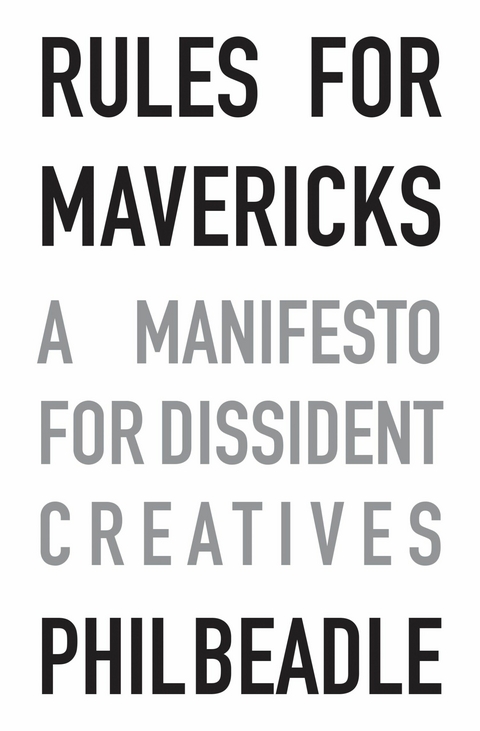
Rules for Mavericks (eBook)
192 Seiten
Crown House Publishing (Verlag)
9781785832253 (ISBN)
Phil Beadle knows a bit about bringing creative projects to fruit. His self-described 'renaissance dilettantism' is best summed up by Mojo magazine's description of him as a 'burnished voice soul man and left wing educationalist'. He is the author of ten books on a variety of subjects, including the acclaimed Dancing About Architecture, described in Brain Pickings as 'a strong, pointed conceptual vision for the nature and origin of creativity'. As songwriter Philip Kane, his work has been described in Uncut magazine as having 'novelistic range and ambition' and in Mojo as having a 'rare ability to find romance in the dirt' along with 'bleakly literate lyricism'. He has won national awards for both teaching and broadcasting, was a columnist for the Guardian newspaper for nine years and has written for every broadsheet newspaper in the UK, as well as the Sydney Morning Herald. Phil is also one of the most experienced, gifted and funniest public speakers in the UK.
Rules for Mavericks: A Manifesto for Dissident Creatives by Phil Beadle is a guidebook to leading a creative life, to being a renaissance dilettante, to infesting your art form with other art forms, to taking a stand against mediocrity, to rejecting bloodless orthodoxies, to embracing your own pretension and, most of all, to dealing with your failure(s). 'If you make any stand against power, then power will stand against and on you. And it will do so with centuries of experience and techniques in how to do so effectively: you will be painted as barbaric, dismissed as stupid and insane, be told to know your place. Most of all, you will be termed maverick.' This genre-flouting manifesto is written by someone who has achieved and has failed in more than one field. As a Guardian columnist, award-winning teacher, award-winning broadcaster, author, editor, singer, songwriter, producer and public speaker, Phil Beadle knows a bit about leading a life producing good work across a variety of platforms. In this elegantly written book he glides and riffs around the idea of maverick nature, examines the processes of producing good work in creative fields and broaches the techniques that orthodoxies use to silence dissident voices. It is a 'how to dream' book, a 'how to create' book, a 'how to work' book and a 'how to fail productively' book; it is an examination of the many accusations that any dissident creative will face over a long career stirring things up, a guide to dealing with these with grace and a study in how to make creativity work for you. Rules for Mavericks is for anyone who wants to live and work more creatively and successfully. Contents include: Introduction: 'maverick nature', 1 Rules, 2 Starting off, 3 Failure, 4 Creativity and the process of production, 5 Work, 6 The realm(s) of appearance, 7 Performance, 8 Change, 9 Renaissance dilettantism, 10 Writing (and reading too), 11 On being reviewed.
You do what you are. You’re born with a gift. If not that, then you get good at something along the way. And what you’re good at, you don’t take for granted. You don’t betray it.
Morgan Freeman1
You.
HUMAN.
You.
Person holding and reading a book that didn’t sell particularly well, at a particularly irrelevant millisecond of human history, at which, most likely no other person is holding the same book. You are on page 5, which tells you what the book is about. You are, in all probability, the only person reading this page at this point in time, being disappointed by the fact that this first page tells you that the book you are holding is predominantly about failure: what to do with it; how and why you should rush towards its embrace; what to do when that embrace becomes too crushing; what to think of it; how to escape its comfy cardigan (if you may).
You, friend – like me and like everyone I know and, certainly, like every successful person I have ever known or heard of – YOU, FRIEND, KNOW OUR DEAR COUSIN, FAILURE, WELL ENOUGH, TOO WELL. YOU MAY HAVE BEEN SHACKLED FOR VASTLY TOO LONG TO HER UNDESIRED, UNWARRANTED HAVERSACK OF PEBBLES AND JAGGED STONES; YOU MAY CARRY HER AROUND WITH YOU DAILY, HEAVILY; YOUR SCHOOLING MAY HAVE GIVEN YOU THE MESSAGE THAT SHE IS YOUR BIRTH RIGHT, PERMANENTLY YOURS TO HAVE, YOURS TO HOLD; you might even have begun on
little more than astrology given a somewhat shitten veneer of respectability by association with ancient Greeks.
You are probably not a bigger failure than this author, nor is it likely that you will have been in receipt of the derisive see-saw mockery of the word “loser” as many times. At the relatively exalted age of 33, I was living in a cold water flat in midwinter with neither the light nor heat of anything more than a candle, with only the fake middle-class bonhomie of Radios 4 and 3 performing their roles as unsatisfying company, the un-illuminating golden light of a quarter bottle of whiskey being the only thing stopping me from freezing to death. At 33 I lived in the most dangerous area of London and walked daily to my work (as I had no money at all) – four miles away – in the second most dangerous area of London: in a tempest of rain, in broken shoes, with neither umbrella nor coat. At 33 I was a pathetic fool cowering beneath a window, fearing the visit of the bad men. They visited. At 34 I was homeless again.
I am now 51 and not a failure any more in my own mind nor in the minds of others. Now the pointing fingers they point, and their laughing owners they laugh, dismissing the paltry stack of accomplishments both “obsolete and small”2 that I’ve “shored against my ruins”3 with three syllables, the plosiveness of which accidentally match the ugliness of their intent: they sound out the following symbol of debatable idiocy – ‘Maverick’!
‘MAVERICK’, you see, is not a title you award yourself – it is thrown at you by others.
‘MAVERICK’ will be thrown at you by others if you meet certain conditions: the first of which is that you do not ever seek it. The second is that you will (always, ever) have an entirely ambiguous relationship with the badge. It is always ambiguously intended, after all.
It is not a title you award yourself. A true maverick does not seek (and has only rarely ever sought out of brutal upset or out of bloody mindedness engendered by that upset) marginalisation – they’ve always regarded their ideas as having some unarguable logic, a degree of mainstream appeal and a hooky enough chorus – and will be initially offended by the award. Your first experience (or memory) of the word may be of your own pathetic, stuttering reaction to its intended assault: a memory of standing, your sweating spine stuck to the back of a grey shirt as you retreated, under fire, into some bland institutional wall having been in receipt of its tepid accusatory slaughter for the first time.
There will be times when it is directed at you, and the thrower of the javelin might be of the distorted mind that the missile they are hurling is a sharpened compliment.
When we are children we attempt to assert our individualism for a while, until we are educated out of it and accept – albeit grudgingly – that we must at least TRY to fit in. As adults, we try to fit in (though we might still make some base claim towards iconoclasm predicated around our taste in novelty socks). Mostly, though, we try to fit in. We conform to what is expected of us by those who might either tut-tut at us or blithely destroy our futures if we refuse to obey the rules.
And yet, at the same time as we are joining in with the twelve statutory choruses of the Company Song, a diminished part of us understands that the lyrics are risible and the tune has a top note resonant of fascism; a further, less developed part of us may secretly wish it was us being pilloried in stocks for refusing to “smudge the air”4 with devotionals to a god who, like his many distracted cousins, manifests only rarely, and even then only to the palpably insane.
Usually, though, we do not have the guts to stand out for the sake of ‘truth’. We may well recognise and quietly applaud the bravery of those who do, even going so far as to attend their funerals at which we’ll half-heartedly lament their fatal weakness( es), but in defining them as ‘maverick’ we throw a word in their direction that we ‘think’ they might appreciate and that we hope will show them our generally all too well hidden sense of kindredness, all the time blissfully only half-aware that this word is one of the chief tools any autocracy uses to discredit those who would stand against such.
“You learn how things are working from what happens to those who challenge how things are working.”5 If you make any stand against power, then power will stand against and on you. And it will do so with centuries of experience and techniques in how to do so effectively: you will be painted as barbaric, dismissed as stupid and insane, be told to know your place. Most of all, you will be termed ‘maverick’. As such, you have no real spurs as a maverick if you are not heartily sick of being described as one. You are not a real maverick if you do not understand that the wages of refusing to conform can be punitive indeed. You are not a real maverick if you want to be a maverick. It is not a choice, it is a dictate; and if that dictate is undeniable, then you will pay for it.
Let’s look at the accusation. What does it mean? Or, rather, what motivates this accusation? In bald answer to both questions, It might be thought to be a marginally politer explication of the word ‘weirdo’. This is how power works.
There are a few people (and these are generally (stuck) in their late teens) who identify themselves as being a ‘weirdo’, and whilst in the bosom(s) of faked social nicety that are most workplaces or political arenas, we cannot openly label someone who doesn’t fit easily into the realms of normative sludge with this signifier (it is deemed offensive), we use another seemingly more innocent epithet to mark anyone who seeks, incomprehensibly, to distance themselves from the ever lowering norm. While they know the wages of refusing to conform are punitive indeed, they are equally aware that the wages of conformity are a lifetime of debt you will never pay off and an existence that no one in possession of any marketable intelligence might possibly dream of.
Eventually, after long years (or decades) of having been identified by this grotesque lapel badge of a word, of trying and failing to fit in, you might finally give up seeking the worthless acceptance of the dull and, instead, seek to reconcile yourself to being distanced from acceptable norms. You might wonder how, given that you cannot escape the pointing finger of the word’s assault, you might try to be as good an outsider as you might possibly be. You might choose, given that the mainstream rejects you, to live the best version of life on the margins that you are able to. The question is: if you are to be identified as left field, then how do you do this as well as you might? And that is what this book is for: to help you turn pariah status into something that works for you. If you are unable to conform, then – you may as well face it, brother – you are unable to conform. You see no value in convention, for, indeed, there is no value in it. You will have to find a way outside of the path of the MEAN average.6
A true MAVERICK has the opposite of Stockholm Syndrome: we have no positive feelings towards our jailors. It is freedom, above all, that...
| Erscheint lt. Verlag | 27.7.2017 |
|---|---|
| Verlagsort | London |
| Sprache | englisch |
| Themenwelt | Sachbuch/Ratgeber ► Gesundheit / Leben / Psychologie ► Esoterik / Spiritualität |
| Sachbuch/Ratgeber ► Gesundheit / Leben / Psychologie ► Lebensdeutung | |
| Sachbuch/Ratgeber ► Gesundheit / Leben / Psychologie ► Lebenshilfe / Lebensführung | |
| Sachbuch/Ratgeber ► Gesundheit / Leben / Psychologie ► Psychologie | |
| Geisteswissenschaften ► Psychologie | |
| Schlagworte | Appearance • being more creative • Black Box Thinking • blink the power of thinking without thinking • Body • Bounce • Business psychology • Change • Collaboration • Creative • Creativity • creativity the psychology of discovery and invention • Dissident • dissident creatives • eccentric • Education • Education & reference • Failure • free spirits • growth • Help • idiosyncratic individuals • Inspiration • Malcolm Gladwell • Manifesto • Matthew Syed • Maverick • maverick nature • Mihaly Csikszentmihaly • mind body • mind body spirit • non-conformist • outliers the story of success • Performance • Personal • personal finance • phil beadle • popular psychology • Psychology • Psychology in education • renaissance dilettantism • Rules • self • Self Help • SPIRIT • Success • The Law of Success • The mind • The Rule of Law • the rules • You Are Awesome |
| ISBN-13 | 9781785832253 / 9781785832253 |
| Informationen gemäß Produktsicherheitsverordnung (GPSR) | |
| Haben Sie eine Frage zum Produkt? |
 EPUB (Wasserzeichen)
DRM: Digitales Wasserzeichen
Dieses eBook enthält ein digitales Wasserzeichen und ist damit für Sie personalisiert. Bei einer missbräuchlichen Weitergabe des eBooks an Dritte ist eine Rückverfolgung an die Quelle möglich.
Dateiformat: EPUB (Electronic Publication)
EPUB ist ein offener Standard für eBooks und eignet sich besonders zur Darstellung von Belletristik und Sachbüchern. Der Fließtext wird dynamisch an die Display- und Schriftgröße angepasst. Auch für mobile Lesegeräte ist EPUB daher gut geeignet.
Systemvoraussetzungen:
PC/Mac: Mit einem PC oder Mac können Sie dieses eBook lesen. Sie benötigen dafür die kostenlose Software Adobe Digital Editions.
eReader: Dieses eBook kann mit (fast) allen eBook-Readern gelesen werden. Mit dem amazon-Kindle ist es aber nicht kompatibel.
Smartphone/Tablet: Egal ob Apple oder Android, dieses eBook können Sie lesen. Sie benötigen dafür eine kostenlose App.
Geräteliste und zusätzliche Hinweise
Buying eBooks from abroad
For tax law reasons we can sell eBooks just within Germany and Switzerland. Regrettably we cannot fulfill eBook-orders from other countries.
aus dem Bereich