


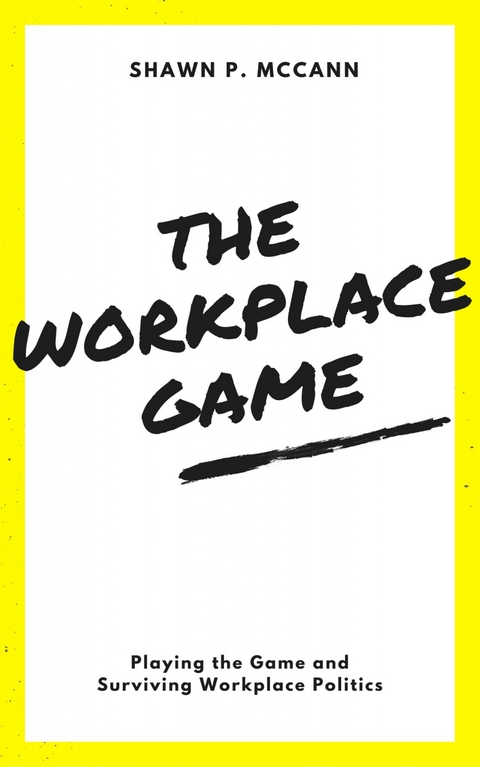
The Workplace Game (eBook)
156 Seiten
Publishdrive (Verlag)
978-0-00-003815-9 (ISBN)
Whether it's to survive horrible bosses, executive politics, you name it, The Workplace Game, teaches employees the rules of this very real game being played in the workplace, and then shows them how to play it better than anyone else.
“Who told you this information?” says an executive.
“I’ve met with employees as part of a climate study and learned more information as a result of meeting with a few employees from the department,” replies Candace.
“That’s only a few employees and we’ll need to know more about what’s going on. Maybe you can see if those employees have had any performance issues,” says an executive.
“I agree, maybe it’s the employees trying to cover up performance issues. We don’t have enough information; let’s not jump to conclusions,” says another executive.
After meeting with the executive team, as promised, Candace meets with the employees and asks additional questions about their concerns. An employee responds, “Candace, I thought that you were going to do something to help us. This is just more corporate bullshit. Don’t worry about doing anything, we don’t want any trouble.”
What’s scary is the fact that this scenario happens in many different forms every day in organizations around the world. Due to the feelings of superiority, many executives fail to react to potential violence. By sending Candace back to question employees who made the complaints, it’s like turning the table on them. As a result, the complainants (employees) now feel like victims of retaliation by executive management.
When it comes to violence in the workplace or potential concerns, corporate privilege is at its highest. Many executives would much rather demonstrate their power and dominance over the workforce, than listen to wise counsel. I’ve never quite understood this type of logic. Perhaps it is human nature or maybe some executives only listen when threats are directed at them. In either case, the previous scenario is what often takes place in many corporate suites, just before workplace violence occurs.
THE PRACTICE
Not only is there disparity when it comes to employees making complaints, but workplace ethics that govern both employees and management are not practiced consistently. As mentioned, there’s a large amount of bureaucracy in organizations and many employees believe that executives and others at the top have no idea about what’s really happening in the lower ranks. This notion isn’t true. Remember, executives are very aware of what’s going on in their respective areas of responsibility at all levels in the workplace. The reality is, many executives either turn a blind eye to issues or react slowly to them.
To be fair, there are executives in organizations who want to listen to concerns and handle them responsibly. However, if the organization in question happens to be their workplace, in consideration of their need to survive, many executives will not—rock the boat. Many of them can’t afford to be without a job. For the few executives who haven’t lost sight of what’s important, when they cross the line to question management’s behavior, they are crossing enemy lines and will be dealt with accordingly.
Tragically, many workplaces operate in an expedient fashion and have skillful attorneys ready to eat employees for lunch the minute they complain. Sadly, when corporate games result in unethical practices, the real victims are the employees in the general population.
THE DATA MONSTROSITY
Many people aren’t aware of the real issues behind research, data and other metrics in the workplace. You’ve probably heard the occasional “…but the research shows,” just after someone makes a point about what they deem as important. And it’s usually just that—what they deem as important. Gathering workplace data specifically for reporting on working conditions is often misleading and one-sided. Data can be manipulated to justify almost any outcome. If I said three out of four employees think that working conditions are great in XYZ organization, my conclusion would then say that seventy-five percent of the workforce is happy. In this case, the math is right; however, the representation is skewed. For all intents and purposes, I could have interviewed only four people out of, let’s say, four thousand employees.
Regarding workplace violence, there’s been much debate and research in the past few years. However, lots of research and statistics reported are used in academia and governing bodies for philosophical, political and creative purposes to increase awareness. The problem with these and other types of data points, is that they don’t get to the crux of the concerns—the real stuff that employees experience daily in the workplace.
Real and important issues are detailed throughout this book. Both employees and management are aware of these issues that take place inside of organizations. They just report and respond to them differently. If the climate in an organization is poor, an executive team might hire an outside consulting firm to conduct research to determine why the workplace climate is low, and to provide recommendations on how to get the organization back on track. Perhaps with a new and improved mission statement. Again, the problem with this approach, is that outside consultants are just that—outsiders.
When problems exist, and persist inside organizations, outsiders are very limited in their abilities to make impactful changes. For one reason, consultants are typically hired by an executive team which means they are paid by the organization. Considering that consultants are typically paid lots of money; they are very good at providing positive feedback even when the workplace is visibly exploding with problems. Also, consultants want more of an organization’s business in the future; therefore, they don’t want to rock the boat. Another reason that outside consultants are limited in their perspective—they are not really invested in organizations getting better or not. For them, it’s on to helping the next organization—or not.
In short, organizations typically have internal professionals who are qualified and should be conducting surveys and providing feedback on working conditions and other potential issues. Considering that these professionals are insiders; it seems likely that they would be able to report on the pulse of concerns in the workplace. However, some executives are reluctant to allow their own teams to conduct surveys on the workplace—maybe, for fear of what they might find. Still, another problem, is that in many organizations, employees don’t trust management. Therefore, surveys, statistics and other data points are just more fuses to light employees’ anger.
IT’S A MAD, MAD, MAD, MAD, WORKPLACE
As you may have guessed by now, corporate privilege and nonsense can be chaotic for organizations. Workplaces filled with avoidance, bureaucracy, politics, games, unreliable data and other psychological hazards add to the potential for breakdown and magnifies destructive consequences.
Like most people, you’re probably thinking that you can handle the nonsense in the workplace and that chaos is someone else’s problem. The truth is, you probably can handle most of the issues and may have weathered many storms at your organization. However, what about the people who work with you that cannot handle the madness? It’s a horrible feeling going to work knowing that today could be your last day—because an employee has decided to shoot up the place since they can no longer cope with workplace politics.
Even the most trained professionals can’t always foresee the madness or displeasure employees have in the workplace or the catalyst that causes frustration. Again, in situations like these, corporate privilege allows executives to pay outside consultants such as psychologists to facilitate training and intervention programs for the workforce. Although some consultants provide excellent training, their strategies typically come after a tragic incident has occurred in the workplace. In other cases, their trainings are meaningless experiments for staff that are already on the verge of meltdown.
Consultant: “I’m speaking with you because I’m worried about the recent events…in the workplace.”
Employee: “Why did you single me out, you should be speaking to the two comma folks.”
Consultant: “I’m sorry I didn’t get that reference, two comma folks.”
Employee: “Yeah, the executives with million-dollar salaries, you know, there’s two commas in a million dollars. Also, I don’t trust you, nor do I feel comfortable in this interview.”
Consultant: “I understand how you might feel, it’s not easy working after an incident of this magnitude, but this organization is strong, spirited and has a committed workforce…”
Employee: “Whatever, dude!”
In the above exchange, the employee doesn’t trust the consultant and has indirectly informed him that executive management is to blame for the recent tragedy in the workplace. Without addressing the issues of why the employee feels a certain way, the consultant delves into painting (deflecting) a picture of the organization as being “committed.” Ironically, this is the same game that causes tragedies in the workplace—that of management not caring.
Also, many organizations have a “madhouse” (or department) that is known throughout the workforce for its destructive nature and is also used to get rid of complainers. These are the departments that no employee wants to work in—and for the unlucky employees that do—they are miserable. We all know that these departments exist and are managed by crazy bosses that...
| Erscheint lt. Verlag | 2.2.2022 |
|---|---|
| Sprache | englisch |
| Themenwelt | Sachbuch/Ratgeber ► Beruf / Finanzen / Recht / Wirtschaft |
| ISBN-10 | 0-00-003815-6 / 0000038156 |
| ISBN-13 | 978-0-00-003815-9 / 9780000038159 |
| Informationen gemäß Produktsicherheitsverordnung (GPSR) | |
| Haben Sie eine Frage zum Produkt? |
 EPUB (Adobe DRM)
Größe: 783 KB
Kopierschutz: Adobe-DRM
Adobe-DRM ist ein Kopierschutz, der das eBook vor Mißbrauch schützen soll. Dabei wird das eBook bereits beim Download auf Ihre persönliche Adobe-ID autorisiert. Lesen können Sie das eBook dann nur auf den Geräten, welche ebenfalls auf Ihre Adobe-ID registriert sind.
Details zum Adobe-DRM
Dateiformat: EPUB (Electronic Publication)
EPUB ist ein offener Standard für eBooks und eignet sich besonders zur Darstellung von Belletristik und Sachbüchern. Der Fließtext wird dynamisch an die Display- und Schriftgröße angepasst. Auch für mobile Lesegeräte ist EPUB daher gut geeignet.
Systemvoraussetzungen:
PC/Mac: Mit einem PC oder Mac können Sie dieses eBook lesen. Sie benötigen eine
eReader: Dieses eBook kann mit (fast) allen eBook-Readern gelesen werden. Mit dem amazon-Kindle ist es aber nicht kompatibel.
Smartphone/Tablet: Egal ob Apple oder Android, dieses eBook können Sie lesen. Sie benötigen eine
Geräteliste und zusätzliche Hinweise
Buying eBooks from abroad
For tax law reasons we can sell eBooks just within Germany and Switzerland. Regrettably we cannot fulfill eBook-orders from other countries.
aus dem Bereich


