


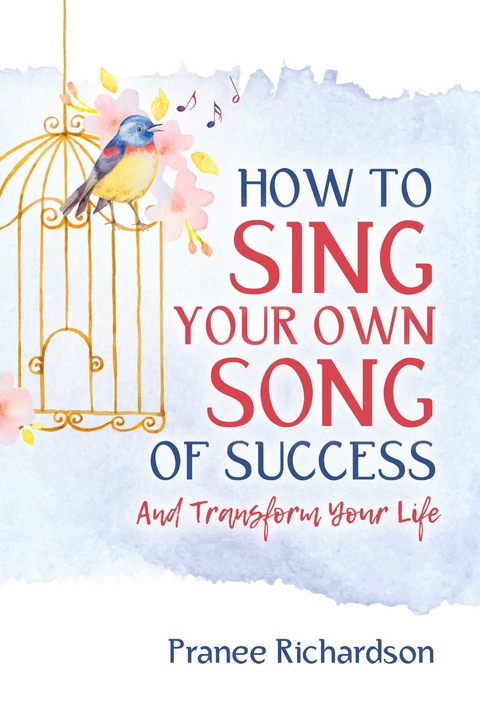
How to Sing Your Own Song of Success (eBook)
200 Seiten
Bookbaby (Verlag)
978-1-5439-0465-9 (ISBN)
How to Sing Your Own Song of Success proudly asserts that every person holds the capacity to excel beyond his or her wildest dreams, and that songs and slogans pave the way to unlimited success. The book employs everyday phenomena to take readers on a ride into the inner workings of thehuman mind to decode its mysteries. As passengers ride along, they explore events from the earliest yearsof childhood all the way to the present day. As readers undergo these experiences, they learn to view their efforts and lives from a different perspective. Through the process of analyzing events from their lives, they develop keen senses of the types of influences that drive the human mind to great levels of achievement. Once they gather this knowledge, they then use it to skillfully and deftly direct their minds to perform in unprecedented fashion. Readers may proceed skeptically at first as they question if they possess the musical ability to succeed. Soon, however, they toss such concerns by the wayside as they understand that the book appeals tothe musician that lives within every human mind, and it draws upon the creativity that lies within each person to accomplish its objectives. How to Sing Your Own Song of Success guides readers to trustthemselves and rely upon their own discoveries to reshape both their minds and their lives. The book exhorts readers to go ahead and live; otherwise, why bother with life at all? In the process, those involved will again learn to dance to their own tunes, and they will once more march to the beatof their own drummers. With that being said, we have reached the jumping off point for each and all to stoke the fires of creativity that burn within and fervently sing the song of success.
CHAPTER ONE
An Index Card And A Pen
As a teacher, I always introduced my students to a magical idea illustrated with the simple tools of an index card and a pen. I found that most held some familiarity with the idea; in fact, some had even performed a version of the experiment in the past although few had devoted much thought to it. To begin, the students would take an index card and fold it in half lengthwise. Then they would draw a birdcage on one side of the cage and a cute little bird on the other side. They would color the bird brightly. They then would tape the card to their pen or pencil with the bird and birdcage featured prominently on the outside. They would now rotate the pencil back-and-forth in their hands and as they did so, they created an optical illusion where the bird seemed to rest happily inside the cage.
This simple little trick reveals how easily the mind may fall victim to treachery or deceptiveness. Out in the world, we encounter abundant phenomena that fool the mind and often leave us bewildered. The card and the pen trick teaches us to step back from our observations and question if we are accurately interpreting reality. In so doing, we learn to discipline ourselves and develop better approaches for interacting with the world.
Consider, for example, how the world bombards us with messages—sometimes ones that suggest we are not good enough or that we fall short in some important area. Such indications assume a variety of forms from the supermodels gracing the covers of magazines to the hunks advertising men’s suits on television. Some of the ads may imply that we are too tall, too short, too black, too white, or too lacking in some supposedly essential area. Other messages suggest that we lack intelligence or confidence (I wonder why?) or the qualities of a winner. As we develop as children, we may discover that parents and teachers like some kids better than others, and we become increasingly aware that our friends often enjoy bigger homes and more expensive toys. Faced with this unsettling array of information, many of us begin to doubt ourselves, to question if we are okay. Such manifestations led me to write this book to remind people of their own irrefutable self-worth and to gently guide them back into the empowering world of self-appreciation. After all, the world can only deceive us if we allow the deception to endure, and only our confusion permits such an unfortunate set of circumstances to stand.
Think, for instance, about something you once believed was true that you no longer view as valid. Peeking back into childhood, you likely feared many make-believe monsters such as those under your bed and the bogey man. You probably entertained concerns over ghosts, witches, werewolves, and the like as well. Despite all those worries and nightmares, though, you found a way to overcome, and you moved on in life with courage and strength. Rest assured that if you surmounted those fears of deepest dread, you can handle anything else that the world might throw at you.
Despite our early triumphs, however, as we progress through life, we generally develop a tendency to pay greater homage to messages from the outside world and dismiss the information that arises from within. However, we must always remember that our uniqueness—our truly special gift—emanates from within. Think about the simple reality, for instance, that nobody can convince you to like a song if you don’t. Songs that you like simply resonate with you in a special way. Proceeding along the same lines, who can tell you whom you should love? We often find it impossible to explain why we love a person—we just do! What moves you to fall for a specific dog or cat? Even with respect to activities such as dancing, drawing, running, and so on, we all exhibit our own unique styles. Contemplate the fact that in all of existence, no person’s mind has functioned in exactly the same way as yours. While we generally acknowledge and appreciate these things about ourselves, we often still fall victim to honoring messages from the world far more highly than we value those from within. At such times, we must remember to reach for an index card and a pen.
As another poignant example of knowledge that flows from within, consider the concept of your own intuition and the intuitions of others. How many times have you heard people bemoan the fact that they—knew—something would occur before it happened, and yet they failed to act? How many times have you done the same? Many express such regrets with respect to sporting events: baseball games, horse races, boxing matches, and the like. We also witness evidence of the same phenomenon with respect to games of chance—the sense that one simply knows the outcome intuitively and yet doubts oneself, hesitates, and perhaps loses the opportunity of a lifetime.
Whether you choose to express such knowledge as confidence, a hunch, a feeling, or intuition, reflect upon some examples from the sporting world; for instance, how could Joe Namath have absolutely known that his New York Jets would upset the heavily favored Baltimore Colts in Super Bowl III? How could Muhammad Ali proclaim himself “the greatest” before he had defeated anyone of note? How could Roger Bannister believe that he could break the four-minute barrier in the mile when no one had done it before? Think of all the people who intuitively believe they can accomplish incredible things despite all evidence to the contrary, and yet they shock the world and prevail.
We all hold familiarity with such manifestations as revealed in stories and confessions from others, but can you think of examples from your own life when you just knew that a certain outcome would result, and yet you failed to positively act? Did you distrust the information because it came from you; did you doubt yourself? How might your life have changed had you trusted yourself a little bit more? How many times have you expressed remorse for choosing to ignore your own hunches?
Intuition, hunches, and spontaneous bursts of insight can make us rich, and they can also protect us from harm. A hunch about the performance of a certain stock could mean millions; similarly, betting big in 1980 that the U.S. Olympic Hockey Team would upset the dominant Soviet squad could have greatly aggrandized your life.
Our intuition often delivers warnings, too. For example, how often have you sensed that you should not trust another person only to disregard the conviction and later pay a significant price for doubting yourself? “I knew I shouldn’t have trusted him” has become a refrain often uttered by the victimized. Sadly, many of us fall short of learning the lesson and commit the same mistake over and over again.
All these things we already know, and yet, we largely ignore them because they emanate from within. Blinded and mesmerized by the sights and sounds of the outside world, we often ignore our own harmonious songs and tune to the shrill and deceptive ones that flow from the world. An index card and a pen can remind us that things are not always what they seem, that unwariness can lead to deception. Pondering this idea helps us to understand that we can identify the world’s pyrite as fool’s gold and reject it in favor of mining our own precious metals that lie within.
We also often stand witness to our deepest sense of self-belief when others challenge us or dare us to attempt something—usually something regarded as beyond our capabilities. At such times, we respond in ways that surprise even ourselves. I refer to this general set of circumstances as the African Lion Syndrome because the reactions that we show in such situations parallel those of the great predator. If you recall, the lion sleeps most of the day and often appears lazy and unmotivated; in fact, the beast frequently seems incapable of brushing aside an annoying pest, behaving as though such an activity would require too much effort.
However, let a rival male or a potential prey suddenly enter the king’s territory and we observe a completely different animal. Displaying enormous energy, the great king bounds to his feet fully prepared for action. The disinterested loafer of moments ago has disappeared, replaced by an engaged—and perhaps enraged—animal that now pulsates with power.
Many humans demonstrate similar tendencies in response to challenges and dares. We may drag through our normal daily activities without showing much pep or pizzazz until someone steps and challenges us. Once this happens, our energy levels elevate and we rise to meet the objection. If you dare us to deliver that speech, we will perform like the world’s greatest orators. If you challenge us to run a marathon, we will prepare with everything we’ve got to ready ourselves for the undertaking. Suggest that we cannot complete the project, and we will move heaven and earth to accomplish the task. Tell us that we can’t and we will stop at nothing to show you that we can.
All of this indicates that we remain aware of our capacities to achieve fantastic things, but like the king of beasts, we sometimes require a powerful stimulus to act. With the foregoing in mind, I suggest that we cease awaiting an action from some outside agency and learn instead to dare and challenge ourselves on a daily basis. Then we regulate our own behavior and begin automatically responding with great enthusiasm as we merrily pursue our own goals and objectives.
Another aspect of our inner power reveals itself when we find ourselves in the zone....
| Erscheint lt. Verlag | 15.6.2017 |
|---|---|
| Sprache | englisch |
| Themenwelt | Sachbuch/Ratgeber ► Beruf / Finanzen / Recht / Wirtschaft |
| ISBN-10 | 1-5439-0465-3 / 1543904653 |
| ISBN-13 | 978-1-5439-0465-9 / 9781543904659 |
| Informationen gemäß Produktsicherheitsverordnung (GPSR) | |
| Haben Sie eine Frage zum Produkt? |
 EPUB (Ohne DRM)
Größe: 804 KB
Digital Rights Management: ohne DRM
Dieses eBook enthält kein DRM oder Kopierschutz. Eine Weitergabe an Dritte ist jedoch rechtlich nicht zulässig, weil Sie beim Kauf nur die Rechte an der persönlichen Nutzung erwerben.
Dateiformat: EPUB (Electronic Publication)
EPUB ist ein offener Standard für eBooks und eignet sich besonders zur Darstellung von Belletristik und Sachbüchern. Der Fließtext wird dynamisch an die Display- und Schriftgröße angepasst. Auch für mobile Lesegeräte ist EPUB daher gut geeignet.
Systemvoraussetzungen:
PC/Mac: Mit einem PC oder Mac können Sie dieses eBook lesen. Sie benötigen dafür die kostenlose Software Adobe Digital Editions.
eReader: Dieses eBook kann mit (fast) allen eBook-Readern gelesen werden. Mit dem amazon-Kindle ist es aber nicht kompatibel.
Smartphone/Tablet: Egal ob Apple oder Android, dieses eBook können Sie lesen. Sie benötigen dafür eine kostenlose App.
Geräteliste und zusätzliche Hinweise
Buying eBooks from abroad
For tax law reasons we can sell eBooks just within Germany and Switzerland. Regrettably we cannot fulfill eBook-orders from other countries.
aus dem Bereich


