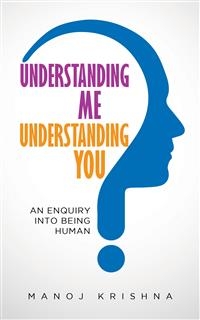
Understanding Me, Understanding You : An enquiry into being human (eBook)
288 Seiten
Publishdrive (Verlag)
9780995683310 (ISBN)

Just as we watch a bird fly across the sky, we can observe our thoughts and feelings simply and clearly.
How can we live in relationships without conflict?
Do we feel unsettled and long for peace within?
How can we find love in our lives, and be happy?
Is it possible not to be emotionally hurt?
The answers to these and other questions can be found through a deeper understanding of how our minds work, by observing our thoughts and feelings as they arise in us, and then exploring what lies behind them.
We are educated to understand the world around us, but not ourselves and this is responsible for many of our problems.
This book enables you to understand yourself clearly, and with this clarity of insight, problems can dissolve. Understanding ourselves helps us to empathize and connect with others because, despite our apparent differences, and hidden from our awareness, the human mind functions in the same way in everyone. This realization can transform our relationships and also lead to resilience, wisdom and a sense of inner peace.
This book is part of the Human Enquiry project, and more information can be found at humanenquiry.com.
Just as we watch a bird fly across the sky, we can observe our thoughts and feelings simply and clearly. How can we live in relationships without conflict? Do we feel unsettled and long for peace within?How can we find love in our lives, and be happy?Is it possible not to be emotionally hurt?The answers to these and other questions can be found through a deeper understanding of how our minds work, by observing our thoughts and feelings as they arise in us, and then exploring what lies behind them.We are educated to understand the world around us, but not ourselves and this is responsible for many of our problems.This book enables you to understand yourself clearly, and with this clarity of insight, problems can dissolve. Understanding ourselves helps us to empathize and connect with others because, despite our apparent differences, and hidden from our awareness, the human mind functions in the same way in everyone. This realization can transform our relationships and also lead to resilience, wisdom and a sense of inner peace.This book is part of the Human Enquiry project, and more information can be found at humanenquiry.com.
Can awareness help solve our problems?
It may seem a strange question to ask, but can ‘awareness’ and an understanding of the self, solve the many problems the world is facing? Our initial reaction is that it can only solve our own internal problems, if at all. We are only interested in exploring awareness, if it is going to improve our lives in some way. Could it bring both harmony and peace to our lives and solve many of the world’s problems at the same time?
We may think the big problems in the world, like the environmental crisis, wars, over-population, drug addiction, relationship breakdown and violence are nothing to do with us. We think there are experts and governments working to solve these problems. But, except for natural disasters, many of the world’s problems are linked to the way our minds work. So, if we are to solve them, we need to understand the link between the problems and ourselves. This is not immediately obvious. We will explore the ideas here in more detail throughout the book.
The environmental crisis
The world is facing an environmental crisis caused by an increasing population and increasing consumption. The earth’s resources are being depleted, forests are shrinking, wildlife habitats are under threat, greenhouse gas emissions are rising resulting in climate change, poor air quality in cities is causing health problems – the list is endless.
Here are some facts from the Worldwatch Institute:
- Global population will rise to 8.9 billion by 2050.
- The 12% of the world’s population that lives in North America and Europe accounts for 60% of global consumption.
- Consumption is rising in India and China and will eventually catch up with the US and Europe.
- 2.8 billion people live in poverty and a billion do not have access to clean water.
Everyone knows that something needs to be done, but nobody knows how to do it. All attempts at controlling greenhouse gas emissions so far have failed. Why? Could the cause and the possible solution to the crisis lie in our consciousness, in the way our minds work?
If we look at ourselves we can see that pleasure is a big driving force in our lives. We are not always aware of this. Pleasure leads to more consumption, both in our need for new experiences, and the enjoyment we get from buying things. We have never questioned why we have this constant thirst for stimulation that pleasure brings. Money buys us pleasure, and that is perhaps one reason we are keen on accumulating as much of it as we can in our lives.
We also have a need for psychological security. We worry about the future and this causes us to accumulate more. It never ends, because psychological insecurity has no end. We always want more than we have. Richer countries have lower birth rates than poorer ones.
It is not possible to impose idealistic solutions on people. History is a testament to that. To tell someone not to drive their car or have more children does not work, without draconian force. The urge for pleasure and security in the human brain is so powerful that it breaks through any rules imposed on it. Without exploring and addressing our need for pleasure and psychological security, we will never solve the environmental crisis.
Being aware of the whole structure of our thinking does bring about a natural intelligence and we may naturally begin to consume less because the thirst for constant pleasure fades away. As our inner insecurity eases, it may result in less need for accumulation and lower birth rates.
To tackle the environmental crisis, we need to begin where the problem originates, in the structure of our thinking process.
Violence and war
There is violence on our streets and between countries, but we think that has nothing to do with us, as individuals. Global military expenditure was $1.7 trillion in 2013, yet 2.8 billion people live in poverty. This is the world our shared human consciousness has created.
According to various estimates more than 200 million people died in the 20th century as a result of wars and oppression. Does this have anything to do with you and me? The patterns of thought that make up our consciousness are the same in you and me, and also in all the people who have been responsible for the 200 million deaths in the last century. That is what unites us.
The feelings of being hurt, getting angry, being violent, and feeling insecure and threatened are common to us all and are also the root cause of violence between countries. The fear of being attacked drives military spending around the world and that fear is the same as the fear you and I experience. The same subtle pleasure that you and I get from exercising power in our lives, is also what drives countries to try and become more powerful. Leaders who are afraid of losing their power end up oppressing others to stay in control, leading to more violence. They have the same feelings of insecurity that you and I do.
Being aware of the patterns of thought behind our feelings of anger, insecurity and our search for power which lead to violence, can bring a natural intelligence into being and a fundamental deep change in ourselves.
Relationship breakdown
Why do human beings struggle to have harmonious relationships with each other? The failure of our relationships causes so many problems, including personal suffering, rising divorce rates, unhappy children, dysfunctional families, and disharmony in the workplace. Conflict in our relationships unites all human beings, rich or poor. It is too simplistic to say it is linked to our ‘ego’. Our urge to have our psychological needs met by others, our need to have our own way, our images and our reaction to getting hurt are some of the factors that contribute to strained relationships. Most of these factors operate in the background, beyond our awareness. By understanding these patterns of thinking we could have more harmonious relationships. By exploring this with young people throughout our education system we could create a more harmonious world in a single generation.
Drug, tobacco and alcohol addiction
The cost of drug addiction in the US alone is estimated to be between $400–500 billion per year. This takes into account the cost of crime, healthcare and lost productivity. The American Centers for Disease Control and Prevention estimates the cost of excess alcohol consumption to be $226 billion per year. It also estimates the economic cost of smoking in the US is $300 billion per year. Add figures from the rest of the world and it is trillions of dollars.
So much misery is caused by illegal drugs, alcohol and tobacco addiction, and a lot of money is spent trying to solve these problems, with limited success. These addictions damage our health and our relationships. If one looks at all three in perspective, we realise that none of them are essential for human survival or our health. So why do people crave them?
They all have one thing in common. They are an easy source of pleasure and an escape from our sense of emptiness and restlessness. We become attached to, and occasionally addicted to, whatever brings us pleasure.
It is perhaps worth asking what is it about human consciousness that makes us seek pleasure and want to escape? Life is only in the moment, so why do we want to escape from it? Why are we uncomfortable in the moment we are in?
Awareness and understanding offer the possibility of freedom from the constant search for pleasure and wanting to escape from the moment we are in. In that quietness, by seeing the truth of our emptiness and being with it, a natural intelligence emerges and right action follows, which is effortless. In that process we may avoid our tendency to get addicted and overcome any addictions we may have.
Obesity
The consultancy firm McKinsey estimates that 2.1 billion people worldwide are obese and it costs the UK alone about £47 billion/year. 25% of the people in the UK are obese and 37% are overweight. Contrast this with the 2.8 billion people living in poverty worldwide who do not get enough to eat every day.
As we will explore elsewhere in this book, we have many psychological needs and there is a strong urge to fulfil them. This makes us insensitive to our own body, and its need for the right food and exercise. Our relationships and our bodies become vehicles for our psychological needs to be fulfilled. We use food and drink as a source of pleasure and comfort, and over-eat as a result. All these urges act in the background and we are not aware of them. All the government programmes to tackle obesity have not succeeded. In fact the problem is getting worse and experts predict a doubling of diabetes cases in 20 years.
Awareness offers a way to understand this problem from a different perspective. By becoming deeply aware of our eating habits and how we use food as a source of pleasure, we may become more sensitive to our bodies’ needs. This would address the problem at its root.
Education is the key
Throughout the world, millions of children go to school and study for years till they start work. Could understanding our human condition as it is, by asking questions, be incorporated into all education systems worldwide? If we could do this, there would be the possibility of a fundamental and deep change in society. There would be no need for a new ideology, a new leader, or a new belief system. The minds of all human beings work in fundamentally similar ways. Our consciousness is the same. We just need to...
| Erscheint lt. Verlag | 22.7.2017 |
|---|---|
| Sprache | englisch |
| Themenwelt | Sachbuch/Ratgeber ► Gesundheit / Leben / Psychologie ► Esoterik / Spiritualität |
| Sachbuch/Ratgeber ► Gesundheit / Leben / Psychologie ► Lebensdeutung | |
| Sachbuch/Ratgeber ► Gesundheit / Leben / Psychologie ► Lebenshilfe / Lebensführung | |
| Sachbuch/Ratgeber ► Gesundheit / Leben / Psychologie ► Psychologie | |
| Schlagworte | addiction • Death • Desire • fear • freedom • Happines • Loneliness. • Love • mindfullness • self-awareness • Stress • wisdom |
| ISBN-13 | 9780995683310 / 9780995683310 |
| Informationen gemäß Produktsicherheitsverordnung (GPSR) | |
| Haben Sie eine Frage zum Produkt? |
 EPUB (Ohne DRM)
Digital Rights Management: ohne DRM
Dieses eBook enthält kein DRM oder Kopierschutz. Eine Weitergabe an Dritte ist jedoch rechtlich nicht zulässig, weil Sie beim Kauf nur die Rechte an der persönlichen Nutzung erwerben.
Dateiformat: EPUB (Electronic Publication)
EPUB ist ein offener Standard für eBooks und eignet sich besonders zur Darstellung von Belletristik und Sachbüchern. Der Fließtext wird dynamisch an die Display- und Schriftgröße angepasst. Auch für mobile Lesegeräte ist EPUB daher gut geeignet.
Systemvoraussetzungen:
PC/Mac: Mit einem PC oder Mac können Sie dieses eBook lesen. Sie benötigen dafür die kostenlose Software Adobe Digital Editions.
eReader: Dieses eBook kann mit (fast) allen eBook-Readern gelesen werden. Mit dem amazon-Kindle ist es aber nicht kompatibel.
Smartphone/Tablet: Egal ob Apple oder Android, dieses eBook können Sie lesen. Sie benötigen dafür eine kostenlose App.
Geräteliste und zusätzliche Hinweise
Buying eBooks from abroad
For tax law reasons we can sell eBooks just within Germany and Switzerland. Regrettably we cannot fulfill eBook-orders from other countries.
aus dem Bereich