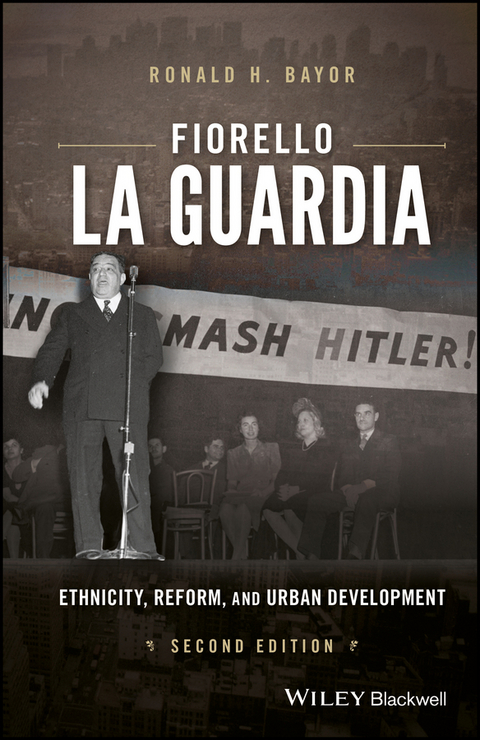
Fiorello La Guardia (eBook)
John Wiley & Sons (Verlag)
978-1-119-10353-0 (ISBN)
Ronald Howard Bayor was born on March 14, 1944 in New York City. Bachelor, City College of New York, 1965. Master of Arts, Syracuse University, 1966. Doctor of Philosophy, University Pennsylvania, 1970. He's a Recipient Distinguished Service Award, Immigration and Ethnic History Society, 1992, Georgia Tech. Outstanding Teacher award, 1983, School of Social Science Excellence in Teaching award, 1990, Lifetime Service award., Association Asian American Studies, 2005, Distinguished Editor award, The Council Editors of Learned Journals, 2008; fellow, National Endowment of the Humanities, 1992-1993.
Preface and Acknowledgments vii
1 Bridging DifferentWorlds 1
2 A Fighting Congressman 21
3 "The Conscience of the Twenties" 49
4 La Guardia as Mayor: The First Term 79
5 Reelection and Disappointment 133
6 La Guardia: His Place in History 177
Bibliographical Essay 185
Index 195
1
Bridging Different Worlds
The United States in the years from the end of the Civil War to the turn of the century was a country going through enormous changes. Industrialization spurred monopolization and concentration of wealth while providing Americans with cheaper and more plentiful products. Declining prices for farm products led farmers to form protest organizations to attempt to redress their grievances. In this age of materialism and greed, corporate influence in politics grew substantially. Union activity, some of it violent, intensified. The immigrants overwhelmed cities, particularly after 1882, when the source of immigrations shifted from northern and western to southern and Eastern Europe, and the numbers increased. By the end of the nineteenth century, New York had grown substantially in area as well with the annexation of the city of Brooklyn, the expansion of New York into Manhattan's northern sections, and the addition of the locales of Queens, Staten Island, and the Bronx. The city population stood at approximately 3.5 million, the nation's largest city.
New York City became the center of immigrant arrival with Ellis Island opening in New York harbor in 1892 as the main United States entry point. From 1892 to 1924, over 14 million immigrants disembarked at the Island, and although many went elsewhere in the country, New York's foreign-born population rose to 14% of its inhabitants. In addition New York experienced a substantial migration of Southern Blacks fleeing destitution and violence. Most new arrivals, whether domestic or foreign, came poverty-stricken, and desperately needing a job and housing. Adding to the ethnic mix already present, the newcomers helped create a diversity unique in the world and exacerbated a number of urban problems particularly in relation to poverty and housing. Certain neighborhoods evolved into ethnic enclaves and ghettoes, areas where a foreign language would be the main speech on the streets, stores catered to ethnic tastes, foreign-language newspapers were widely read, and politicians wooed groups with ethnically based campaigns.
These ethnic groups also competed and conflicted with each other, trying to secure limited resources, challenging cultural values, and at times tearing the city apart in race riots and ethnic conflicts. New York's housing, jobs, and political positions all became part of the competition that emerged especially between the Irish, Jews, Germans, Italians, and Blacks. Furthermore, what happened in their ancestral homes often impacted New York's politics. The eventual rise of Russian Communism, Italian Fascism, and German Nazism had strong implications for New York's immigrant populations.
As New York emerged into the twentieth century, problems abounded and opportunities appeared. The new population's poverty resulted in the growth of slum housing, sweatshop conditions in factories, and crime. Jobs became available with the building of the New York subways, opening in 1904, and with the growth of the garment industry. But these jobs did not pay much, workmen's compensation and unemployment insurance were not yet available, employers abused child labor, and they fought any union attempts to better the workers' lives.
Many Americans became concerned about this poverty in the midst of plenty, corrupt city governments, exploitation of workers, child labor, and the threat the new industrial wealth posed to democratic institutions. As the nation tried to come to terms with industrialization and urbanization, responses varied. Some, such as financier J.P. Morgan, fit well into this period and reaped enormous profit from it. Other, like Yale professor William Graham Sumner, became spokesmen for Social Darwinism, which justified the great wealth of the corporate entrepreneurs. Still others railed against the essence of the Gilded Age and offered criticisms and suggestions that would create a more equitable system and smooth away the harsh edges of nineteenth-century capitalism.
Fiorello Enrico (later Henry) La Guardia, born on December 11, 1882, in New York City in the midst of this turmoil, was to provide a unique response to the economic and social upheavals of his time. La Guardia bridged the era between the early years of protest against the industrial system and the later outburst of reform in the 1930s, and he took part in all the major issues and events of this period: immigration and ethnicity, Progressivism, the fight against the corrupt urban political machines, World War I, the 1920s conservative and nativist reaction, the 1930s economic collapse, Franklin Roosevelt's New Deal reforms, World War II and its immediate aftermath. He emerged as a spokesman for good government, unions, immigrants, Blacks, the urban poor, miners, and farmers. Fiorello connected the philosophies and activism of an earlier generation of reformers – among them, housing crusader Jacob Riis, Theodore Roosevelt, and Senators George Norris, Robert La Follette, and William Borah – to the later reformers of the New Deal generation. He interacted both with the older reform generation and with his own cohort in New York. The latter group provided various alternatives for coming to terms with the industrial age. James J. (Jimmy) Walker, born in 1881 and later New York mayor, accepted and profited from the urban corruption of his times. Franklin D. Roosevelt, born in 1882, brought reform with a new and surprising influence that uplifted the nation as well as New York City. Future governor and presidential candidate Alfred E. Smith, born in 1873, Robert F. Wagner, born in 1877 and future US Senator, and Salvatore Cotillo, born in 1886 and later justice on the New York State Supreme Court, represented the Tammany political machine's approach to needed reform. (Tammany was New York County's Democratic party organization).
The bridging of a generational gap among the reformers is only part of La Guardia's story. He also connected the values of the Old and New Worlds, immigrants and the native-born, and western and eastern America. As such, La Guardia linked a New York City immigrant reform tradition represented by the socialist-oriented garment unions with the reform of middle America's farmer-labor groups. Moreover, as biographer Arthur Mann relates, La Guardia was “a marginal man who lived on the edge of many cultures.” In addition to English, he could speak Yiddish, French, Italian, Hungarian, German, and Croatian. “Half Jewish and half Italian, born in [New York's] Greenwich Village yet raised in Arizona, married first to a Catholic and then to a Lutheran but himself … an Episcopalian, Fiorello La Guardia was a Mr. Brotherhood week all by himself.” Like New York, he was a product of diverse elements, all of which explain his personality, commitment, and accomplishments.
Family Background
When Fiorello was born in 1882 in an ethnically diverse section of New York's Greenwich Village, large-scale Italian and eastern European Jewish migration was just beginning and would reach its peak in the early years of the twentieth century. His parents, Achille Luigi Carlo La Guardia and Irene Coen, had arrived in New York in 1880. Achille's music brought the La Guardias to the United States. His skill as a cornetist and arranger had led him in 1878 to tour the United States with Adelina Patti, a well-known Italian opera star. Achille, captivated by the New World, resolved during the tour to come back to live in America. After returning to Europe, he met and married Irene in 1880 in Trieste, Austria-Hungary, her birthplace, and then immigrated to the United States. Gemma, a daughter, was born in 1881, followed by Fiorello (Little Flower) in 1882, and Richard in 1887. Had the La Guardias stayed in New York City, Fiorello would have grown up in a milieu of Irish political control through the Tammany machine and of competition among often contentious and striving ethnic groups over housing, jobs, political positions, and criminal operations. This environment nurtured Jimmy Walker, Al Smith, and Robert Wagner, who moved easily up the political ladder, but reluctantly offered only a few political positions to Italians. If America faced serious issues during a period of industrial growth and heavy immigration, New York City, where every problem seemed magnified, experienced wrenching times. Crime, poverty, ethnic conflict, corruption, labor violence, worker exploitation, disease, and inadequate housing were part of New York life. All these problems grew worse during the 1890s Depression.
To the Frontier
Fiorello would work to relieve these problems as New York's mayor and as a dominant force in the city's political world. However, in 1885, Achille, experiencing difficulty in finding steady work as a musician in New York, joined the army as chief musician in the Eleventh Infantry Regiment and moved his family west. Achille took his bold step of leaving a relatively comfortable New York ethnic world to venture to the unknown western frontier in search of opportunity. Fiorello thereby grew up with a unique childhood experience and a different perspective than he would have learned in New York's overcrowded tenements. The La Guardias moved a number of times – from Fort Sully in North Dakota to Madison Barracks, Sackets Harbor, New York to Fort Huachuca, Arizona Territory; and finally, in 1892, to Whipple Barracks near Prescott, Arizona Territory. By this time, Achille had become a bandmaster. The small western frontier...
| Erscheint lt. Verlag | 11.7.2017 |
|---|---|
| Sprache | englisch |
| Themenwelt | Literatur ► Biografien / Erfahrungsberichte |
| Literatur ► Romane / Erzählungen | |
| Sachbuch/Ratgeber ► Geschichte / Politik | |
| Geisteswissenschaften ► Geschichte ► Regional- / Ländergeschichte | |
| Sozialwissenschaften ► Politik / Verwaltung | |
| Schlagworte | 20th century history • American Cultural History • American Politics • American Social & Cultural History • American Social & Cultural History • American social history • American Studies • Ethnic & Immigration History • Ethnische Geschichte u. Einwanderungsgeschichte der USA • famous congressmen • famous mayors • famous politicians • Fiorello La Guardia • Geschichte • Geschichte der USA • great American mayors • History • history of the progressive era • Immigration History • La Guardia • New York • New York City • new york city history • New York during the Great Depression • New York mayor • New York State history • New York survey • nyc history • Sozial- u. Kulturgeschichte Amerikas • The 1920s • the 1930s • the 1940s • The Great Depression • The New Deal • The Progressive Era • urban america • urban politics • us history • U.S. History • U.S. political history • U.S. survey • World War II |
| ISBN-10 | 1-119-10353-3 / 1119103533 |
| ISBN-13 | 978-1-119-10353-0 / 9781119103530 |
| Informationen gemäß Produktsicherheitsverordnung (GPSR) | |
| Haben Sie eine Frage zum Produkt? |
 EPUB (Adobe DRM)
Kopierschutz: Adobe-DRM
Adobe-DRM ist ein Kopierschutz, der das eBook vor Mißbrauch schützen soll. Dabei wird das eBook bereits beim Download auf Ihre persönliche Adobe-ID autorisiert. Lesen können Sie das eBook dann nur auf den Geräten, welche ebenfalls auf Ihre Adobe-ID registriert sind.
Details zum Adobe-DRM
Dateiformat: EPUB (Electronic Publication)
EPUB ist ein offener Standard für eBooks und eignet sich besonders zur Darstellung von Belletristik und Sachbüchern. Der Fließtext wird dynamisch an die Display- und Schriftgröße angepasst. Auch für mobile Lesegeräte ist EPUB daher gut geeignet.
Systemvoraussetzungen:
PC/Mac: Mit einem PC oder Mac können Sie dieses eBook lesen. Sie benötigen eine
eReader: Dieses eBook kann mit (fast) allen eBook-Readern gelesen werden. Mit dem amazon-Kindle ist es aber nicht kompatibel.
Smartphone/Tablet: Egal ob Apple oder Android, dieses eBook können Sie lesen. Sie benötigen eine
Geräteliste und zusätzliche Hinweise
Buying eBooks from abroad
For tax law reasons we can sell eBooks just within Germany and Switzerland. Regrettably we cannot fulfill eBook-orders from other countries.
aus dem Bereich