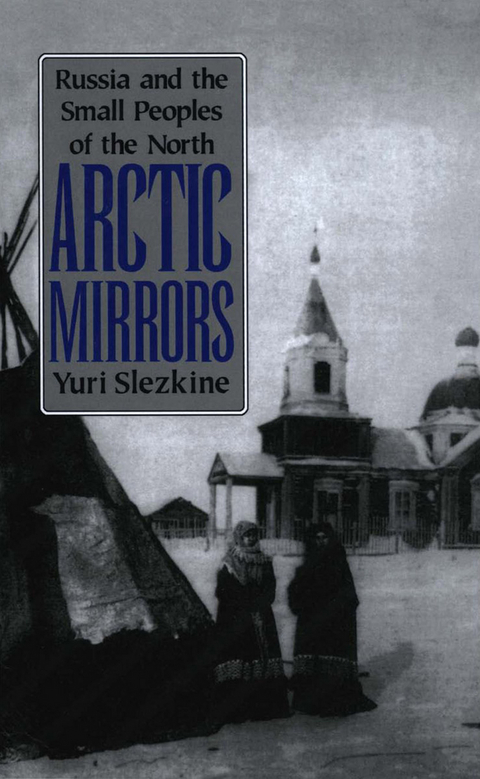
Arctic Mirrors (eBook)
476 Seiten
Cornell University Press (Verlag)
978-1-5017-0330-0 (ISBN)
Arctic Mirrors is a vividly rendered history of circumpolar peoples in the Russian empire and the Russian mind.
For over five hundred years the Russians wondered what kind of people their Arctic and sub-Arctic subjects were. "They have mouths between their shoulders and eyes in their chests," reported a fifteenth-century tale. "They rove around, live of their own free will, and beat the Russian people," complained a seventeenth-century Cossack. "Their actions are exceedingly rude. They do not take off their hats and do not bow to each other," huffed an eighteenth-century scholar. They are "children of nature" and "guardians of ecological balance," rhapsodized early nineteenth-century and late twentieth-century romantics. Even the Bolsheviks, who categorized the circumpolar foragers as "authentic proletarians," were repeatedly puzzled by the "peoples from the late Neolithic period who, by virtue of their extreme backwardness, cannot keep up either economically or culturally with the furious speed of the emerging socialist society."Whether described as brutes, aliens, or endangered indigenous populations, the so-called small peoples of the north have consistently remained a point of contrast for speculations on Russian identity and a convenient testing ground for policies and images that grew out of these speculations. In Arctic Mirrors, a vividly rendered history of circumpolar peoples in the Russian empire and the Russian mind, Yuri Slezkine offers the first in-depth interpretation of this relationship. No other book in any language links the history of a colonized non-Russian people to the full sweep of Russian intellectual and cultural history. Enhancing his account with vintage prints and photographs, Slezkine reenacts the procession of Russian fur traders, missionaries, tsarist bureaucrats, radical intellectuals, professional ethnographers, and commissars who struggled to reform and conceptualize this most "alien" of their subject populations.Slezkine reconstructs from a vast range of sources the successive official policies and prevailing attitudes toward the northern peoples, interweaving the resonant narratives of Russian and indigenous contemporaries with the extravagant images of popular Russian fiction. As he examines the many ironies and ambivalences involved in successive Russian attempts to overcome northern—and hence their own—otherness, Slezkine explores the wider issues of ethnic identity, cultural change, nationalist rhetoric, and not-so European colonialism.
Yuri Slezkine is the Jane K. Sather Professor of History at the University of California, Berkeley.
Introduction: The Small Peoples of the NorthPART I. SUBJECTS OF THE TSARCHAPTER 1. The Unbaptized
The Sovereign's Profit
The Sovereign's ForeignersCHAPTER 2. The Unenlightened
The State and the Savages
The State and the Tribute PayersCHAPTER 3. The Uncorrupted
High Culture and the Children of Nature
The Empire and the AliensPART II. SUBJECTS OF CONCERNCHAPTER 4. The Oppressed
Aliens as Neighbors and Tribute Payers as Debtors
The Russian Indians and the Populist IntellectualsCHAPTER 5. The Liberated
The Commissariat of Nationalities and the Tribes of the Northern Borderlands
The Committee of the North: The Committee
The Committee of the North: The NorthPART III. CONQUERORS OF BACKWARDNESSCHAPTER 6. The Conscious Collectivists
Class Struggles in a Classless Society
Hunting and Gathering under SocialismCHAPTER 7. The Cultural Revolutionaries
The War against Backwardness
The War against EthnographyCHAPTER 8. The Uncertain Proletarians
The Native Northerners as Industrial Laborers
The North without the Native Northerners
The Long Journey of the Small PeoplesPART IV. LAST AMONG EQUALSCHAPTER 9. The Socialist Nationalities
Socialist Realism in the Social Sciences
Fiction as HistoryCHAPTER 10. The Endangered Species
Planners' Problems and Scholars' Scruples
The Return of Dersu Uzala
Perestroika and the Numerically Small Peoples of the NorthConclusionBibliography
Index
| Erscheint lt. Verlag | 1.11.2016 |
|---|---|
| Zusatzinfo | 12 halftones |
| Verlagsort | Ithaca |
| Sprache | englisch |
| Maße | 160 x 160 mm |
| Themenwelt | Literatur ► Biografien / Erfahrungsberichte |
| Sachbuch/Ratgeber ► Geschichte / Politik | |
| Geisteswissenschaften ► Geschichte ► Regional- / Ländergeschichte | |
| Sozialwissenschaften ► Ethnologie | |
| Sozialwissenschaften ► Soziologie ► Makrosoziologie | |
| Schlagworte | 26 indigenous ethnic groups of the Arctic tundra • Anthroplogy • anthropology of Siberia • arctic anthropolgy • arctic people • arctric tundra people • book about people who live in the arctic • books on russian history • circumpolar peoples in the Russian empire • Cultural • Cultural Anthropology • ehtnic groups in the north • ethnographies • Etnografia • history of northern russian people • history of northern Siberia's natives • History of the Native Peoples of Siberia • hunter-gatherers of northern eurasia • indigenous peoples of the arctic • modernization policies of the Soviets • native arctic peoples • northern russian ethnic groups • northern russian people • okhotnik sibiri • people in russian arctic • people of the arctic • politics of northern russian people • regional studies the arctic • reindeer pastrolists • Russian History • russian people of the north • Russian Studies • Siberian minorities • siberian speakers • Slavic Review • Slavic Studies • society of arctic peoples • socio cultural anthroplogy arctic • Students of the soviet period • subarctic taiga people • the small peoples of the north • who lives in the russian arctic • zakanov |
| ISBN-10 | 1-5017-0330-7 / 1501703307 |
| ISBN-13 | 978-1-5017-0330-0 / 9781501703300 |
| Informationen gemäß Produktsicherheitsverordnung (GPSR) | |
| Haben Sie eine Frage zum Produkt? |
 EPUB (Adobe DRM)
Kopierschutz: Adobe-DRM
Adobe-DRM ist ein Kopierschutz, der das eBook vor Mißbrauch schützen soll. Dabei wird das eBook bereits beim Download auf Ihre persönliche Adobe-ID autorisiert. Lesen können Sie das eBook dann nur auf den Geräten, welche ebenfalls auf Ihre Adobe-ID registriert sind.
Details zum Adobe-DRM
Dateiformat: EPUB (Electronic Publication)
EPUB ist ein offener Standard für eBooks und eignet sich besonders zur Darstellung von Belletristik und Sachbüchern. Der Fließtext wird dynamisch an die Display- und Schriftgröße angepasst. Auch für mobile Lesegeräte ist EPUB daher gut geeignet.
Systemvoraussetzungen:
PC/Mac: Mit einem PC oder Mac können Sie dieses eBook lesen. Sie benötigen eine
eReader: Dieses eBook kann mit (fast) allen eBook-Readern gelesen werden. Mit dem amazon-Kindle ist es aber nicht kompatibel.
Smartphone/Tablet: Egal ob Apple oder Android, dieses eBook können Sie lesen. Sie benötigen eine
Geräteliste und zusätzliche Hinweise
Buying eBooks from abroad
For tax law reasons we can sell eBooks just within Germany and Switzerland. Regrettably we cannot fulfill eBook-orders from other countries.
aus dem Bereich