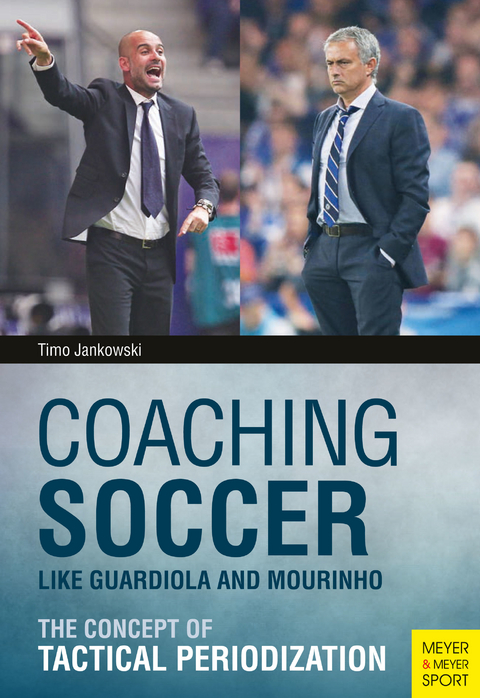
Coaching Soccer Like Guardiola and Mourinho (eBook)
248 Seiten
Meyer & Meyer Fachverlag und Buchhandel GmbH
978-1-78255-741-8 (ISBN)
Timo Jankowski holds the UEFA A License and is Life Kinetic and Functional Fitness trainer. Following his jobs as coach of the German Football Association as well as of the U16 of Grasshoppers Zurich, Jankowski currently trains the U16 team of FC Aarau. In addition, he runs a sports center with a hotel and soccer school. He is the author of Successful German Soccer Tactics.
A soccer player is more than the sum of his parts: endurance, speed, shooting technique, passing technique, and many more. All of these factors need to be turned into one system to create good players. Traditional training theory doesn't achieve that because each skill is trained individually. This is why the concept of Tactical Periodization has become the preferred training theory for many of the current most successful soccer coaches: Pep Guardiola, Jose Mourinho, Diego Simeone, Andre Villas-Boas, and many others train according to these principles. By creating match-like situations in practice, players learn to link their technical, tactical, and athletic abilities to match intelligence. They will learn to transfer their skills to soccer matches and they can improve endurance, technique, and tactics all at the same time while enjoying the practice sessions more. For this book, the author has evaluated and analyzed hundreds of training sessions and has tailored exercises to specific demands. All exercises are performed with a ball so that players learn to apply each skill to the game. Every coach will find numerous exercises in this book to help them create better and more efficient practice sessions so they can improve their players' and the team's performance. With Tactical Periodization, your team will become better and be successful on the next match day!
Timo Jankowski holds the UEFA A License and is Life Kinetic and Functional Fitness trainer. Following his jobs as coach of the German Football Association as well as of the U16 of Grasshoppers Zurich, Jankowski currently trains the U16 team of FC Aarau. In addition, he runs a sports center with a hotel and soccer school. He is the author of Successful German Soccer Tactics.
COVER 1
INHALT 7
1 WORK HARD AND WORK SMART – FACTS, TRENDS, “FANS,” AND TACTICAL PERIODIZATION 12
1.1 THE CONCEPT OF TACTICAL PERIODIZATION 18
2 THE PLAYER WHO MAKES THE DIFFERENCE – SELF-CONFIDENCE, SELF-MOTIVATION, HUMILITY, PRESSURE TO PERFORM, PERSONAL DEVELOPMENT, AND POSITIVE PUSHING 24
3 PLANNING AND DIRECTING TRAINING – DEFINITIONS AND FUNDAMENTALS 36
3.1 PRINCIPLES OF TRAINING AS THE BASIS FOR ATHLETIC SUCCESS 37
3.2 PRINCIPLES OF TRAINING AS THE BASIS FOR PLANNING AND DIRECTING 39
3.3 PRINCIPLES OF ADAPTATION REINFORCEMENT 41
3.4 TAPERING – ACHIEVING PERFORMANCE AT THE RIGHT MOMENT 41
4 LONG-TERM ATHLETE DEVELOPMENT – THE SEVEN STEPS OF LONG-TERM ATHLETE DEVELOPMENT (LTAD) 46
5 A CROSS-SECTION OF DIFFERENT PERIODIZATION MODELS 52
5.1 CLASSIC LINEAR PERIODIZATION 53
5.1.1 PREPARATION PERIOD 56
5.1.2 COMPETITION PERIODS 56
5.1.3 TRANSITION PERIOD 58
5.1.4 YEAR-ROUND PERIODIZATION IN SOCCER – DOUBLE PERIODIZATION WITH CYCLIZATION 58
5.1.5 APPLYING CLASSIC PERIODIZATION IN SOCCER 59
5.2 BLOCK PERIODIZATION 61
5.2.1 CHARACTERISTICS OF BLOCK PERIODIZATION 64
5.2.2 USING BLOCK PERIODIZATION IN SOCCER 65
5.3 WAVE-LIKE PERIODIZATION 66
5.3.1 USING WAVE-LIKE PERIODIZATION IN SOCCER 67
5.4 THE COERVER METHOD 68
5.4.1 THE COERVER PYRAMID METHOD 71
5.5 SIMON CLIFFORD’S BRAZILIAN SOCCER SCHOOLS RECIPE FOR SUCCESS 78
5.6 THE HORST WEIN DEVELOPMENTAL MODEL 82
5.6.1 THOUGHTS ON GAME INTELLIGENCE IN SOCCER 84
5.6.2 GAME INTELLIGENCE DURING COMPETITION 89
5.6.3 DIGRESSION: “I LIKE CONTROLLED CHAOS” – QUICKER PERCEPTION, QUICKER ACTION IN SOCCER AS A MENTAL SPORT 91
5.6.4 TRAINING GAME INTELLIGENCE – THE HORST WEIN FIVE-STEP DEVELOPMENTAL MODEL IN DETAIL 92
5.6.5 HORST WEIN’S MINI SOCCER CONCEPT FUNI.O AND MANCHESTER UNITED’S U9 STUDY 98
5.6.6 EXAMPLES OF OPEN QUESTIONS IN SOCCER 102
5.7 DR. RAYMOND VERHEIJEN’S MODEL 103
5.7.1 THE FOUR FITNESS-RELATED ABILITIES AS PER VERHEIJEN 105
5.8 SUMMARY OF PRESENTED PERIODIZATION MODELS 112
6 DUALISM, SOCCER MINDSET, AND WHY PERFORMANCE SHOULD ALWAYS BE TRAINED OVER COMPETENCE 118
7 THE SUCCESSFUL TACTICAL PERIODIZATION CONCEPT – A SOCCER-SPECIFIC, HOLISTIC, AND TACTICAL APPROACH 124
7.1 THE FOUR GAME PHASES AND TRANSITION PLAY 129
7.2 IMPORTANCE AND DEVELOPMENT OF A GAME MODEL IN THE CONTEXT OF TATICAL PERIODIZATION 132
7.2.1 DEVELOPMENTAL STEPS OF A GAME MODEL IN DETAIL 135
7.2.2 EXAMPLE OF THE TACTICAL BEHAVIOR PATTERNS BREAKDOWN 139
7.3 THE EIGHT METHODOLOGICAL PRINCIPLES AND THE TEN BIGGEST MISTAKES ONE CAN MAKE WITH THE TACTICAL PERIODIZATION CONCEPT 142
7.3.1 THE EIGHT METHODOLOGICAL PRINCIPLES 143
7.3.2 TEN MISTAKES THAT SHOULD BE AVOIDED AT ALL COST 148
7.4 MENTAL INFLUENCING FACTORS, TATICAL CONCENTRATION, AND THE IMPORTANCE OF SPECIFICITY AND REALISTIC INTENSITY 149
7.5 TEACHING LEARNING CONTENT IN TACTICAL PERIODIZATION 151
7.5.1 THE DIFFERENTIATED LEARNING METHOD 151
7.5.2 IMPLICIT LEARNING 154
7.6 MICROCYCLE – DETAILED WEEKLY STRUCTURING OF TACTICAL PERIODIZATION 156
7.6.1 WEEKLY SCHEDULE IN DETAIL 157
7.7 TACTICAL PERIODIZATION OF TRAINING CONTENT AND THE GREAT ADVANTAGES OF POSITIONAL PLAY 160
7.8 CONCLUSION AND THE SUPERIORITY OF TACTICAL PERIODIZATION 168
8 MORE THAN 60 PRACTICAL EXAMPLES FROM TOP COACHES AND TOP YOUTH ACADEMIES 172
9 LAST BUT NOT LEAST – CONTENTMENT VS. GRATITUDE 244
PHOTO CREDITS 246
5.1 Classic Linear Periodization
“In training it isn’t necessarily the time you put in that matters, but rather what you accomplish.” – NHL pro Eric Lindros, world-class ice hockey player
Once a long-term development model has been chosen, the long-term phases must be further broken down by periodizing these phases into smaller and smaller units.
Breakdown of a long-term training structure
Lew Matwejew, a psychologist from the former Soviet Union, is considered the founder of athletic training and classic periodization because he closely analyzed the Soviet Olympic teams of 1952 and 1956, and based on these findings, developed training plans for the 1960 Olympics, where the athletes were able to celebrate great success due to his methods.
Classic periodization is also referred to as linear periodization, and the training method used in classic periodization remains the same throughout an entire mesocycle. Here, the individual areas of performance are trained separately until the desired training goal in one of these areas has been reached.
In classic periodization, an annual plan is created first, regardless of the type of sport.
For Olympic athletes, a quadrennial, meaning a four-year plan, is usually created.
First, it is determined at which competitions, tournaments, or games the athlete or team must bring his or their peak performance.
Practice times for classic periodization in sports with long seasons, such as soccer, must be lowered since there is a match nearly every weekend at which a top performance must be achieved.
In soccer, building on his knowledge as coach for Dynamo Kiev, Walerij Lobanovskyi developed the first periodization versions for soccer based on this periodization concept in the mid-70s and became an eight-time Soviet Champion with his team.
© picture-alliance/dpa;
Successful with his long-term planning—Walerij Lobanovskyi of Dynamo Kiev
In this model, the ultimate objective is an athlete’s or team’s preparation for competition.
Beginning with previously set competition dates, the annual training is rolled up back to front, meaning planning and organizing is done temporally backwards.
Thus, the question is, what must the athlete or team do to achieve the best possible performance on day X, Y, or Z?
In classic periodization, training is planned in such a way that certain factors are trained during specific time periods over the course of the year, while other factors are merely maintained during that time period.
To simplify, the annual plan in most sports, including soccer, is still basically divided into three large blocks:
-
Preparation period
-
Competition period
-
Transition period
Since the season in most soccer leagues includes a preliminary round and a second half, the competition phase can, furthermore, be subdivided into two periods, whereby we then refer to a double periodization.
-
PP = Preparation period
-
CP = Competition period
-
TP = Transition period
5.1.1 Preparation Period
Some coaches differentiate between a general preparation period in which foundations for physical fitness are created and an advanced period in which specificity increases.
Intensity increases until the first high point, which, in soccer, is the first championship game, while the volume simultaneously decreases.
With respect to the first championship game, training becomes increasingly competition specific (see chapter 3.4, Tapering).
But in soccer, a common myth is that the basic endurance established during the general preparation period will last the entire season, which is simply physiologically impossible and is the reason why the general preparation period is, fortunately, gradually disappearing from soccer.
5.1.2 Competition Periods
During the competition period, the objective is to keep the performance constant or, ideally, to keep improving.
A big mistake often made in soccer is that too little consideration is given to regeneration.
Regeneration is as much a part of the training plan as all the other components:
100 % training and 100 % regeneration.
It must be an important goal for a coach to have the largest number of players from his squad available for the long haul to maintain a high degree of quality of training and have lots of choices for game day.
In competitive sports, every detail matters: For a recreational athlete to improve by 5 %, he must train about three months. A world-class athlete must train for about two years for a mere 2 % improvement.
Next to an optimal diet and the right sleep behavior and massages and saunas, top teams like Bayer Leverkusen or Chelsea FC now are increasingly betting on cold chambers that speed up regeneration at -166 °F.
In a cold chamber, all of the vessels directly below the skin are constricted, the blood is forced back, and the body now has more time to optimally supply the working muscles.
When a top athlete uses a cold chamber directly before training or a competition, he afterwards has more explosive power and is able to train approximately 10 % longer at the anaerobic threshold.
Is it any wonder that Cristiano Ronaldo had a cold chamber installed in his home?
Law of specificity: Does Usain Bolt do his speed training on the soccer field? No! Then why do so many soccer players spend so much time on the tartan track or trail running?
5.1.3 Transition Period
The competition period is followed by the transition period.
The transition period should be active, but, of course, with a reduced volume and reduced intensity so body and mind can recover.
In the transition period, the players usually complete individual programs that can enhance strengths and eliminate weaknesses.
In addition, classic periodization works with the already proven basis of cyclization.
This cyclization results in three different cycles that build on each other to transition to a more detailed training plan.
-
Microcycle: 1-14 days, usually one week of soccer
-
Mesocycle: 2 weeks to 6 months, usually four weeks of soccer
-
Macrocycle: 1-4 years, usually one whole season of soccer
5.1.4 Year-round Periodization in Soccer – Double Periodization With Cyclization
It has been scientifically proven that double periodization is far more advantageous, which is why many teams that use classic periodization in soccer are using double periodization.
With respect to performance, the soccer season usually extends over 11 months and is characterized by the milestones, such as the start of the season, individual match days, or international matches.
The objective here is to stabilize form for the entire season.
To do so, it is important to introduce new stimuli no later than every six to eight weeks to prevent stagnation.
| MACROCYCLE I |
| Preparation I | Mesocycle I | Mesocycle II | Transition phase I |
| JUL | AUG | SEP | OCT | NOV | DEC/JAN |
| MACROCYCLE II |
| Preparation II | Mesocycle III | Mesocycle IV | Transition phase II |
| JAN | FEB | MAR | APR | MAY | JUN |
5.1.5 Applying Classic Periodization in Soccer
Running in circles around the field is a waste of time and should be prohibited, especially in youth soccer. Instead, a technical and tactical warm-up should be used.
Classic periodization certainly is the basis for considering the planning and directing of an athletic team’s training, and even today, every training plan includes the terms preparation period, competition period, and transition period coined by Matwejew.
But, except for the adopted terminology, classic periodization is of little use in soccer as shown by the following:
-
The classic periodization model was developed in the 1960s and, to date, is nearly unchanged.
-
The model was only tested in individual sports, such as weight lifting and swimming, where there were few high points over the course of the year and for which Matwejew foresaw a five- to six-month preparation period, a four- to five-month competition period, and a brief transition period of one to two months.
-
Moreover, for most individual athletes, the high point is the Olympic Games, which only take place every four years.
-
But in soccer, there is a high point nearly every weekend, and the timespan for preparation is also considerably shorter.
-
Classic periodization focuses on a game density of 10...
| Erscheint lt. Verlag | 17.11.2016 |
|---|---|
| Verlagsort | Aachen |
| Sprache | englisch |
| Themenwelt | Sachbuch/Ratgeber ► Sport ► Ballsport |
| Schlagworte | Ausdauer • Die Mannschaft • Dribbling • Football • Fußball • german soccer • Match-Plan • Passspiel • Spielintelligenz • Spielnahes Training • Strategie • Strategy • Tactics • Taktik • Taktische Periodisierung • Trainer • Training • Übungen |
| ISBN-10 | 1-78255-741-5 / 1782557415 |
| ISBN-13 | 978-1-78255-741-8 / 9781782557418 |
| Informationen gemäß Produktsicherheitsverordnung (GPSR) | |
| Haben Sie eine Frage zum Produkt? |
 PDF (Adobe DRM)
Kopierschutz: Adobe-DRM
Adobe-DRM ist ein Kopierschutz, der das eBook vor Mißbrauch schützen soll. Dabei wird das eBook bereits beim Download auf Ihre persönliche Adobe-ID autorisiert. Lesen können Sie das eBook dann nur auf den Geräten, welche ebenfalls auf Ihre Adobe-ID registriert sind.
Details zum Adobe-DRM
Dateiformat: PDF (Portable Document Format)
Mit einem festen Seitenlayout eignet sich die PDF besonders für Fachbücher mit Spalten, Tabellen und Abbildungen. Eine PDF kann auf fast allen Geräten angezeigt werden, ist aber für kleine Displays (Smartphone, eReader) nur eingeschränkt geeignet.
Systemvoraussetzungen:
PC/Mac: Mit einem PC oder Mac können Sie dieses eBook lesen. Sie benötigen eine
eReader: Dieses eBook kann mit (fast) allen eBook-Readern gelesen werden. Mit dem amazon-Kindle ist es aber nicht kompatibel.
Smartphone/Tablet: Egal ob Apple oder Android, dieses eBook können Sie lesen. Sie benötigen eine
Geräteliste und zusätzliche Hinweise
Buying eBooks from abroad
For tax law reasons we can sell eBooks just within Germany and Switzerland. Regrettably we cannot fulfill eBook-orders from other countries.
aus dem Bereich