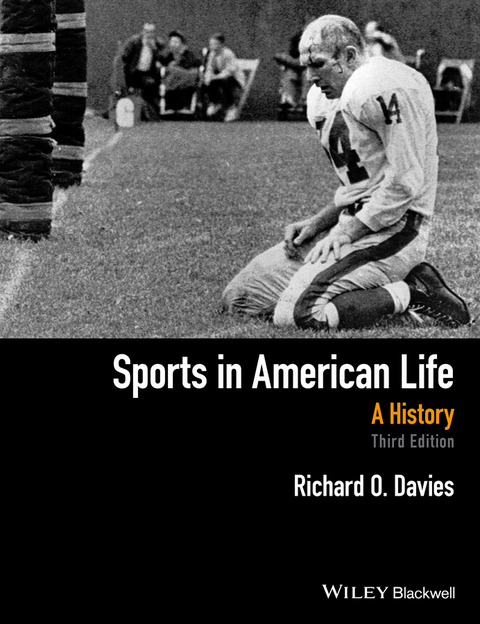
Sports in American Life (eBook)
John Wiley & Sons (Verlag)
978-1-118-91254-6 (ISBN)

The third edition of author Richard O. Davies' highly praised narrative of American sports, Sports in American Life: A History, features extensive revisions and updates to its presentation of an interpretative history of the relationship of sports to the larger themes of U.S. history. Updated include a new section on concussions caused by contact sports and new biographies of John Wooden and Joe Paterno.
- Features extensive revisions and updates, along with a leaner, faster-paced narrative than previous editions
- Addresses the social, economic, and cultural interaction between sports and gender, race, class, and other larger issues
- Provides expanded coverage of college sports, women in sports, race and racism in organized sports, and soccer's sharp rise in popularity
- Features an all-new section that tackles the growing controversy of head injuries and concussions caused by contact sports
Richard O. Davies is Distinguished Professor of History, Emeritus, at the University of Nevada, Reno. His books include Rivals! The Ten Greatest American Sports Rivalries of the 20th Century (Wiley, 2010), Sports in American Life: A History (Wiley, 2007, 2012), Betting the Line: Sports Wagering in American Life (2001), and Main Street Blues: The Decline of Small-Town America (1998). Davies was inducted into the Nevada Writers Hall of Fame in 2013 and continues to pursue an active retirement.
The third edition of author Richard O. Davies' highly praised narrative of American sports, Sports in American Life: A History, features extensive revisions and updates to its presentation of an interpretative history of the relationship of sports to the larger themes of U.S. history. Updated include a new section on concussions caused by contact sports and new biographies of John Wooden and Joe Paterno. Features extensive revisions and updates, along with a leaner, faster-paced narrative than previous editions Addresses the social, economic, and cultural interaction between sports and gender, race, class, and other larger issues Provides expanded coverage of college sports, women in sports, race and racism in organized sports, and soccer's sharp rise in popularity Features an all-new section that tackles the growing controversy of head injuries and concussions caused by contact sports
Richard O. Davies is Distinguished Professor of History, Emeritus, at the University of Nevada, Reno. His books include Rivals! The Ten Greatest American Sports Rivalries of the 20th Century (Wiley, 2010), Sports in American Life: A History (Wiley, 2007, 2012), Betting the Line: Sports Wagering in American Life (2001), and Main Street Blues: The Decline of Small-Town America (1998). Davies was inducted into the Nevada Writers Hall of Fame in 2013 and continues to pursue an active retirement.
Introduction
During the early years of the nineteenth century, the word sport carried a much different connotation than it does today. To be a sporting man in the mid-nineteenth century was to be someone who flouted the rules of social acceptability by gravitating toward activities deemed inappropriate for a proper gentleman. The term sport was, in fact, used to identify men who embraced the bachelor culture of the tavern, where amid a haze of cigar smoke and the odor of stale beer and cheap whiskey, they watched cockfights and dogfights, bet on an upcoming horse race or baseball match, and won or lost money on the toss of the dice or the turn of a card. Upon special occasions they might even watch pugilists bloody each other in a bare-knuckle prizefight.
There also emerged during the same time period a group of men referred to as sportsmen. These were men of good social standing who found outlets from their pressing business and professional lives as participants and spectators in such activities as sailing, swimming, horse racing, foot racing, rowing, and baseball. By century's end they likely had also gravitated toward popular new activities such as tennis, bicycle racing, football, golf, basketball, and volleyball. As these sports grew in popularity, sportsmen (now joined by a small but growing number of sportswomen) mimicked trends within the professional and business worlds by striving to achieve order and stability. They established amateur and professional leagues and associations, published statistics, developed and marketed specialized equipment, and enforced written rules governing athletic competition.
Although sports and games revealed a distinctly provincial quality in 1800, by the beginning of the twentieth century spontaneity and informality had been replaced by formalized structures, written rules, and bureaucratic organization. Befitting the growing specialization within the emerging national marketplace, a small number of skilled athletes were even able to work at play, earning their living as professional athletes. Several of the new sports provided women opportunities to participate, although under carefully constrained conditions. In this rapidly changing environment, the word sport lost much of its negative connotation. Now, to be a sporting man or woman was to be involved in a robust new American lifestyle. By the early twentieth century, organized sports had assumed a prominent place in American life, reflective of the exuberant capitalistic and democratic spirit of a rapidly maturing society.
This book traces the evolution of American sports, from its unorganized and quaint origins to the present time. The narrative is organized around the argument that sports, for good or for ill, have been a significant social force throughout the history of the United States. In recent years, historians have come to recognize that games have revealed many of the underlying values of society. Rather than being irrelevant diversions of little consequence, such activities provide important insights into fundamental values and beliefs. The games people played may have provided a convenient means of releasing tensions or a means of escaping the realities of the day, but they also provided rituals that linked generations and united communities.
The essential assumption of this book is that throughout American history the form and purpose of sporting events have been closely connected to the larger society from which they arose. As but one recent example: during the days immediately following the terrorist attack upon the World Trade Center in New York City and the Pentagon in Washington, DC, on September 11, 2001, Americans found reassurance in expressing their national unity and resolve through highly symbolic patriotic exercises conducted prior to the start of baseball and football games. National leaders urged the resumption of sports schedules as soon as it became apparent that no more attacks were imminent, viewing the playing of games as an emphatic statement of national resolve that the terrorists would not disturb the rhythms of everyday American life.
Sports in American Culture
Organized sports in the nineteenth century grew naturally with the new systems of transportation, manufacturing, and commercial organization. During the twentieth century they grew exponentially, propelled to prominence by the new communications mediums of radio, motion pictures, newspapers, and television. In contemporary America, sports have become an enormous multibillion-dollar enterprise. Professional football and baseball franchises are valued at between $500 million upwards to $3 billion, and nearly every major American city has in recent years spent hundreds of millions of dollars to build sports arenas and stadiums to accommodate professional teams. Most major professional teams operate on annual budgets that exceed $200 million, and major college athletic programs have annual budgets ranging between $30 million and $150 million. An oft-overlooked ancillary economic activity attests to the importance Americans place upon sporting events: conservative estimates are that gamblers bet at least $4 billion a year on sporting events, a figure larger than the gross national product of several less developed countries. At least 20 percent of the news reported in any daily urban newspaper is devoted to the activities of a small handful of that city's prominent residents who dribble basketballs, hit baseballs, or knock each other to the ground with intense ferocity. Radio and television networks provide 24-hour coverage of America's sports to a seemingly insatiable audience, and a complex infrastructure of social media web sites and blogs have in recent years added a new and increasingly influential layer to the communications mix.
My first effort to examine the role of sports in American life presented the argument that a broad swath of the American people were obsessed with sports; at the time I thought my interpretation would engender considerable criticism, but instead it resonated with general readers as well as those in academia.1 In many ways, America's obsession with sports and the men and women who play the games has intersected in unsuspected ways with larger issues of public policy. For example, in many cities students attend public schools in dilapidated buildings with leaking roofs and outmoded classrooms and laboratories, and are taught by underpaid teachers using tattered out-of-date textbooks. City streets go unrepaired, libraries close, and public hospitals struggle to deal with patient loads, but in these same cities, civic leaders eagerly cater to the demands of professional teams. The owners – multimillionaires all – enjoy a special kind of public welfare through their lucrative agreements with local governments. Crucial social services might go untended, but time and again, taxpayers vote in favor of a tax increase to build a new arena or stadium and public officials placate team owners by granting tax breaks, sweetheart deals on rental fees, and control of concessions and parking. For the fortunate few franchise owners, their costs have been socialized through active government subsidies, their profits privatized.
Between 1980 and 2010, nearly every major American city constructed lavish new sports venues for several professional teams, often to the serious neglect of other community needs. Just as the citizenry of medieval European communities revealed their essential values by constructing imposing cathedrals in the town square, so too have modern American cities given expression to their priorities and values by erecting enormous sports facilities.
Sports and American History
The pages that follow examine the role of sports within the broader context of the major themes of American history. This book is an extension of major trends of the last quarter century that have reshaped the way historians look at the past. The historical profession, which had long focused its attention on political, economic, and diplomatic themes, was fundamentally affected by the social upheavals of the 1960s. A new generation of students, who questioned many of the existing myths about the “Establishment,” demanded courses in African American, Hispanic, and Native American history, and fresh perspectives on the American experience written from the vantage point of the poor, women, and the working class.
It was within this period of intellectual ferment that scholars first began a serious examination of the role of sports in American history. The extensive body of literature upon which this book is based reveals that most of the writing on the history of American sports before the mid-1970s was done outside the academy, but in recent decades professional historians have produced important books and articles that explore the relationship of American sports with larger social issues. In 1972, the first professional society in the United States devoted to the field of sports history was established, and several pioneering scholars made laudable efforts to provide a meaningful synthesis.2 A few courses on the history of baseball had been taught previously, but in the ensuing decades more inclusive histories of American sports were introduced. Academic publishers began releasing a growing number of scholarly monographs on the subject of sports. History survey textbooks now included pictures of early baseball parks or college football games along with the more conventional images of soldiers, presidents, and smoke-belching factories and train locomotives. But resistance, or at least persistent apathy, has slowed the integration of sports into...
| Erscheint lt. Verlag | 23.5.2016 |
|---|---|
| Sprache | englisch |
| Themenwelt | Sachbuch/Ratgeber ► Sport |
| Geisteswissenschaften ► Geschichte ► Regional- / Ländergeschichte | |
| Weitere Fachgebiete ► Sportwissenschaft | |
| Schlagworte | amateur sports • American Social & Cultural History • American Social & Cultural History • college sports • concussion</p> • evolution of sports • Games • Geschichte • History • Joe Paterno • John Wooden • <p>American sports • organized sports • professional sports • Sozial- u. Kulturgeschichte Amerikas • sports culture • U.S. sports • U.S. sports history |
| ISBN-10 | 1-118-91254-3 / 1118912543 |
| ISBN-13 | 978-1-118-91254-6 / 9781118912546 |
| Informationen gemäß Produktsicherheitsverordnung (GPSR) | |
| Haben Sie eine Frage zum Produkt? |
 EPUB (Adobe DRM)
Kopierschutz: Adobe-DRM
Adobe-DRM ist ein Kopierschutz, der das eBook vor Mißbrauch schützen soll. Dabei wird das eBook bereits beim Download auf Ihre persönliche Adobe-ID autorisiert. Lesen können Sie das eBook dann nur auf den Geräten, welche ebenfalls auf Ihre Adobe-ID registriert sind.
Details zum Adobe-DRM
Dateiformat: EPUB (Electronic Publication)
EPUB ist ein offener Standard für eBooks und eignet sich besonders zur Darstellung von Belletristik und Sachbüchern. Der Fließtext wird dynamisch an die Display- und Schriftgröße angepasst. Auch für mobile Lesegeräte ist EPUB daher gut geeignet.
Systemvoraussetzungen:
PC/Mac: Mit einem PC oder Mac können Sie dieses eBook lesen. Sie benötigen eine
eReader: Dieses eBook kann mit (fast) allen eBook-Readern gelesen werden. Mit dem amazon-Kindle ist es aber nicht kompatibel.
Smartphone/Tablet: Egal ob Apple oder Android, dieses eBook können Sie lesen. Sie benötigen eine
Geräteliste und zusätzliche Hinweise
Buying eBooks from abroad
For tax law reasons we can sell eBooks just within Germany and Switzerland. Regrettably we cannot fulfill eBook-orders from other countries.
aus dem Bereich