Body Language For Dummies (eBook)
John Wiley & Sons (Verlag)
978-1-119-07644-5 (ISBN)
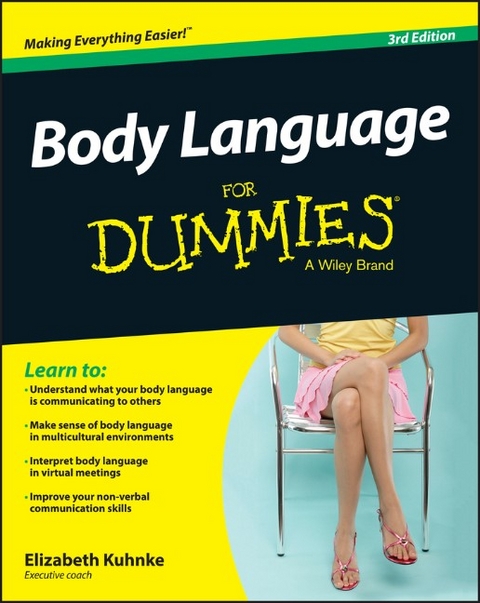
Body Language For Dummies is your ideal guide to understanding other people, and helping them understand you. Body language is a critical component of good communication, and often conveys a bigger message than the words you say. This book teaches you how to interpret what people really mean by observing their posture, gestures, eye movements, and more, and holds up a mirror to give you a clear idea of how you're being interpreted yourself. This updated third edition includes new coverage of virtual meetings, multicultural outsourcing environments, devices, and boardroom behaviours for women, as well as insight into Harvard professor Amy Cuddy's research into how body language affects testosterone and cortisol, as published in the Harvard Business Review..
Body language is a fascinating topic that reveals how the human mind works. Image and presentation are crucial to successful communication, both in business and in your personal life. This book is your guide to decoding body language, and adjusting your own habits to improve your interactions with others.
- Become a better communicator without saying a word
- Make a better first (and second, and third...) impression
- Learn what other people's signals really mean
- Transform your personal and professional relationships
Realising what kind of impression you give is a valuable thing, and learning how to make a more positive impact is an incredibly useful skill. Whether you want to improve your prospects in job seeking, dating, or climbing the corporate ladder, Body Language For Dummies helps you translate the unspoken and get your message across.
Elizabeth Kuhnke founded Kuhnke Communication - a team of expert and experienced subject specialists, known for providing consistently outstanding customer service. Their customers come from a wide range of industry and the professional services including, and not limited to: accountancy; law; manufacturing, and telecoms. The firm is also an avid supporter of the charity sector. Kuhnke Communication also has expertise in diversity issues and supports both the public and private sectors in this area. They specialize in interpersonal communication for both teams and individuals and is consistently acknowledged for providing top notch training, coaching and facilitating services in this field. Kuhnke Communication's team of associates are acknowledged experts in their fields. Their proficiency in areas such as cross-cultural communication, media skills, team-building and leadership is highly respected throughout the coaching industry. Elizabeth runs workshops, training courses and coaching programmes, and speaks regularly at business events and international conferences, so she will be very active in promoting the new edition at these events (as well as purchasing copies for them!). Her clients have included Vodafone, Gillette, KPMG, Lundbeck Pharmaceuticals and Rieter Automotive Systems.
The complete guide to mastering the art of effective body language Body Language For Dummies is your ideal guide to understanding other people, and helping them understand you. Body language is a critical component of good communication, and often conveys a bigger message than the words you say. This book teaches you how to interpret what people really mean by observing their posture, gestures, eye movements, and more, and holds up a mirror to give you a clear idea of how you're being interpreted yourself. This updated third edition includes new coverage of virtual meetings, multicultural outsourcing environments, devices, and boardroom behaviours for women, as well as insight into Harvard professor Amy Cuddy's research into how body language affects testosterone and cortisol, as published in the Harvard Business Review.. Body language is a fascinating topic that reveals how the human mind works. Image and presentation are crucial to successful communication, both in business and in your personal life. This book is your guide to decoding body language, and adjusting your own habits to improve your interactions with others. Become a better communicator without saying a word Make a better first (and second, and third...) impression Learn what other people's signals really mean Transform your personal and professional relationships Realising what kind of impression you give is a valuable thing, and learning how to make a more positive impact is an incredibly useful skill. Whether you want to improve your prospects in job seeking, dating, or climbing the corporate ladder, Body Language For Dummies helps you translate the unspoken and get your message across.
Elizabeth Kuhnke founded Kuhnke Communication, a team of experts that specializes in interpersonal communication for both groups and individuals. Elizabeth runs workshops, training courses and coaching programmes, and speaks regularly at business events and international conferences.
Introduction 1
Part I: Getting Started with Body Language 5
Chapter 1: Defining Body Language 7
Chapter 2: Looking Closer at Non-Verbal Gestures 35
Part II: Starting at the Top 45
Chapter 3: Heading to the Heart of the Matter 47
Chapter 4: Watching Facial Expressions 63
Chapter 5: The Eyes Have It 77
Chapter 6: Mastering Lip Reading 95
Part III: The Trunk: Limbs and Roots 109
Chapter 7: Taking It From the Torso 111
Chapter 8: Arming Yourself 127
Chapter 9: Letting Your Hands Do the Talking 143
Chapter 10: Standing Your Ground 169
Chapter 11: Playing with Props 181
Part IV: Putting the Body into Social and Business Context 191
Chapter 12: Being Aware of Territorial Rights and Regulations 193
Chapter 13: Rating, Dating and Mating: Courting with Your Body 211
Chapter 14: Interviewing, Influencing and Playing Politics 231
Chapter 15: Crossing the Cultural Divide 255
Chapter 16: Reading the Signs 271
Part V: The Part of Tens 279
Chapter 17: Ten Ways to Spot Deception 281
Chapter 18: Ten Ways to Reveal Your Attractiveness 289
Chapter 19: Ten Ways to Find Out About Someone Without Asking 295
Chapter 20: Ten Ways to Improve Your Silent Communication 303
Index 309
Chapter 1
Defining Body Language
In This Chapter
Finding out how body language speaks
Gesturing for a purpose
Understanding what you’re communicating
In the big scheme of things, the scientific study of body language is a fairly recent phenomenon, with documented research covering only the last 80 years or so. In order to better understand the thoughts and emotions behind human behaviour, psychologists, zoologists and social anthropologists have conducted detailed investigations into the use and components of body language – part of the larger family known as non-verbal behaviour.
When you take the time to focus on your own and others’ physical movements and expressions, you can spot and interpret unspoken thoughts, feelings and intentions that reveal more about a person than that individual may want you to know. You can even identify some people by a particular gesture or expression such as pursed lips, swaying hips, fiddling fingers or an arched brow.
By observing people’s body language you can detect their inner state. Are they despondent, in turmoil or feeling cool, calm and collected? Through a twitch of the mouth, flare of a nostril or change of posture, people unconsciously reveal their thoughts, intentions and feelings. In this chapter, you begin discovering how to interpret non-verbal language and you explore the gestures and actions that reveal attitudes, thoughts and intentions. You also have a quick dip into some of the research into this silent language and glance at the similarities and differences within non-verbal behaviour across the globe. In addition, you find out how you can use gestures to enhance your relationships and improve your communications.
Discovering How Body Language Conveys Messages
When cave-dwellers discovered how to decipher grunts and to create words to convey their messages, their lives became a lot more complex. Before verbal communication, they relied on their bodies to communicate. Their simple brains informed their faces, torsos and limbs. They instinctively knew that fear, surprise, love, hunger and annoyance were different attitudes requiring different movements and facial expressions. Emotions were less complex then, and so were gestures.
Speech is a relatively new introduction to the communication process and is used to persuade and influence others and to convey information, including facts and data. Body language, on the other hand, has been around forever. Without relying on the spoken word for confirmation, the body’s movements also persuade and influence others by conveying feelings, thoughts and intentions. Like it or not, your body speaks through signs and signals.
According to research conducted by Professor Albert Mehrabian at the University of California, Los Angeles, 55 per cent of the message in face-to-face communication is relayed through body language when the message contains emotional content. You only have to experience any of the following gestures or expressions to know how true is the adage, ‘Actions speak louder than words’:
- Someone raising her fist to you
- A warm embrace
- A finger wagging in your face
- A child’s pout
- A lover’s frown
- A parent’s look of worry
- An exuberant smile
- Your hand placed over your heart
Figure 1-1 shows two different gestures – one conveying a positive message and the other a negative one.
Figure 1-1: His gesture is aggressive while hers is protective.
Creating an impression within moments
You can tell within the first seven seconds of meeting someone how she feels about herself by the expression on her face and the way she moves her body. Whether she knows it or not, she’s transmitting messages through her gestures and actions.
You walk into a room of strangers and, from their stance, movements and expressions, you receive messages about their feelings, moods, thoughts and intentions. Look at the teenage girl standing in the corner. From her slouching shoulders, her lowered head and the way her hands fidget over her stomach, you can tell that this is not a happy camper.
Another young woman in this room of strangers is standing amongst a group of contemporaries. Her eyes twinkle, she throws back her head as she laughs, her hands and arms move with ease and openness and her weight is evenly distributed between her feet, which are placed beneath her, hip width apart. This woman is projecting an image of self-confidence and joie de vivre that draws people to her.
Like it or not, how you position your head, shoulders, torso, arms, hands, legs and feet, and how your eyes, mouth, fingers and toes move, tell an observer more about your state of being than any words you can say.
Early observations about body language
Before the twentieth century, only a few forays were made into identifying and analysing movement and gesture. The first known work exclusively addressing body language is John Bulwer’s Chirologia: or the Natural Language of the Hand, published in 1644. By the nineteenth century, directors and teachers of drama and pantomime were instructing their actors and students how to convey emotion and attitude through movement and gesture.
In The Expression of the Emotions in Man and Animals (1872), Charles Darwin explores the connection between humans, apes and monkeys. These species use similar facial expressions, inherited from a common ancestor, to express specific emotions. Out of Darwin’s work grew an interest in ethology – the study of animal behaviour.
In the late 1960s, Desmond Morris created a sensation when his interpretations of human behaviour, based on ethological research, were published in The Naked Ape and Manwatching. Further publications and media presentations continue to reveal how much our non-verbal behaviour is based on our animal nature.
Transmitting messages unconsciously
In addition to your ability to consciously choose precise gestures and actions to convey a particular message, your body sends out signals without your awareness. Dilated or contracted pupils and the unconscious movements of your hands and feet indicate an inner emotion that you may wish to conceal. For example, if you notice that the pupils of someone’s eyes are dilated, and you know that she’s not under the influence of drugs, you’d be correct in assuming that whatever she’s looking at is giving her pleasure. If the pupils are contracted, the opposite is true.
While body language speaks volumes, be careful when ascribing feelings and attitudes based solely on non-verbal behaviour. Individual signals can be easily overlooked or misidentified if they’re taken out of their social context. Look for clusters of gestures and expressions that involve several parts of the body. Also observe breathing patterns to gauge someone’s internal state. For more about how your breathing patterns influence the way you behave, have a look at Communication Skills For Dummies by Elizabeth Kuhnke (Wiley). At times, you may want to conceal your thoughts and feelings, so you behave in a way that you believe hides your true emotions. And then, wouldn’t you know it, out pops a giveaway gesture, barely perceptible to the untrained eye, sending a signal that all’s not what it appears. Don’t kid yourself that no one notices. Just because these micro-gestures and -expressions are fleeting doesn’t mean that they don’t send powerful messages.
In the 1970s, Paul Ekman and Wallace V. Friesen developed the Facial Action Coding System (FACS) to measure, describe and interpret facial behaviours. This instrument is designed to gauge even the slightest facial muscle contractions and determine what category or categories each facial action fits into. It detects what the naked eye can’t and is used by the police, film animators and researchers of human behaviour.
According to research conducted by Professor Mehrabian, when people are discussing feelings and emotions in a face-to-face setting and an incongruity exists between the words themselves and the way you deliver them, 7 per cent of the message received is conveyed through your words, 38 per cent is revealed through your vocal quality and a whopping 55 per cent of your message is expressed through your gestures, expression and posture. Mehrabian’s premise is that your non-verbal behaviours are directly tied to your feelings, whether you’re conscious of the connection or not. Although sceptics contest Mehrabian’s figures, the point remains that body language and vocal quality significantly contribute to the meaning of the message.
Gunther is the CFO of a global corporation and is a charming, successful and popular man. In addition, he is used to getting what he wants, when he wants it. You know the time has come to step lively when Gunther points his index finger in your direction, raises his chin, lifts his eyebrows and barks out a rapid-fire command, even if he has a smile on his face. For more about how smiling informs communication, flip to Chapter 6.
Substituting gestures for the spoken word
Sometimes a gesture is more effective in conveying a message than any words you can say. Signals expressing love and support, pleasure and pain, fear, loathing and disappointment are clear to decipher and require few, if any, words...
| Erscheint lt. Verlag | 13.5.2015 |
|---|---|
| Sprache | englisch |
| Themenwelt | Sachbuch/Ratgeber ► Gesundheit / Leben / Psychologie ► Esoterik / Spiritualität |
| Geisteswissenschaften ► Psychologie ► Allgemeine Psychologie | |
| Schlagworte | Amy Cuddy • Body language • body language across distance • body language and communication • body language for dating • Body Language For Dummies 3rd Edition • body language for women • body language guide • Body Language In Business • body language signals • changing your body language • Communication & Social Interaction • communication skills • cross-cultural body language • decoding body language • Elizabeth E. Kuhnke • improving body language • improving communication • interpreting body language • Kommunikation u. soziale Interaktion • Kuhnke Communication • professional body language • Psychologie • Psychology • Relationship Building • Understanding body language |
| ISBN-10 | 1-119-07644-7 / 1119076447 |
| ISBN-13 | 978-1-119-07644-5 / 9781119076445 |
| Informationen gemäß Produktsicherheitsverordnung (GPSR) | |
| Haben Sie eine Frage zum Produkt? |
 EPUB (Adobe DRM)
Kopierschutz: Adobe-DRM
Adobe-DRM ist ein Kopierschutz, der das eBook vor Mißbrauch schützen soll. Dabei wird das eBook bereits beim Download auf Ihre persönliche Adobe-ID autorisiert. Lesen können Sie das eBook dann nur auf den Geräten, welche ebenfalls auf Ihre Adobe-ID registriert sind.
Details zum Adobe-DRM
Dateiformat: EPUB (Electronic Publication)
EPUB ist ein offener Standard für eBooks und eignet sich besonders zur Darstellung von Belletristik und Sachbüchern. Der Fließtext wird dynamisch an die Display- und Schriftgröße angepasst. Auch für mobile Lesegeräte ist EPUB daher gut geeignet.
Systemvoraussetzungen:
PC/Mac: Mit einem PC oder Mac können Sie dieses eBook lesen. Sie benötigen eine
eReader: Dieses eBook kann mit (fast) allen eBook-Readern gelesen werden. Mit dem amazon-Kindle ist es aber nicht kompatibel.
Smartphone/Tablet: Egal ob Apple oder Android, dieses eBook können Sie lesen. Sie benötigen eine
Geräteliste und zusätzliche Hinweise
Buying eBooks from abroad
For tax law reasons we can sell eBooks just within Germany and Switzerland. Regrettably we cannot fulfill eBook-orders from other countries.
aus dem Bereich