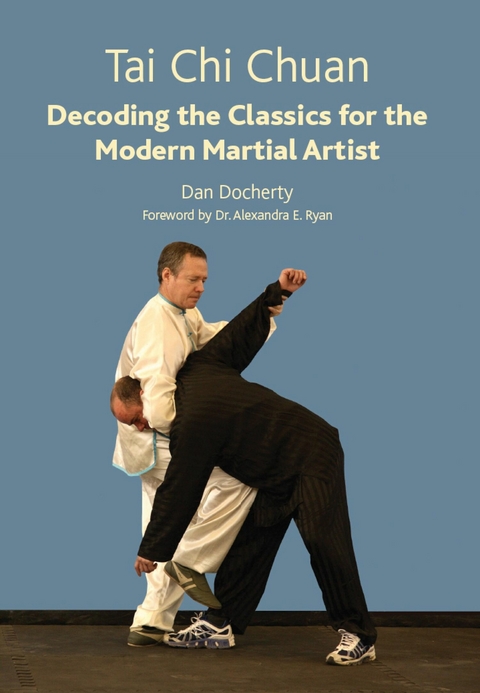
Complete Tai Chi Chuan (eBook)
192 Seiten
Crowood (Verlag)
9781847979179 (ISBN)
1This is Complete Tai Chi Chuan
Tai Chi Chuan (sometimes rendered Taijiquan) is a Chinese martial art and exercise method – and a great deal more besides; a fuller definition will be provided later. The object of this book is to present an overview of the art itself and of different approaches to it in both the Far East and the West.
There is now great interest in Tai Chi Chuan throughout the world, and there are many books available on the subject. However, most of these deal only with certain aspects of the art, or they deal with the art from the point of view of one particular style, or they are too basic for the advanced reader or too advanced for the beginner. Many books also suffer from being contradictory or unclear, particularly as regards the history, and how to put theory into practice.
There are now many different styles of Tai Chi Chuan, and even styles within styles, and we will examine the more important of these in turn to trace and discuss their evolution and development.
The majority of Tai Chi Chuan practitioners only practise a few aspects of the art, and in most cases are also only aware of a few, and this applies to Chinese and non-Chinese alike. Furthermore, despite claims to the contrary, no-one alive today is practising precisely the art that Yang Lu-chan brought with him to Beijing around 1852. Since that time, successive generations of teachers have added to, and just as often have subtracted from the art; moreover in many cases the additions have been as detrimental as the subtractions. Nevertheless we must accept that any art, if it is to thrive, must develop and change to fit the circumstances of the society in which it exists.
Our journey in search of Tai Chi Chuan will cover thousands of years of Chinese history and culture. In addition on our travels we will examine medicine, self defence, physiological alchemy, weaponry, philosophy, religion, competition methods, aesthetics, teaching methodology and ritual initiation. It is a journey that will take us all over China and the Far East; a quest for truth and order in a jungle of mystery, fraud and conflicting theories.
THE FIVE ASPECTS OF TAI CHI CHUAN
There are five aspects which together make up the traditional Tai Chi Chuan syllabus. Here they are set out briefly, but they will be discussed in more detail later. They should be seen as complementary and interdependent rather than as completely separate entities.
The Hand Form (Tao Chuan)
This is a series of set moves performed in a flowing manner (Fig 1). Most schools of Tai Chi Chuan practise a traditional long form of some kind which includes many combinations and repetitions of techniques. It can take half an hour or more to do the traditional long form, while it can take up to two years to finish learning the form. This has led many teachers, particularly those teaching in the West, to develop short forms which can be learned more easily as they contain fewer combinations and repetitions; some of these can take as little as three or four minutes to perform. The mainland Chinese government has introduced simplified forms, but most practitioners prefer to practise traditional Tai Chi Chuan in all its aspects, rather than a simplified version.
In most styles the form is practised slowly and in a relaxed manner to enhance the respiration and circulation and to relax body and mind. In addition such practice helps to improve coordination, posture and balance.
Fig 1 Sifu Chu Wai-man from Hong Kong demonstrating Parry and Punch.
Pushing Hands (Tui Shou)
This term is something of a misnomer, as some of the drills which come under this heading are not restricted to pushing or to the use of the hands. In fact the term refers to partnered drills which are designed to improve qualities useful in self defence such as sensitivity, balance, footwork, distance, angle, timing and co-ordination, as well as how to disrupt an opponent’s centre of gravity. The drills described can be formal or spontaneous. There are also various methods of competition pushing hands.
Certain schools use pushing hands practice as a way of therapy and interaction, but this is a modern and largely Western development.
Self Defence (San Shou)
The term San Shou literally means ‘scattering’ or ‘dispersing hands’. Many Tai Chi Chuan schools do not teach self defence, and in the schools that do teach it, the San Shou is seldom taught in a practical way, but consists of merely attempting to apply techniques against an opponent in exactly the same way that the techniques are executed in the form. Many Tai Chi techniques are not found in the form, and in any case it is the form which is based on self defence techniques rather than the other way round.
The footwork and body evasion methods trained in pushing hands are concomitant with the strategies elucidated in the Tai Chi Chuan classics in applying the self defence techniques. Certain conditioning methods are also advisable. Tai Chi Chuan is fundamentally a counterattacking style using low kicks, strikes, grappling and throwing techniques.
Weapons
The three Tai Chi Chuan traditional weapon forms are Dao (sabre/broadsword), Jian (straight sword) and Qiang (spear), and they are normally taught after the student has gained a certain level of proficiency in the hand form, pushing hands and self defence. The techniques of the weapon forms can be applied in self defence using the same strategies and tactics as in the case of the unarmed self defence techniques. We will discuss other weapons later.
Fig 2 Sifu Ian Cameron demonstrating Tai Chi sword.
Internal Strength (Nei Kung)
Internal strength is part of what is known as ‘inside the door training’: in other words, it is not something that is taught in open classes, but only after the student has undergone a formal initiation ceremony. It consists of twenty-four exercises: twelve Yin and twelve Yang, and these exercises have therapeutic, meditative and self defence aspects. They are seldom taught now and not many of those who do teach them are able to explain their function properly. In many respects this is the most effective form of training for both health and self defence, certainly far more so than the form, although it is a much more demanding type of training.
Fig. 3 Sifu Cheng Kam demonstrating Nei Kung.
In recent years a number of Tai Chi Qi Gong methods have come out of China which borrow partly from the form and partly from soft exercise methods such as Eight Pieces of Brocade (Baduanjin) to make up a simple exercise regimen that can be learned easily by older people and the sick. They are less sophisticated than traditional Tai Chi Chuan, but are useful where a student has difficulties in, or no time to learn Tai Chi Chuan. Certain Kung Gong methods are inherently dangerous or can be dangerous if practised incorrectly, as we shall see, so quality tuition is most advisable in this field.
Auxiliary Training
In addition to these five aspects it is necessary to learn the philosophical and theoretical side of the art to make sense of certain of the training methods, and to derive maximum benefit from your practice. Furthermore, there are other drills and training methods which don’t quite fit into any of the categories given above, in particular certain conditioning methods.
TAI CHI CHUAN FOR ALL?
While Tai Chi Chuan can be practised by people of all ages, they cannot and should not be expected to practise it in the same way, as the type and method of the training should vary according to the physical and mental capabilities of the student. As with any martial art, generally the younger you are when you start, the better. My own daughter has been training in Tai Chi Chuan since before she went to school; firstly some simple Nei Kung exercises, then spear and then sabre. Only after all this did I start to teach her the form.
Sick and retired people, however, are normally more interested in learning the form to improve their health; and most students fall somewhere between the extremes of childhood and old age. I generally teach students the pushing hands and the martial aspects together with the form right from the first class, as I believe that practice of each aspect improves the student’s ability to perform the others.
Learning Tai Chi Chuan
The first requirement for learning Tai Chi Chuan is to establish your reasons for doing so: thus, if you wish to learn it in all its aspects, then your choice of teacher will be limited as there are few of such calibre in either the Far East or the West. If you wish to learn only for health purposes, then as long as the teacher can do the form competently, this is usually enough for him/her to impart some basic skill.
The other requirements are that you must watch, ask, listen, read, and above all, practise: watch your teacher and fellow students, watch other teachers and students. Using the criteria mentioned in the chapter on form, you can analyse the good and bad points of technique. There is a lot of truth in the old saying that ‘if you don’t practise for one day, you know it; if you don’t practise for two days, your teacher knows it; and if you don’t practise for three days, everybody knows it.’
It is important to ask questions: most students ask the wrong...
| Erscheint lt. Verlag | 30.9.2014 |
|---|---|
| Verlagsort | London |
| Sprache | englisch |
| Themenwelt | Sachbuch/Ratgeber ► Sport ► Kampfsport / Selbstverteidigung |
| ISBN-13 | 9781847979179 / 9781847979179 |
| Informationen gemäß Produktsicherheitsverordnung (GPSR) | |
| Haben Sie eine Frage zum Produkt? |
 EPUB (Wasserzeichen)
DRM: Digitales Wasserzeichen
Dieses eBook enthält ein digitales Wasserzeichen und ist damit für Sie personalisiert. Bei einer missbräuchlichen Weitergabe des eBooks an Dritte ist eine Rückverfolgung an die Quelle möglich.
Dateiformat: EPUB (Electronic Publication)
EPUB ist ein offener Standard für eBooks und eignet sich besonders zur Darstellung von Belletristik und Sachbüchern. Der Fließtext wird dynamisch an die Display- und Schriftgröße angepasst. Auch für mobile Lesegeräte ist EPUB daher gut geeignet.
Systemvoraussetzungen:
PC/Mac: Mit einem PC oder Mac können Sie dieses eBook lesen. Sie benötigen dafür die kostenlose Software Adobe Digital Editions.
eReader: Dieses eBook kann mit (fast) allen eBook-Readern gelesen werden. Mit dem amazon-Kindle ist es aber nicht kompatibel.
Smartphone/Tablet: Egal ob Apple oder Android, dieses eBook können Sie lesen. Sie benötigen dafür eine kostenlose App.
Geräteliste und zusätzliche Hinweise
Buying eBooks from abroad
For tax law reasons we can sell eBooks just within Germany and Switzerland. Regrettably we cannot fulfill eBook-orders from other countries.
aus dem Bereich