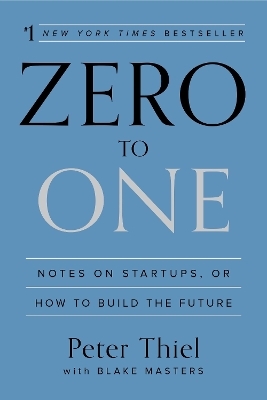
Zero to One
Currency (Verlag)
978-0-553-41828-6 (ISBN)
#1 NEW YORK TIMES BESTSELLER
If you want to build a better future, you must believe in secrets.
The great secret of our time is that there are still uncharted frontiers to explore and new inventions to create. In Zero to One, legendary entrepreneur and investor Peter Thiel shows how we can find singular ways to create those new things.
Thiel begins with the contrarian premise that we live in an age of technological stagnation, even if we're too distracted by shiny mobile devices to notice. Information technology has improved rapidly, but there is no reason why progress should be limited to computers or Silicon Valley. Progress can be achieved in any industry or area of business. It comes from the most important skill that every leader must master: learning to think for yourself.
Doing what someone else already knows how to do takes the world from 1 to n, adding more of something familiar. But when you do something new, you go from 0 to 1. The next Bill Gates will not build an operating system. The next Larry Page or Sergey Brin won't make a search engine. Tomorrow's champions will not win by competing ruthlessly in today's marketplace. They will escape competition altogether, because their businesses will be unique.
Zero to One presents at once an optimistic view of the future of progress in America and a new way of thinking about innovation: it starts by learning to ask the questions that lead you to find value in unexpected places.
Peter Thiel is an entrepreneur and investor. He started PayPal in 1998, led it as CEO, and took it public in 2002, defining a new era of fast and secure online commerce. In 2004 he made the first outside investment in Facebook, where he serves as a director. The same year he launched Palantir Technologies, a software company that harnesses computers to empower human analysts in fields like national security and global finance. He has provided early funding for LinkedIn, Yelp, and dozens of successful technology startups, many run by former colleagues who have been dubbed the "PayPal Mafia." He is a partner at Founders Fund, a Silicon Valley venture capital firm that has funded companies like SpaceX and Airbnb. He started the Thiel Fellowship, which ignited a national debate by encouraging young people to put learning before schooling, and he leads the Thiel Foundation, which works to advance technological progress and long- term thinking about the future. Blake Masters was a student at Stanford Law School in 2012 when his detailed notes on Peter's class "Computer Science 183: Startup" became an internet sensation. He is President of The Thiel Foundation and Chief Operating Officer of Thiel Capital.
Preface Every moment in business happens only once. The next Bill Gates will not build an operating system. The next Larry Page or Sergey Brin won't make a search engine. And the next Mark Zuckerberg won't create a social net-work. If you are copying these guys, you aren't learning from them. Of course, it's easier to copy a model than to make something new. Doing what we already know how to do takes the world from 1 to n, adding more of something familiar. But every time we create something new, we go from 0 to 1. The act of creation is singular, as is the moment of creation, and the result is something fresh and strange. Unless they invest in the difficult task of creating new things, American companies will fail in the future no matter how big their profits remain today. What happens when we've gained everything to be had from fine- tuning the old lines of business that we've inherited? Unlikely as it sounds, the answer threatens to be far worse than the crisis of 2008. Today's "best practices" lead to dead ends; the best paths are new and untried. In a world of gigantic administrative bureaucracies both public and private, searching for a new path might seem like hoping for a miracle. Actually, if American business is going to succeed, we are going to need hundreds, or even thousands, of miracles. This would be depressing but for one crucial fact: humans are distinguished from other species by our ability to work miracles. We call these miracles technology. Technology is miraculous because it allows us to do more with less, ratcheting up our fundamental capabilities to a higher level. Other animals are instinctively driven to build things like dams or honeycombs, but we are the only ones that can invent new things and better ways of making them. Humans don't decide what to build by making choices from some cosmic catalog of options given in advance; instead, by creating new technologies, we rewrite the plan of the world. These are the kind of elementary truths we teach to second graders, but they are easy to forget in a world where so much of what we do is repeat what has been done before. Zero to One is about how to build companies that create new things. It draws on everything I've learned directly as a co-founder of PayPal and Palantir and then an investor in hundreds of startups, including Facebook and SpaceX. But while I have noticed many patterns, and I relate them here, this book offers no formula for success. The paradox of teaching entrepreneurship is that such a formula necessarily cannot exist; because every innovation is new and unique, no authority can prescribe in concrete terms how to be innovative. Indeed, the single most powerful pattern I have noticed is that successful people find value in unexpected places, and they do this by thinking about business from first principles instead of formulas. This book stems from a course about startups that I taught at Stanford in 2012. College students can become extremely skilled at a few specialties, but many never learn what to do with those skills in the wider world. My primary goal in teaching the class was to help my students see beyond the tracks laid down by academic specialties to the broader future that is theirs to create. One of those students, Blake Masters, took detailed class notes, which circulated far beyond the campus, and in Zero to One I have worked with him to revise the notes for a wider audience. There's no reason why the future should happen only at Stanford, or in college, or in Silicon Valley. Chapter 1 The Challenge of the Future Whenever I interview someone for a job, I like to ask this question: "What important truth do very few people agree with you on?" This question sounds easy because it's straightforward. Actually, it's very hard to answer. It's intellectually difficult because the knowledge that everyone is taught in school is by definition ag
| Erscheint lt. Verlag | 16.9.2014 |
|---|---|
| Zusatzinfo | 15-20 CHAP OPENER ART |
| Sprache | englisch |
| Maße | 140 x 208 mm |
| Gewicht | 261 g |
| Themenwelt | Sachbuch/Ratgeber ► Beruf / Finanzen / Recht / Wirtschaft |
| Wirtschaft ► Allgemeines / Lexika | |
| Wirtschaft ► Betriebswirtschaft / Management ► Unternehmensführung / Management | |
| Schlagworte | Advice • Artificial Intelligence • business • CEO • competing against luck • Competition • Computer • Contrarian • Director • Educational • entrepreneur books • Entrepreneurs • Entrepreneurship • Facebook • Futurism • Gesellschaftlicher Wandel • Globalisierung • Globalization • high output management • Human nature • Innovation • Innovationsmanagement • Innovation (Wirtschaft) • Investing • Investment • Investor • IT • Management • PayPal • principles life and work • Progress • seeing green • Silicon Valley • Software • Start up • Startup • Startups • Strategy • Superintelligence • Tech • technological • Technology • Unternehmensstrategie • VC • Venture Capital • Vision • Zero to One |
| ISBN-10 | 0-553-41828-9 / 0553418289 |
| ISBN-13 | 978-0-553-41828-6 / 9780553418286 |
| Zustand | Neuware |
| Informationen gemäß Produktsicherheitsverordnung (GPSR) | |
| Haben Sie eine Frage zum Produkt? |
aus dem Bereich