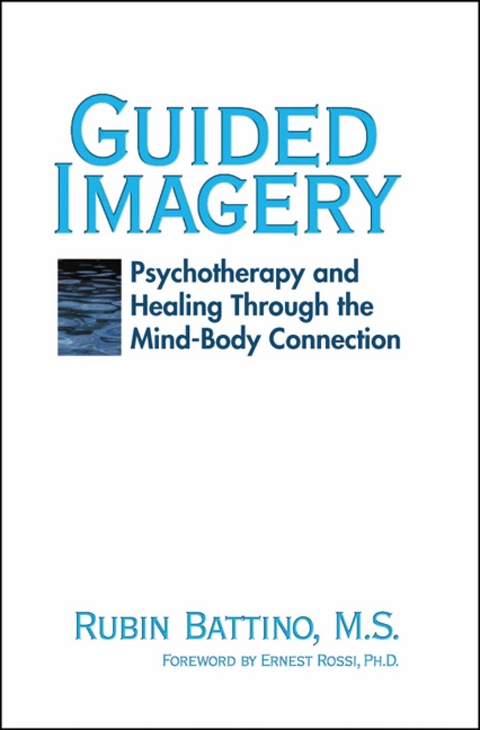
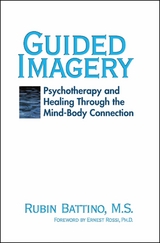
Guided Imagery (eBook)
394 Seiten
Crown House Publishing (Verlag)
978-1-84590-611-5 (ISBN)
Rubin Battino MS has a private practice in Yellow Springs, Ohio. He is an Adjunct Professor for the Department of Human Services at Wright State University, and has over twenty five years of experience as a facilitator of a support group for people who have life-challenging diseases and for caregivers. He is a Fellow of the National Council for Hypnotherapy (UK), and also a Fellow of two chemistry societies. Other publications by Rubin include: Healing Language. A Guide for Physicians, Dentists, Nurses, Psychologists, Social Workers, and Counselors; Howie and Ruby. Conversations 2000 - 2007; That's Right, Is it Not? A Play About the Life of Milton H. Erickson, MD. and Guided Imagery and Hypnosis in Brief Therapy and Palliative Care.
This unique, practical and accessible healing manual explores the most powerful methods of healing, primarily focusing on guided imagery, a healing technique integrating the connection between mind and body. "e;Well-researched and authoritative."e; Belleruth Naparstek, LISW, The Guided Imagery Resource Center
1.1 Introduction
The purpose of this book is to share with helping professionals the approaches that I have found to be useful in working with people who have life-challenging diseases. Part One is designed to systematically teach how to do guided imagery work. Part Two details the psychotherapy-based approaches which I consider to be necessary for comprehensive work in healing. Part Three is concerned with related approaches.
A broad definition of guided imagery for healing might be: any internal work that you do that involves thoughts (uses the “mind”) and has a positive effect on health. This can range from “thinking positive” to elaborately structured processes involving relaxation, meditation, and body postures. It can include biofeedback and various enhancements of mood via music, electrical or vibrating stimulation, massage, acupuncture, magnetic (or other) fields, or ingested supplements of drugs and herbs. The common denominator is thoughts, and their effects on body function. There is currently a great deal of evidence for this assertion. Scientific evidence is presented in the first part of the book. There is then a systematic presentation about the theory and practice of guided imagery, with an emphasis on the “how to.” The latter will involve excursions into rapport building and hypnotic language forms. The overall intent of the book is to provide practical methods in such a way that workers in the field can use them with their own clients. Exercises will be introduced where appropriate. One example of this approach is the detailed linguistic analysis of transcripts of guided imagery. Examples of recommended language usage and the design of guided imagery are also provided. Finally, the audiotapes accompanying this book contain examples of generic and specific guided imagery sessions.
Welcome!
1.2 A Personal Note
I have spent most of my professional life as a professor of chemistry, dividing my interest between chemical education and “hard” research in the area of the thermodynamics of solutions, which I continue in retirement. This has been a rewarding career, and includes two co-authored books on thermodynamics and many technical publications.
A number of years ago I was in treatment with a Gestalt Therapist. After I completed my significant personal work with him, I approached him about doing some more group work. Instead, he invited me to join a training group in Gestalt Therapy. I did so, and was the only lay person in training. This involvement led me to obtain a master’s degree in mental health counseling in 1978. I have had a small private practice specializing in very brief therapy since that time. (I am licensed in Ohio and a national board certified counselor.) In addition to Gestalt Therapy, I have had training in bioenergetic analysis, Neuro-Linguistic Programming (NLP), Ericksonian hypnosis and hypnotherapy, and solution-oriented approaches among other modalities. T.L. South and I recently (1999) have had published Ericksonian Approaches: A Comprehensive Manual. For over fifteen years I have taught specialty workshops for the Department of Human Services (counseling) at Wright State University as an Adjunct Professor. This book is based on one of those courses.
How, then, did I become interested in healing and working with people who have life-challenging diseases? About seven years ago I read Bernie Siegel’s first book (1986)—Love, Medicine &Miracles—and afterward asked myself the question, “With your skills and training, why aren’t you working with the kinds of people Bernie describes?” A phone call to ECaP (Exceptional Cancer Patients, 522 Jackson Park Drive, Meadville, PA16355: (814) 337-8192) put me in touch with the Charlie Brown Exceptional Patient Support Group of Dayton. They kindly let me sit in on their semi-monthly sessions. With what I learned from them, I started a support group in the village of Yellow Springs. This group ran for two years while I continued to attend meetings of the Dayton group. Eventually, I became one of the facilitators of the Dayton group. (The way the Dayton group functions is described later for those interested in establishing similar groups.)
It has been my practice to “adopt” two or three members of the support group for more intensive follow-up and individualized work. (All of this is done as a volunteer.) The individual work involves teaching guided imagery, information, and the clearing up of unfinished business. My personal philosophy can be summarized in two statements, “I always have hope” and “I believe in miracles.” Certainly, some miracles have occurred. In some ways, this book is about facilitating miracles.
Is this work wearing and depressing? Most emphatically NO! There is always laughter and joy in our support group. Of course, there is also some sadness and crying and depression. But, the overall mood of these exceptional people is one of hope and unconditional love. I invariably leave a meeting feeling renewed and inspired by their incredible courage. It sounds paradoxical, but everyone I know who has a life-challenging disease has said at some time that their disease was a blessing. For most of them, life was pretty routine, even dull, up to that point. Now, every day, every hour, every minute is important—they are really living in the here-and-now, experiencing life, moment by moment, with an unprecedented intensity. Someone pointed out that the “present” is called that because it is indeed a gift. To be alive now, rather than dwell in the past or the future, is what my friends have taught me.
Through the very nature of this work many of my friends have died. Yet, I would not trade getting to know them and being part of their lives for anything—they have all become part of me.
1.3 Disease/Cure and Illness/Healing
Despite the ancient adage of “sticks and stones can break your bones, but words can never hurt you” words can have powerful positive and negative effects on the human mind and body. Since this book is primarily about the careful use of words to help people (see Chapter 7), it is important to define certain words carefully. We will start this process with a few significant words.
It is popular in some quarters to write the word “disease” as dis-ease, implying that it describes a state which is the opposite of being at ease, in comfort, or relaxed. In this book we define a disease as something that is physically wrong with the body. That is, a disease is the pathology itself. Examples are: cancer, infections, hormonal imbalances, diverticulitis, ulcers, strokes, myocardial infarctions and insufficiencies, and broken bones. The reversing or fixing of a disease (in Western societies) typically involves a “mechanical” intervention of some sort: surgery, chemotherapy, radiation, antibiotics, supplements, dieting changes, physical rehabilitation, and drugs. When the disease is fixed or has gone away, the person is said to be “cured.” So, a cure is the reversal of a disease, the disappearance of its physical manifestations, and a return to normal healthy functioning. We are fortunate that there are a great many diseases that can be cured in a straightforward manner.
The title of this book uses the word “healing.” How is healing different from curing? To clarify this, we first need to make a distinction between an illness and a disease. We define illness to be the meaning that you personally attribute to the disease. These meanings are unique to you and are determined by your history, culture, religion, ethnicity, belief system, intellectual predilection, upbringing, heritage, philosophy of life. Siblings are more likely to interpret a given disease in the same way than people from different cultures. Yet, due to different life experiences, sisters may react in very different ways to a preliminary diagnosis of breast cancer. Healing applies to the meaning of the disease, i.e., the illness. The root of healing signifies “to make whole.” Healing is more related to internal feeling states than physical states.
For example, when I was growing up in the Bronx in a Greek-Jewish subculture, the word “cancer” was rarely mentioned, or spoken in only a whisper. There was a belief that saying the word out loud (or even thinking it!) would catch the attention of the “Evil One” and you would then be more susceptible to getting cancer. Evil Ones or devils were part of the belief system of my relatives. This reaction to a word colored all of our thinking and responses. A person who had CANCER was doomed to a horrible death, but it also bore connotations of shame and pity. The illness was worse than the disease; it led to a helplessness and hopelessness on the part of the afflicted person, as well as care-givers and well-wishers. Thankfully, many of our attitudes towards cancer-the-disease have changed. Bernie Siegel sums it up best by saying, “Cancer is not a sentence, it is just a word.”
Healing deals with attitudes and meaning. When a person is healed, they become whole again, and can be at peace with themself, the disease, and the world at large. Healing is involved with the spirit, the soul, and one’s essence. For some, a healing experience may be described as a religious experience, perhaps even a religious transformation. To become whole, to be in...
| Erscheint lt. Verlag | 10.6.2007 |
|---|---|
| Verlagsort | London |
| Sprache | englisch |
| Themenwelt | Sachbuch/Ratgeber ► Gesundheit / Leben / Psychologie ► Esoterik / Spiritualität |
| Sachbuch/Ratgeber ► Gesundheit / Leben / Psychologie ► Psychologie | |
| Geisteswissenschaften ► Psychologie ► Allgemeine Psychologie | |
| Medizin / Pharmazie ► Gesundheitsfachberufe | |
| Medizin / Pharmazie ► Medizinische Fachgebiete ► Psychiatrie / Psychotherapie | |
| ISBN-10 | 1-84590-611-X / 184590611X |
| ISBN-13 | 978-1-84590-611-5 / 9781845906115 |
| Informationen gemäß Produktsicherheitsverordnung (GPSR) | |
| Haben Sie eine Frage zum Produkt? |
 EPUB (Wasserzeichen)
DRM: Digitales Wasserzeichen
Dieses eBook enthält ein digitales Wasserzeichen und ist damit für Sie personalisiert. Bei einer missbräuchlichen Weitergabe des eBooks an Dritte ist eine Rückverfolgung an die Quelle möglich.
Dateiformat: EPUB (Electronic Publication)
EPUB ist ein offener Standard für eBooks und eignet sich besonders zur Darstellung von Belletristik und Sachbüchern. Der Fließtext wird dynamisch an die Display- und Schriftgröße angepasst. Auch für mobile Lesegeräte ist EPUB daher gut geeignet.
Systemvoraussetzungen:
PC/Mac: Mit einem PC oder Mac können Sie dieses eBook lesen. Sie benötigen dafür die kostenlose Software Adobe Digital Editions.
eReader: Dieses eBook kann mit (fast) allen eBook-Readern gelesen werden. Mit dem amazon-Kindle ist es aber nicht kompatibel.
Smartphone/Tablet: Egal ob Apple oder Android, dieses eBook können Sie lesen. Sie benötigen dafür eine kostenlose App.
Geräteliste und zusätzliche Hinweise
Buying eBooks from abroad
For tax law reasons we can sell eBooks just within Germany and Switzerland. Regrettably we cannot fulfill eBook-orders from other countries.
aus dem Bereich