Aiki-Jujutsu (eBook)
192 Seiten
Crowood (Verlag)
9781847975706 (ISBN)
Cary Nemeroff is founder of Fukasa-Ryu Bujutsu Kai, a member organization of the International Okinawan Martial Arts Union. A teacher of Japanese and Okinawan martial arts, he holds a 10th Degree Black Belt in Aiki-Jujutsu (Jujutsu) as well as many other Master-level gradings, with thirty-five years of training to his credit. In addition to his martial arts training, Cary Nemeroff, MA (Teachers College, Columbia University, NY) is fluent in sign language and specializes in the development of unique programmes for teaching the martial arts to children and adults with physical and cognitive challenges.
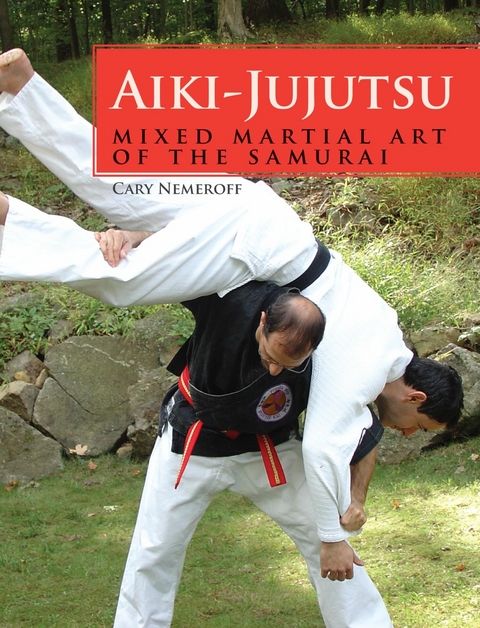
Aiki-Jujutsu: Mixed Martial Art of the Samurai is essential reading for practitioners and instructors of mixed martial arts, the traditional Asian martial arts and those who seek to learn more about the techniques, philosophy and history of the fighting arts of the Samurai. Using easy to follow, step-by-step photography and text, 10th Dan Cary Nemeroff demonstrates how to perform the throws, hand strikes, grappling/groundwork manoeuvres, blocks, break-falls, kicks and sword-disarming techniques of the complete Aiki-Jujutsu system, including Kempo-Jutsu, Aiki-Jutsu and Ju-Jutsu. It also provides a concise history of the concepts and systems surrounding Aiki-Jujutsu's development, such as Budo and Bujutsu, enabling the practitioner to gain a more comprehensive understanding of the art.
Having described the essence of Aiki-Jujutsu and the different classes of technique that comprise the breadth of the martial system, the next topic of discussion will be dedicated to how Budo (martial ways) expanded one step further, forming a subclass or new generation of techniques and martial philosophy.
During the Meiji period, Bujutsu was stripped of its important role in the security of the Japanese nation, and Japan’s values and priorities changed dramatically. The need for Bujutsu, the combat-effective martial arts technique developed to combat the sword-wielding Samurai, became obsolete and was replaced by more modern instruments of war.
The realization and acceptance of Japan’s ‘new vision’ catalysed change in the manner in which the martial arts were practised and how they were applied to people’s lives. As a consequence, Budo, evolving from its predecessor, Bujutsu, was born. Martial arts techniques were modified for aesthetic reasons and people began to contemplate the techniques, painstakingly studying each movement in order to learn why they worked and how the techniques might be improved upon. The efficacy of the techniques took on a less significant role, while much time was spent in contemplation of how they worked on energetic, physical and spiritual levels. The objective of martial arts training became oriented more toward the attainment of spiritual enlightenment and physical prowess than battle-readiness. The aspiration to ‘perfect’ techniques, by demonstrating them in a flawless and most economical fashion, became a goal as well.
While there are unique characteristics that differentiate Budo from Bujutsu, it is important to remember that a thorough study of Bujutsu contains all the characteristics of its (contemporary) Budo. The difference is a matter of perception and in the application of its techniques. In my study of Budo, I have observed that Budo tends to focus on a particular aspect of a Bujutsu predecessor, which I intend to elaborate upon as I describe the Budo that evolved from Aiki-Jutsu and Ju-Jutsu.
Aikido
Aikido (the way of harmonizing energy) naturally evolved from the techniques of Aiki-Jutsu, an aspect of the martial art of Aiki-Jujutsu. Its movements and throwing techniques were used to counter powerful, impending forces through the use of strong momentum, with the goal of redirecting an opponent. In the post-Meiji era, when martial arts practitioners were rarely in danger of being confronted by a swordsman, there was no need to practise defending against a sword-wielding attacker. There was, however, and still continues to be, a belief that the movements and varieties of defence techniques developed during real bouts had great value for the Budo-Ka (practitioner of Budo). Aikido, similar to other Budo, was developed with priorities differing from Bujutsu; however, certain aspects of Bujutsu were painstakingly preserved.
Most Aikido styles that are practised today emphasize the wrist-locking, arm-locking and throwing techniques that characterize the martial art of Aiki-Jutsu. In the case of an attempted strike to the head, however, Samurai sword-attack technique might be represented by the use of the edge of the hand (Shuto Uchi or knife-hand strike), simulating the motions of the sword. In other instances, a Bokken (a wooden Samurai sword replica) or Jo (short staff) is used in a similar fashion. One of the primary objectives of Aikido training is to be able to learn how to react instantaneously to an attack and redirect or continue an opponent’s energy into a throw or locking technique without striking the opponent. Conditioning the body to react naturally in response to overwhelming force, by using the principles of avoidance, yielding and the redirection of an attacker’s momentum, are some of the fundamental precepts of the art form. The ability to relax and respond to multiple attacks with grace and fluidity is learned through ‘Kata’ (contrived practice) and then applied to Aiki-Randori (free-sparring), an uncontrived exercise that builds this skill. It is essential to remember that an opponent must be attacking with powerful momentum in order for the practitioner to perform an uninterrupted throw without striking his opponent.
Aikido throw (1).
Aikido throw (2).
Another aspect of Aikido practice focuses on Kansetsu Waza, the joint-locking techniques of Aiki-Jutsu. In this phase of training, most techniques are performed from a stationary position and attacks usually consist of grabs (as opposed to strikes) to different areas of the body. Different styles of Aikido employ strikes, to varying degrees, as a retaliatory technique.
Aikido can naturally evolve from any style of Aiki-Jutsu and/or Aiki-Jujutsu and is practised outside the famous Ueshiba family tree. Similar to Judo, the subject of my next discussion, other styles are practised outside of the auspices of the Kodokan, the most famous style of Judo, developed by Jigoro Kano.
Judo: Gentle Way
Judo (gentle or soft way) evolved from the Aiki-Jujutsu techniques classified as Ju-Jutsu in the same way that Aikido proliferated from the Aiki-Jutsu component of Aiki-Jujutsu. The throwing techniques employed in Judo to uproot a more grounded opponent were practised and intellectualized in terms of how the practitioner might execute his technique in a most economical fashion, by generating enough Kuzushi (off-balancing) and leverage to throw an opponent.
Judo throw.
Similar to Aikido, the earliest forms of Judo appeared almost identical to its predecessor martial art Ju-Jutsu with regard to strategy and technique but without the need for defensive techniques against the Samurai arsenal of weaponry. The objective of Judo focused on attaining physical, intellectual and spiritual enlightenment via training, which, similar to Aikido, gradually modified the way Ju-Jutsu techniques were practised. Dissimilar to Aikido, Judo’s version of the Randori exercise evolved into a competitive sport between Judo-Ka (Judo players). Judo Randori commences with two Judo-Ka, each grabbing the other’s uniform. This is accomplished through the use of one hand to grab the opponent’s lapel and the other hand to grab the opponent’s opposite sleeve. Each competitor tries to lure his opponent toward a particular direction in order to catch him off-balance. He then attempts to guide him into a throw, finishing with a submission hold on the Tatame (mats).
Outside the context of competition, the practice of Judo Randori can be an important tool for the student of Judo and Ju-Jutsu. The exercise enhances the body’s sensitivity to another person’s movements, teaching the practitioner to ‘feel’ where his opponent is moving without having to redirect his eyes toward that direction. This represents an important skill that is applicable while moving in for a throw to an opponent. In addition, Randori provides a vehicle through which to practise the application of Kuzushi and to leverage an opponent who is unwilling to fall unless he is compelled to do so involuntarily.
Some of the older styles of Judo still use striking techniques in their art, but this practical element has essentially been abandoned. Today Judo is practised mostly as a sport, with very little use of some of the more pragmatic characteristics of Ju-Jutsu.
More About Budo
Budo can be regarded as a way in which the contemporary Japanese of the time demonstrated their reverence and appreciation for the skill and techniques that were conceived of and developed by the Samurai, based upon their experiences in combat. It is a methodology that continues to take on new shapes, indirectly making use of the lessons of Bujutsu. Budo is multi-faceted; it is a way in which to enlighten the mind, exercise the body and soothe the soul. Budo may have begun as Bujutsu and first practised on the bare ground. From there, it may have moved on to the Tatame in a small Dojo (martial arts school), made its way to fame in the great Kodokan (Judo School in Japan) and then on to international Olympic status thereafter. It is important to keep in mind, however, that the majority of the original founders of Budo were aspiring to find enlightenment through the practice and lifestyle of the martial arts. Contemplation of the way in which techniques worked most efficiently, and then practising them to exhaustive lengths, became a meditative exercise, sometimes leading to an epiphany or a ‘higher knowledge’ of the martial arts. I have chosen, therefore, to characterize the martial arts as ‘meditation in movement’, with the practitioner exercising the body while simultaneously contemplating the movements.
Whether the martial artist is practising Randori with a partner or training solo, he is connecting with the energy that surrounds him, with the Spirit with which we all connect and feel at home… he is connecting with The Infinite.
It is my opinion that every element of Budo that I have described is as much a part of Bujutsu as it is Budo. While these elements are the hallmarks of Budo, they are only a few of the ‘building blocks’ that comprise the thickly woven fabric of Bujutsu.
While I haven’t lived the life of a Samurai, I believe that each Samurai had a different load of duties, providing for more or less time for contemplation, meditation and the consequent development of the hallmarks of Budo.
It is my contention that Bujutsu is the most complete manifestation of the Japanese martial arts and the Ryu the most profound conglomeration of these martial arts into a...
| Erscheint lt. Verlag | 30.6.2013 |
|---|---|
| Zusatzinfo | 830 colour photographs |
| Verlagsort | London |
| Sprache | englisch |
| Themenwelt | Sachbuch/Ratgeber ► Sport ► Kampfsport / Selbstverteidigung |
| Schlagworte | Aikido • Budo • cross arm lock • Dachi waza • Judo • kempo-jutsu • Samurai • scarf hold • shoulder hold • ude gatame |
| ISBN-13 | 9781847975706 / 9781847975706 |
| Informationen gemäß Produktsicherheitsverordnung (GPSR) | |
| Haben Sie eine Frage zum Produkt? |
 EPUB (Wasserzeichen)
DRM: Digitales Wasserzeichen
Dieses eBook enthält ein digitales Wasserzeichen und ist damit für Sie personalisiert. Bei einer missbräuchlichen Weitergabe des eBooks an Dritte ist eine Rückverfolgung an die Quelle möglich.
Dateiformat: EPUB (Electronic Publication)
EPUB ist ein offener Standard für eBooks und eignet sich besonders zur Darstellung von Belletristik und Sachbüchern. Der Fließtext wird dynamisch an die Display- und Schriftgröße angepasst. Auch für mobile Lesegeräte ist EPUB daher gut geeignet.
Systemvoraussetzungen:
PC/Mac: Mit einem PC oder Mac können Sie dieses eBook lesen. Sie benötigen dafür die kostenlose Software Adobe Digital Editions.
eReader: Dieses eBook kann mit (fast) allen eBook-Readern gelesen werden. Mit dem amazon-Kindle ist es aber nicht kompatibel.
Smartphone/Tablet: Egal ob Apple oder Android, dieses eBook können Sie lesen. Sie benötigen dafür eine kostenlose App.
Geräteliste und zusätzliche Hinweise
Buying eBooks from abroad
For tax law reasons we can sell eBooks just within Germany and Switzerland. Regrettably we cannot fulfill eBook-orders from other countries.
aus dem Bereich