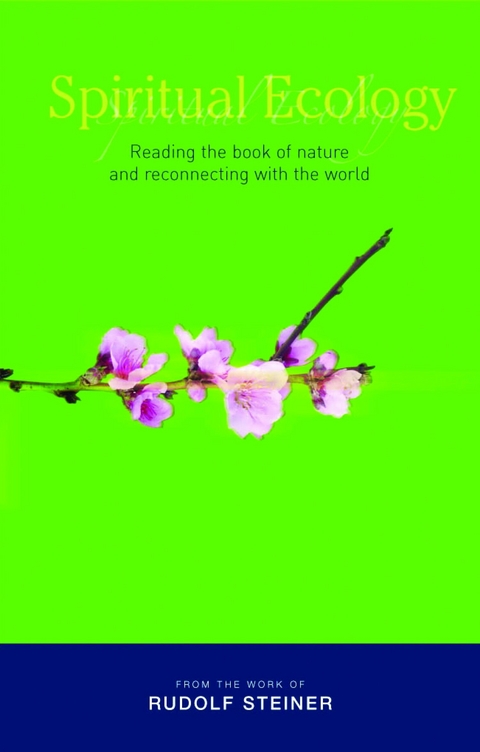
Spiritual Ecology (eBook)
Rudolf Steiner Press (Verlag)
978-1-85584-305-9 (ISBN)
Today we face an increasing number of challenges connected to our environment - from climate change and extreme weather patterns to deforestation, threats to animal species and ongoing crises in farming. Hardly a day goes by without further alarming reports. How are we to respond - particularly if we wish to take a broader, spiritual view of these events? Today we face an increasing number of challenges connected to our environment - from climate change and extreme weather patterns to deforestation, threats to animal species and ongoing crises in farming. Hardly a day goes by without further alarming reports. How are we to respond - particularly if we wish to take a broader, spiritual view of these events? In the extracts compiled in this volume, presented here with commentary and notes by Matthew Barton, Steiner speaks about human perception, the earth, water, plants, animals, insects, agriculture and natural catastrophes. Spiritual Ecology offers a wealth of original thought and spiritual insight for anyone who cares about the future of the earth and humanity.
3. Heightening Perception, Tuning to Natural Phenomena
Extracts from Chapter 2 of Knowledge of the Higher Worlds: ‘The Stages of Initiation’
It is not enough just to say, theoretically, that we need to refine both our physical perceptions and understanding of nature. Steiner here outlines some aspects of a meditative practice that can develop our sensitivity for natural processes and phenomena. He urges us to pay careful attention to very subtle experiences which are really a first glimmer of the world speaking through and to us, rather than us foisting ourselves on the world. In this way we can begin to form a receptive vessel in which nature itself resonates.
Flourishing and withering
The first step is made by directing the attention of the soul to certain occurrences in the world around us. Such phenomena are, on the one hand, life that is budding, growing and flourishing; and, on the other, all phenomena of fading, decaying and withering. We can see all this going on wherever we look, and it naturally evokes feelings and thoughts in us. But in ordinary circumstances we pay too little attention to these thoughts and feelings. We hurry too quickly from one impression to another. The essential thing is that we should fix our attention intently and consciously upon them. Wherever we observe a quite definite blossoming and flourishing of nature we should banish everything else from the soul and for a short time give ourselves up entirely to this one impression. We will soon discover that a feeling which previously would have merely flitted through the soul now acquires strong and energetic form. We must then allow this feeling to reverberate quietly within us, while maintaining perfect inner calm. We must shut ourselves off from the rest of the outer world and pursue only what our soul can tell us of these phenomena of blossoming.
But we must not think that much progress can be made if the senses are blunted. First look at things in the world as keenly and precisely as you possibly can. Only then give yourself up to the feeling and thought arising in the soul. What is important is that attention should be focused with perfect inner equilibrium on both activities. If you achieve the necessary tranquillity and surrender yourself to what arises in the soul, then after a time you will experience thoughts and feelings of a new character, unknown before, rising up. In fact, the more often your attention is turned alternately upon something that is flourishing and blossoming and then upon something that is fading and dying the more animated these feelings will become. And just as natural forces build the eyes and ears of the physical body out of living substance, so the organs of clairvoyance will be built out of the feelings and thoughts thus evoked...
Anyone who has often turned his attention to the process of growing, blossoming and flourishing will feel something remotely similar to the experience of sunrise. And the process of withering and dying will evoke an experience comparable in the same way to the slow rising of the moon over the horizon. These feelings are two forces which, when properly nurtured and developed to an ever-increasing intensity, lead to the most significant results. A new world opens for anyone who systematically and deliberately surrenders himself again and again to such feelings ...
Animate and inanimate
The pupil must also give further care to cultivating the world of sound. He must discriminate between the sounds produced by anything called lifeless (for example, a falling object, a bell or musical instrument) and sounds that come from a living creature (an animal or a human being). When we hear the sound of a bell we may associate a feeling of pleasure with it. But when we hear the cry of an animal we can discern in the sound, besides our own feeling, the expression of the animal’s inner experience, whether of pleasure or pain. It is with this latter category of sounds that the pupil must set to work. He must concentrate his whole attention on the fact that the sound tells him of something foreign to his own soul, and he must immerse himself in this foreign element. He must inwardly unite his own feelings with the pain or pleasure which the sound communicates to him, and care nothing for whether the sound is pleasant or unpleasant to himself. His soul must be imbued only with what is going on in the being from whom the sound proceeds. Anyone who carries out such exercises with method and deliberation will acquire the faculty of merging as it were with the being who uttered the sound ... And by this means a new faculty will take root in the world of feeling and thought. Through its resounding tones the whole of nature begins to whisper secrets to the pupil. What he previously experienced as incomprehensible noise will become an expressive language of nature herself. And whereas he had previously heard only sounds from the so-called lifeless world he is now aware of a new language of the soul.
Stone, plant, animal
First one studies different beings of nature in a particular way, for example a transparent, beautifully formed stone (a crystal), a plant and an animal. One should initially try to focus one’s whole attention on comparing the stone with the animal. Such thoughts must pass through the soul accompanied by alert feelings, and no other thoughts or feelings must intrude and disturb this sharp attentiveness. We can see that the stone has a form, as does the animal. The stone remains motionless in its place while the animal changes its place. It is natural impulse (desire) which causes the animal to move, and such natural impulses are served by the animal’s form—its organs and limbs are in keeping with them. The stone’s structure, in contrast, is not fashioned according to desire but by forces devoid of desire.
If we think our way deeply into such thoughts, contemplating the stone and the animal with absolute focus of attention, two quite different kinds of feelings will arise in the soul: one kind from the stone and another from the animal. At first the attempt will probably not succeed, but little by little, by dint of genuine and patient practice, these feelings will arise. This must be practised over and over again. At first the feelings are present only as long as the contemplation lasts; later on their after-effects continue. And then they become something that remains alive in the soul... If the plant is then included in the contemplation, it will be found that the feeling emanating from it lies midway, both in character and degree, between the feeling that streams from the stone and the feeling that flows from the animal.
Seed meditation
Let the pupil place before him a small seed from a plant. The aim is to intensify the right kinds of thoughts while contemplating this insignificant object, and through these thoughts to develop certain feelings. First we need to realize what our eyes are actually seeing. We should describe to ourselves its shape, colour and all other distinctive features of the seed. Then we should reflect as follows: ‘Out of this seed, if planted in the soil, there will grow a plant of complex structure.’ Visualize this plant, develop it in your imagination, and then say: ‘What I am now picturing in my imagination will later be drawn out of the seed by the forces of the earth and light. If I had before me an artificial object which imitated the seed to such a deceptive degree that my eyes could not distinguish it from a real seed, no forces of the earth or light could call a plant forth from it.’ By grasping this thought clearly so that it becomes experience that is felt, you can unite the following thought with the right feeling: ‘All that will ultimately grow out of the seed is already secretly enfolded within it as the force of the whole plant. No such force is present in the artificial imitation of the seed. And yet to my eyes both appear alike. The real seed therefore contains something invisible which is not present in the imitation.’ It is to this invisible aspect that thought and feeling should now be directed.3 Let the pupil picture the following to himself: This invisible aspect will gradually transform itself into the visible plant whose shapes and colours I will then have before me. Let him hold fast to the thought that the invisible will become visible, and that, if he could not think, then what will become visible only later could not already announce its presence to him.
It is particularly important that what is being thought here must also be intensely felt. The thought must be experienced in inner quiet, with no disturbing intrusions from other thoughts. And sufficient time must be allowed for the thought and feeling united with it to penetrate the soul. If this is done in the right way then, after a time—possibly only after many attempts—an inner force will make itself felt, and this force will create a new power of perception. The grain of seed will appear as if enveloped in a small, luminous cloud. In a sensory-spiritual way it will be felt as a kind of flame. The centre of this flame evokes a similar impression to that made by the colour lilac, and the edges give the impression of a bluish tint. Something formerly not seen is revealed here, created by the power of the thoughts and feelings that have been inwardly stirred into activity. The plant itself, which will become physically visible only later on, now manifests in a spiritually visible way.
It is understandable that many people will regard all this as illusion. They will say: ‘What is the use to me of such visions and fantasies?’ And many will abandon the path. But this is the all-important point: not to confuse fantasy with spiritual reality at these difficult stages of development; and then to...
| Erscheint lt. Verlag | 9.5.2013 |
|---|---|
| Übersetzer | Matthew Barton |
| Verlagsort | London |
| Sprache | englisch |
| Themenwelt | Sachbuch/Ratgeber ► Gesundheit / Leben / Psychologie ► Esoterik / Spiritualität |
| Geisteswissenschaften ► Religion / Theologie | |
| Weitere Fachgebiete ► Anthroposophie | |
| ISBN-10 | 1-85584-305-6 / 1855843056 |
| ISBN-13 | 978-1-85584-305-9 / 9781855843059 |
| Informationen gemäß Produktsicherheitsverordnung (GPSR) | |
| Haben Sie eine Frage zum Produkt? |
 EPUB (Adobe DRM)
Kopierschutz: Adobe-DRM
Adobe-DRM ist ein Kopierschutz, der das eBook vor Mißbrauch schützen soll. Dabei wird das eBook bereits beim Download auf Ihre persönliche Adobe-ID autorisiert. Lesen können Sie das eBook dann nur auf den Geräten, welche ebenfalls auf Ihre Adobe-ID registriert sind.
Details zum Adobe-DRM
Dateiformat: EPUB (Electronic Publication)
EPUB ist ein offener Standard für eBooks und eignet sich besonders zur Darstellung von Belletristik und Sachbüchern. Der Fließtext wird dynamisch an die Display- und Schriftgröße angepasst. Auch für mobile Lesegeräte ist EPUB daher gut geeignet.
Systemvoraussetzungen:
PC/Mac: Mit einem PC oder Mac können Sie dieses eBook lesen. Sie benötigen eine
eReader: Dieses eBook kann mit (fast) allen eBook-Readern gelesen werden. Mit dem amazon-Kindle ist es aber nicht kompatibel.
Smartphone/Tablet: Egal ob Apple oder Android, dieses eBook können Sie lesen. Sie benötigen eine
Geräteliste und zusätzliche Hinweise
Buying eBooks from abroad
For tax law reasons we can sell eBooks just within Germany and Switzerland. Regrettably we cannot fulfill eBook-orders from other countries.
aus dem Bereich