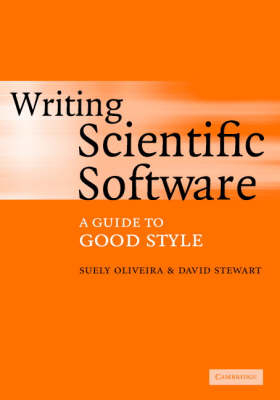
Writing Scientific Software (eBook)
Cambridge University Press (Verlag)
978-0-511-24320-2 (ISBN)
The core of scientific computing is designing, writing, testing, debugging and modifying numerical software for application to a vast range of areas: from graphics, meteorology and chemistry to engineering, biology and finance. Scientists, engineers and computer scientists need to write good code, for speed, clarity, flexibility and ease of re-use. Oliveira and Stewart's style guide for numerical software points out good practices to follow, and pitfalls to avoid. By following their advice, readers will learn how to write efficient software, and how to test it for bugs, accuracy, and performance. Techniques are explained with a variety of programming languages, and illustrated with two extensive design examples, one in Fortran 90 and one in C++: other examples in C, C++, Fortran 90 and Java are scattered throughout the book. This manual of scientific computing style will be an essential addition to the bookshelf and lab of everyone who writes numerical software.
The core of scientific computing is designing, writing, testing, debugging and modifying numerical software for application to a vast range of areas: from graphics, meteorology and chemistry to engineering, biology and finance. Scientists, engineers and computer scientists need to write good code, for speed, clarity, flexibility and ease of re-use. Oliveira and Stewart's style guide for numerical software points out good practices to follow, and pitfalls to avoid. By following their advice, readers will learn how to write efficient software, and how to test it for bugs, accuracy and performance. Techniques are explained with a variety of programming languages, and illustrated with two extensive design examples, one in Fortran 90 and one in C++: other examples in C, C++, Fortran 90 and Java are scattered throughout the book. This manual of scientific computing style will be an essential addition to the bookshelf and lab of everyone who writes numerical software.
| Erscheint lt. Verlag | 7.9.2006 |
|---|---|
| Sprache | englisch |
| Themenwelt | Sachbuch/Ratgeber |
| Mathematik / Informatik ► Informatik ► Software Entwicklung | |
| Mathematik / Informatik ► Mathematik ► Analysis | |
| ISBN-10 | 0-511-24320-0 / 0511243200 |
| ISBN-13 | 978-0-511-24320-2 / 9780511243202 |
| Informationen gemäß Produktsicherheitsverordnung (GPSR) | |
| Haben Sie eine Frage zum Produkt? |
 PDF (Adobe DRM)
Kopierschutz: Adobe-DRM
Adobe-DRM ist ein Kopierschutz, der das eBook vor Mißbrauch schützen soll. Dabei wird das eBook bereits beim Download auf Ihre persönliche Adobe-ID autorisiert. Lesen können Sie das eBook dann nur auf den Geräten, welche ebenfalls auf Ihre Adobe-ID registriert sind.
Details zum Adobe-DRM
Dateiformat: PDF (Portable Document Format)
Mit einem festen Seitenlayout eignet sich die PDF besonders für Fachbücher mit Spalten, Tabellen und Abbildungen. Eine PDF kann auf fast allen Geräten angezeigt werden, ist aber für kleine Displays (Smartphone, eReader) nur eingeschränkt geeignet.
Systemvoraussetzungen:
PC/Mac: Mit einem PC oder Mac können Sie dieses eBook lesen. Sie benötigen eine
eReader: Dieses eBook kann mit (fast) allen eBook-Readern gelesen werden. Mit dem amazon-Kindle ist es aber nicht kompatibel.
Smartphone/Tablet: Egal ob Apple oder Android, dieses eBook können Sie lesen. Sie benötigen eine
Geräteliste und zusätzliche Hinweise
Buying eBooks from abroad
For tax law reasons we can sell eBooks just within Germany and Switzerland. Regrettably we cannot fulfill eBook-orders from other countries.
aus dem Bereich