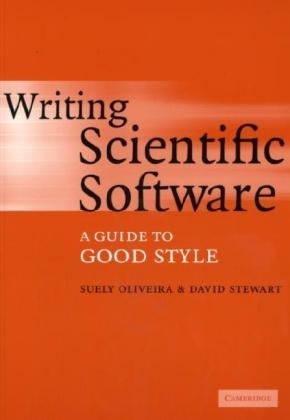
Writing Scientific Software
Cambridge University Press (Verlag)
978-0-521-67595-6 (ISBN)
The core of scientific computing is designing, writing, testing, debugging and modifying numerical software for application to a vast range of areas: from graphics, meteorology and chemistry to engineering, biology and finance. Scientists, engineers and computer scientists need to write good code, for speed, clarity, flexibility and ease of re-use. Oliveira and Stewart's style guide for numerical software points out good practices to follow, and pitfalls to avoid. By following their advice, readers will learn how to write efficient software, and how to test it for bugs, accuracy and performance. Techniques are explained with a variety of programming languages, and illustrated with two extensive design examples, one in Fortran 90 and one in C++: other examples in C, C++, Fortran 90 and Java are scattered throughout the book. This manual of scientific computing style will be an essential addition to the bookshelf and lab of everyone who writes numerical software.
Suely Oliveira is Associate Professor of Computer Science at the University of Iowa. David Stewart is an Associate Professor in the Department of Mathematics at the University of Iowa.
Part I. Numerical Software: 1. Why numerical software?; 2. Scientific computation and numerical analysis; 3. Priorities; 4. Famous disasters; 5. Exercises; Part II. Developing Software: 6. Basics of computer organization; 7. Software design; 8. Modularity and all that; 9. Data structures; 10. Design for testing and debugging; 11. Exercises; Part III. Efficiency in Time, Efficiency in Memory: 12. Be algorithm aware; 13. Computer architecture and efficiency; 14. Global vs. local optimization; 15. Grabbing memory when you need it; 16. Memory bugs and leaks; Part IV. Tools: 17. Sources of scientific software; 18. Unix tools; 19. Cubic spline function library; 20. Multigrid algorithms; Appendix A: review of vectors and matrices; Appendix B: trademarks; Bibliography; Index.
| Erscheint lt. Verlag | 7.9.2006 |
|---|---|
| Zusatzinfo | Worked examples or Exercises |
| Verlagsort | Cambridge |
| Sprache | englisch |
| Maße | 246 x 174 mm |
| Gewicht | 549 g |
| Themenwelt | Mathematik / Informatik ► Informatik ► Software Entwicklung |
| ISBN-10 | 0-521-67595-2 / 0521675952 |
| ISBN-13 | 978-0-521-67595-6 / 9780521675956 |
| Zustand | Neuware |
| Informationen gemäß Produktsicherheitsverordnung (GPSR) | |
| Haben Sie eine Frage zum Produkt? |
aus dem Bereich