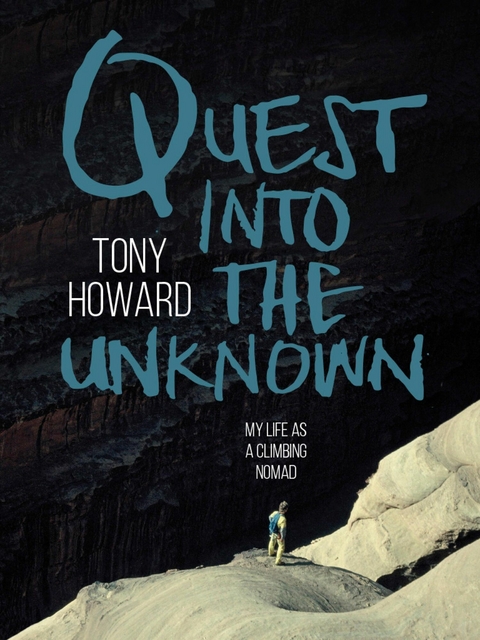
Quest into the Unknown (eBook)
Vertebrate Publishing (Verlag)
978-1-911342-84-7 (ISBN)
Tony Howard grew up in the Chew Valley, at the northern tip of the Peak District. After starting climbing in 1953, Tony became well known in climbing circles for his new routes and his contribution to local guidebooks. He worked as an instructor in the early 1960s and qualified as a BMC Guide in 1965, the year he and his friends famously made the first ascent of Norway's 1,000-metre Troll Wall. Tony was a founding partner of Troll Climbing Equipment, producing many innovative designs such as the world's first commercial range of nuts, the first climbing sit harnesses and the first sewn slings. He has climbed all over the world, discovering new areas and making many first ascents. Tony is a regular contributor to outdoor magazines, and has written or contributed to guidebooks for the English Peak District, Norway, Oman, Morocco, Jordan and Palestine.
We are all climbing where we are and with the gear we use in no small part due to Tony Howard's quest for adventure. Tony Howard rose to fame in 1965 as a member of a group of young climbers from northern England who made the first British ascent of Norway's Troll Wall; a climb described by Joe Brown as, 'One of the greatest ever achievements by British rock climbers'. Tony went on to design the modern sit harness, now used worldwide by most climbers. He founded the company Troll Climbing Equipment but never stopped exploring. Quest into the Unknown is his story. Tony has dedicated his life to travelling the world in search of unclimbed rock faces and remote trekking adventures. The scale of his travels is vast: he has visited all of the North African countries, much of the Arab land of the Middle East, the mountainous regions of Scandinavia, Canada and the rocky spine of the Americas, the Himalaya, remote Indian provinces, South East Asia, Madagascar, South Georgia and Antarctica. This book, the last word in adventure travel, takes the reader from Tony's youth spent developing the crags of the English Peak District, via whaling ships in the Southern Ocean, thousand-mile canoe trips in the Canadian Arctic, living amongst the Bedouin in the rocky mountains of Jordan, to the isolated opium tribes of Thailand. Tony Howard's Quest into the Unknown is the jaw-dropping account of a life of adventure that is the very definition of true exploration.
I belonged to that generation which saw, by chance, the end of a thousand years’ life.
Cider with Rosie, Laurie Lee
The day I was born was a momentous day. Mum and Dad must have wondered anxiously about the world I was entering. It was Britain’s darkest hour: the eve of the World War Two Dunkirk evacuation in May 1940. Over 7,000 men were rescued from the beaches of northern France on that first day, and over a third of a million on subsequent days. I, of course, knew nothing of it, but soon after my father was sent to work in London at the time of the Blitz, which lasted from September 1940 to May 1941. Bombs fell on London for seventy-six consecutive nights, killing over 20,000 civilians and destroying more than a million houses. Worrying days for Mum, though Dad wrote often and whenever possible came home to Greenfield, the village where we lived on the edge of the Pennine moors in the West Riding of Yorkshire.
Rationing of food and petrol was introduced the year I was born and continued throughout the war. Bread escaped rationing but was in such short supply that it had to be sold a day old when it would be going stale and could consequently be cut into thinner slices. The shortage of food was so great that on my fifth birthday – three weeks after the end of the war in Europe in 1945 – food rations were reduced even further. The weekly bacon allowance went down from four ounces to three ounces, cooking fat from two ounces to just one, and the meagre meat ration of 1/2 d (half an old penny) per family had to be taken in corned beef. Supplies of food continued to be so short that bread was finally added to the ration list a year later and was not removed until 1948.
Rationing of other foods continued until 1954 when I was fourteen and the last item, meat, was finally taken off the government’s list. Mum used to make ‘rag puddings’ to make the meat go further. They consisted of chopped-up pieces of meat with onions and gravy, wrapped in suet pastry, tied in a ‘rag’ and boiled in a pan on the fire. Cheap, and saved electricity too. Raiding our pantry to make a swift treacle butty when no one was around, or sticking my finger in the jam jar, became habits. Mum never said anything. Dripping butties were another secret delight, the best bits of dripping being the dark brown bottom layer. Mum always knew I had been in the jar as the top crust had to be broken to get at the juicier layer underneath.
My sister Kathryn was born a couple of years after me, and with Dad still working away, Mum worked hard bringing us up. Despite the difficulties of life at that time, our home was a happy place, surrounded on three sides by fields. It seemed everyone knew everyone in the village. Nestled beneath the western edge of the Pennines, Greenfield is overlooked by the wild moors and jutting gritstone crags of Chew Valley. These cliff-rimmed hills – which I still think are the nearest thing to mountains between Snowdonia and the Lakes – were to become my childhood playground and had a huge influence on my life, but not before my formative years in the friendly warmth of the village community.
A cousin of my mum’s lived just across the road with his family including a couple of lads about my age. My aunty lived down the lane with her family including two daughters, also of similar age to me. My uncle and his wife also lived nearby. Sadly, both my mum’s parents died young and I never met them, but my dad’s parents lived in an old stone cottage in a small hamlet just up the hill from us, across some fields. Other relations from both sides of the family also lived in the village where, as in many northern villages, our life revolved around the Methodist chapel.
Sundays were not my favourite days, as I had to wear ‘Sunday best’ and attend Sunday school. I could never relate to the Sunday school classes and hymns, though the pictures of desert scenes with their dunes, palm trees, camels and exotically garbed people always intrigued me. Nor did I enjoy the pantomimes in which I was a very reluctant actor dressed embarrassingly in anything from sailor suits to Hawaiian grass skirts, to perform on stage for parental admiration.
Otherwise, the village was a great place to grow up in and, for the most part, certainly for a young lad, was far from the war. Despite the mill in Chew Valley manufacturing gun-cotton and presumably being a potential bombing target, the nearest thing to a hit came one night in 1941 when a bomb accidentally landed on the cricket pitch. How dare they! I remember the rationing, the blackout blinds, my gas mask, the sirens and the drone of enemy planes going over in the night as they headed to and from Manchester and Salford docks just ten miles away. Two of Mum’s brothers were killed in the wars, when both were in their teens. I often wonder what it must have been like for someone who had never previously travelled to die in such alien places so far from home and family. Everyone dreaded receiving a black-edged envelope from the Ministry of Defence. Mum’s sister had been working in the Women’s Land Army down south and had met an American soldier. They came up to see us and the rest of the family in Greenfield and were married soon after the war, moving to America where she stayed – a major step for a country girl in the 1940s.
I remember the first bananas and pineapples coming into the village in 1946 and everyone making such a fuss about it. The ‘Dig for Victory’ campaign was still promoted every week by the BBC and we worked in the school allotments one day a week, growing vegetables, just as my dad and everyone else did in their gardens at home. School dinners were good and I ate everything that was put on my plate.
What with the Great Depression of the 1930s and then the war and rationing, it’s no wonder people with rickets were still a common sight, as were men in uniform, or with missing limbs and burnt faces. A large house at the entrance to Chew Valley was then a recuperation home for injured soldiers that we used to visit on special occasions such as Whit Fridays when the brass bands were out in full force and there were games and competitions in the field near the cricket pitch.
Primary school was just five minutes’ walk down our lane; sometimes Mum would walk with us on her way to or from the shops, otherwise I would go with my sister or friends. There was no paranoia about kids being out without their parents in those days. School itself was fine, we all knew each other and enjoyed our time there, learning our ‘three Rs’, as well as art, music, history, geography, RE and PE. The map of the world on the classroom wall was predominantly pink, the colour of our empire ‘on which the sun never set’. We used old-fashioned nibbed pens that were provided by the school and dipped into inkwells that were set in our desks and filled each day by an ‘ink monitor’.
After school I would be off into the fields with my mates, damming streams or up trees and generally doing what boys do. Looking for birds’ nests was a springtime hobby – frowned upon these days, I know. But we never damaged them; the fun was in finding them. Once, trying to climb a big sycamore with no low branches I hammered in some six-inch nails to make a ladder (I had discovered what aid climbing was, but didn’t know it). Inevitably one of them came out and I tore my leg badly on the nails lower down resulting in a real telling off from my mum once she had recovered from the shock of all the blood and my ripped trousers. Autumn meant raiding orchards. The stolen apples were usually small and sour, but it was worth it for the fun. Inevitably I would arrive home dirty to be asked yet again by my long-suffering mum why I hadn’t come home from school to put my old clothes on.
Washing clothes wasn’t easy in those days: no washing machines, just a boiler, poss-tub or dolly tub and mangle. Weather permitting, it was then pegged out on the line, all of which I sometimes helped with, though often I had already managed to escape outdoors. Other chores included washing and drying the pots after meals, which Kathryn and I tried to avoid, usually without success. Chopping wood for lighting the fire was my dad’s job, though that was something I always enjoyed. No one we knew had any form of central heating then, so the coal fire was essential in winter and lit by Mum to warm the living room before she made breakfast and packed us off to school.
On winter mornings the insides of the windows would often be covered in frost-feathers. Getting up and dressed was a chilly business. Then, as the room warmed with the heat of the fire, the frost would melt, sending trickles of water down the glass into small channels cut into the bottoms of the wooden window frames. From there, the water escaped outside through holes drilled specially in the wood … unless the hole was frozen up, which it usually was, then the water overflowed to form small pools on the window ledge. It was normal. I even had my tonsils taken out at home, while my two mates who lived next door tried to peep between the drawn curtains. I remember lying on the table in our living room and being chloroformed, then waking up just as the doctor was throwing my tonsils in the fire.
An everyday event was the delivery of milk and eggs by our local farmer, Billy Bradbury. He arrived by horse and cart with churns of milk from which he would fill a shiny gallon can to carry to the door,...
| Erscheint lt. Verlag | 4.4.2019 |
|---|---|
| Verlagsort | London |
| Sprache | englisch |
| Themenwelt | Literatur ► Biografien / Erfahrungsberichte |
| Literatur ► Romane / Erzählungen | |
| Sachbuch/Ratgeber ► Freizeit / Hobby ► Sammeln / Sammlerkataloge | |
| Sachbuch/Ratgeber ► Sport | |
| Reisen ► Reiseberichte | |
| Schlagworte | Adventure Travel • Antarctic • Bedouin • bouldering • Canada • Chris Bonington • Climbing • climbing book • desert • Dolomites • Don Whillans • Egypt • Ethiopia • exploration book • Greenland • Hiking • Jordan • jordan trail • kassala • Libya • Madagascar • Mali • Morocco • Mountains • Nomad • Norway • Oman • Palestine • Persia • Red Sea • Rimmon • rock climb • South Georgia • Sudan • Thailand • Trekking • Troll Wall • Wadi Rum • World Culture • Yukon |
| ISBN-10 | 1-911342-84-3 / 1911342843 |
| ISBN-13 | 978-1-911342-84-7 / 9781911342847 |
| Informationen gemäß Produktsicherheitsverordnung (GPSR) | |
| Haben Sie eine Frage zum Produkt? |
 EPUB (Adobe DRM)
Kopierschutz: Adobe-DRM
Adobe-DRM ist ein Kopierschutz, der das eBook vor Mißbrauch schützen soll. Dabei wird das eBook bereits beim Download auf Ihre persönliche Adobe-ID autorisiert. Lesen können Sie das eBook dann nur auf den Geräten, welche ebenfalls auf Ihre Adobe-ID registriert sind.
Details zum Adobe-DRM
Dateiformat: EPUB (Electronic Publication)
EPUB ist ein offener Standard für eBooks und eignet sich besonders zur Darstellung von Belletristik und Sachbüchern. Der Fließtext wird dynamisch an die Display- und Schriftgröße angepasst. Auch für mobile Lesegeräte ist EPUB daher gut geeignet.
Systemvoraussetzungen:
PC/Mac: Mit einem PC oder Mac können Sie dieses eBook lesen. Sie benötigen eine
eReader: Dieses eBook kann mit (fast) allen eBook-Readern gelesen werden. Mit dem amazon-Kindle ist es aber nicht kompatibel.
Smartphone/Tablet: Egal ob Apple oder Android, dieses eBook können Sie lesen. Sie benötigen eine
Geräteliste und zusätzliche Hinweise
Buying eBooks from abroad
For tax law reasons we can sell eBooks just within Germany and Switzerland. Regrettably we cannot fulfill eBook-orders from other countries.
aus dem Bereich