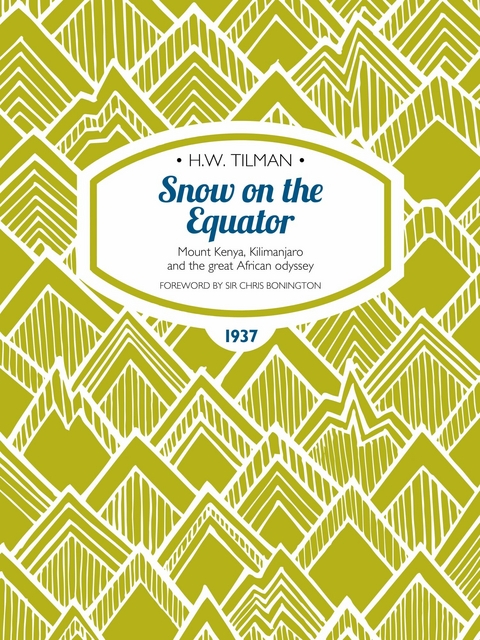
Snow on the Equator (eBook)
Vertebrate Publishing (Verlag)
978-1-909461-15-4 (ISBN)
Harold William Bill Tilman (1898 1977) was among the greatest adventurers of his time, a pioneering mountaineer and sailor who held exploration above all else. Tilman joined the army at seventeen and was twice awarded the Military Cross for bravery during WWI. After the war Tilman left for Africa, establishing himself as a coffee grower. He met Eric Shipton and began their famed mountaineering partnership, traversing Mount Kenya and climbing Kilimanjaro. Turning to the Himalaya, Tilman went on two Mount Everest expeditions, reaching 27,000 feet without oxygen in 1938. In 1936 he made the first ascent of Nanda Devi the highest mountain climbed until 1950. He was the first European to climb in the remote Assam Himalaya, he delved into Afghanistan's Wakhan Corridor and he explored extensively in Nepal, all the while developing a mountaineering style characterised by its simplicity and emphasis on exploration. It was perhaps logical then that Tilman would eventually buy the pilot cutter Mischief, not with the intention of retiring from travelling, but to access remote mountains. For twenty-two years Tilman sailed Mischief and her successors to Patagonia, where he crossed the vast ice cap, and to Baffin Island to make the first ascent of Mount Raleigh. He made trips to Greenland, Spitsbergen and the South Shetlands, before disappearing in the South Atlantic Ocean in 1977.
'To those who went to the War straight from school and survived it, the problem of what to do afterwards was peculiarly difficult.'For H.W. 'Bill' Tilman, the solution lay in Africa: in gold prospecting, mountaineering and a 3,000-mile bicycle ride across the continent. Tilman was one of the greatest adventurers of his time, a pioneering climber and sailor who held exploration above all else. He made first ascents throughout the Himalaya, attempted Mount Everest, and sailed into the Arctic Circle. For Tilman, the goal was always to explore, to see new places, to discover rather than conquer. First published in 1937, Snow on the Equator chronicles Tilman's early adventures; his transition from East African coffee planter to famed mountaineer. After World War I, Tilman left for Africa, where he grew coffee, prospected for gold and met Eric Shipton, the two beginning their famed mountaineering partnership, traversing Mount Kenya and climbing Kilimanjaro and Ruwenzori. Tilman eventually left Africa in typically adventurous style via a 3,000-mile solo bicycle ride across the continent all recounted here in splendidly funny style. Tilman is one of the greatest of all travel writers. His books are well-informed and keenly observed, concerned with places and people as much as summits and achievements. They are full of humour and anecdotes and are frequently hilarious. He is part of the great British tradition of comic writing and there is nobody else quite like him.
– Chapter 11 –
Amateur Prospectors
A thirst for gold,
The beggars vice which can but overwhelm
The meanest hearts
– Byron
The formation of this new and powerful combine, which for the moment we forbore naming, was honoured that night in the usual fashion, and no time was wasted in getting to work. Next morning at dawn the partners went down to the Yala to measure and peg out their alluvial claims. A layer of gravel and sand under both banks was known to be gold-bearing, so presumably the same held good for the gravel under the present river-bed. It was, therefore, only a matter of selecting from the few promising places still unclaimed. Difficulties enough would come later with the working, for the ‘pay-dirt’ was eight feet below the surface of the banks, while the river itself was a good hundred feet wide and six feet deep. For the present we ignored this, trusting that later someone with sufficient capital would come along to work our claims on a percentage basis, or even buy them outright.
These hopes were never realised. Our claims were examined, but the test bore-holes showed that they were not rich enough to warrant the heavy expenditure necessary to win the gold. On the banks eight feet of overburden had to be removed to reach the underlying gravel, while to reach that in the river-bed itself the river would have had to be diverted. Alterations of the landscape on this scale were not to be undertaken lightly, for, although the man of money might, and in some cases did, say, like another Hotspur proposing to turn the Trent, ‘I’ll have it so, a little charge will do it,’ there was a Glendower in the shape of the Government which, though it did not actually forbid, insisted on the river being restored eventually to its original course and all the excavations filled in when the gold had been won. A hard condition this, unpalatable, and unprofitable to mining Hotspurs, and one which saved more parts of the river than ours from violent hands.
My recollections of that first day are of the junior partner swimming about in the river at one end of one hundred and twenty feet of chain, played by the senior partner, like a tired tunny-fish, of washing pans of ‘pay gravel’ brought up by the auger from under eight feet of foul-smelling overburden, and finally of returning late to camp through a deluge of rain. It was a hard day but an interesting one, for the kick we got out of watching the specks of gold trailing after the black sand as we ‘panned’ the gravel more than repaid us for our toil.
After another day or so of this promiscuous bathing and mud-larking, when a thousand feet of both river-banks had been pegged we turned our attention more than willingly to the reef claims—there one could at least keep dry.
These were the claims under which we hoped to expose, by deep trenching or shaft sinking, a body of goldbearing rock. The rock is usually, not necessarily, quartz—that which Spaniards call madre de oro, or ‘mother of gold’—and the reef may outcrop at the surface or be buried at a depth of hundreds or even thousands of feet. (On the Rand, in the Village Deep Mine, gold is being mined at 7600 feet below ground level.) Near the surface the ore body may be only a few inches thick—what is termed a ‘leader’ or ‘stringer’—but if this is found to be carrying gold it is always worth while following, as it may lead to the mother lode, of which it is an offshoot. If the reef outcrops, well and good, but more usually the only indications to guide one in the search for the reef are bits of quartz lying about on the surface—‘floats,’ which have to be traced if possible to their sources. Sometimes there are not even any ‘floats’ to be found, and then samples of the subsoil have to be taken at close intervals to be washed for traces of gold. As the traces in the sample increase or diminish, so the prospector knows whether he is getting ‘colder’ or ‘warmer’ in the game of hunting the elusive reef.
D.’s original discovery was an outcrop of rock in which there were thin veins of quartz. Having crushed the rock in a ‘dolly’ (an iron pestle and mortar) and having washed the fine sand so obtained in a prospector’s pan, one got a fair-sized ‘tail’ of gold; that is to say, a fine streak of the yellow metal tailing behind the residual sand owing to its greater weight, and showing up unmistakably against the black bottom of the pan. Perhaps not ‘unmistakably,’ as I remember one sample of quartz which showed tremendous ‘tails’ of some heavy yellow stuff—a find which made us almost sleepless with excitement until an assay showed it to be, not gold, but some metal of no value.
However, there was no deception about this first discovery, from the quartz veins of which gold was found in every sample, with ‘tails’ of sufficient size to fill us with the wildest hopes. Unfortunately, the quartz veins, which were few and small, petered out very quickly; nor did we ever succeed in finding the reef from which they must have come.
This early and very partial success went to our inexperienced heads. We did not realise its unsubstantial nature, and so left a more thorough investigation to the future, while we embarked upon a policy of ‘pegging’ as much of the surrounding unclaimed country as we could, with the object of having something worth while to offer the company which, we confidently expected, would sooner or later come along. This area was all part of a vast tract pegged by a man who later found that he had swallowed more than he could digest, and who for some reason, probably financial, had failed to register the claims. This meant that he had no rights over them, with the result that several people, including D., had taken advantage of his faulty title.
We were so confident of the latent possibilities that we regarded every chance white man who showed himself in the neighbourhood as a dangerous rival—an object of suspicion and hatred. Our days were laborious, our nights uneasy. Christmas Day itself brought to us neither peace nor goodwill, for on the previous evening we had happened upon the ‘discovery peg’ of some wandering Dutchman, which so wrought upon us that we proclaimed our ‘goodwill toward men’ by searching feverishly for something to justify the placing of a ‘discovery peg’ close to his, so as to prevent his encroaching any further on what we regarded as our preserves. Thus did the gold bug arouse the envy, hatred, and malice of two mild, kindly disposed coffee-planters, for I think we were quite prepared to jump his claim, shoot him, and bury him in his own trench had we not already sampled his ‘discovery’ and found it barren.
Our daily routine was to leave camp at daybreak armed with an entrenching-tool, a geologist’s hammer, a magnifying-glass, and a pan, and accompanied by two boys carrying pick, shovel, earth-auger, and food. An eye-witness might well have mistaken us for a party of gravediggers attending the funeral of one of their fellows. We proceeded with bowed head and measured step, our eyes glued to the ground searching for likely looking stones. Quite literally, no stone was left unturned. Any arousing interest were broken, to be examined with the magnifying-glass for traces of free gold. The promising bits of quartz were put in separate bags, with notes as to where they had been found, before being taken home for crushing and testing. The note specifying the place of origin was important, because more experienced prospectors than ourselves had been known to carry home a load of samples, prove one to be carrying gold, and then find themselves unable to remember its place of origin. The methodical examination of every piece of quartz with the pocket lens for visible gold was a rite seldom omitted, and, although none was ever seen, the search never lost its interest or excitement. But the most exciting part of the day came when, back in camp, all the samples were crushed and panned. This was the decisive test, for quartz may be rich in gold and yet show no trace of it even under a magnifying-glass. We worked sitting on boxes outside the tent, one of us pounding away at the quartz in the iron ‘dolly,’ the other carefully washing the fine dust in the pan. Usually, of course, silence or a groan of despair showed the result to be negative, but occasionally a triumphant yell announced the presence of a ‘speck’ or, rarely enough, a palpable ‘tail’ amongst the fine black sand in the pan.
This washing and crushing had to be done with scrupulous care. It was easy to overlook specks, but easier still to see some that were not there. Neglect to clean very thoroughly after each trial the dolly, pestle, sieve, and pan was a fruitful source of trouble. Specks of gold from one successful sample might be left over and turn up again in the next, which, though in reality completely barren, was now made to appear gold-bearing. Much extra work and eventual disappointment were the result, because at least ten more negative tests were necessary before the culprit was compelled to admit that he was the victim of his own carelessness, and that the successful pan had been unwittingly ‘salted’ by himself.
If a sample giving a ‘colour’ was found, the procedure was to return to the place next day to try to discover from where the bits of surface quartz or ‘floats’ had come. If they appeared to lie more plentifully in one particular spot than another, a long narrow trench running at right angle to the general ‘strike’ of the field would be sunk, in the hope of cutting the reef itself or being directed to it by the finding of some ‘leader’ or ‘stringer.’ As previously explained, these are the narrow veins of quartz an inch to...
| Erscheint lt. Verlag | 1.9.2015 |
|---|---|
| Reihe/Serie | H.W. Tilman: The Collected Edition |
| H.W. Tilman: The Collected Edition | H.W. Tilman: The Collected Edition |
| Vorwort | Chris Bonington |
| Verlagsort | London |
| Sprache | englisch |
| Themenwelt | Literatur ► Biografien / Erfahrungsberichte |
| Literatur ► Romane / Erzählungen | |
| Sachbuch/Ratgeber ► Sport | |
| Reisen ► Reiseberichte | |
| Reisen ► Reiseführer | |
| Schlagworte | adventurers • Africa • Arctic circle • Atlantic • Bangui • baroque • Bill Tilman • boating books • Bob Comlay • Bonington • Chris Bonington • Climb • Climbing • climbing books • coffee planter • East Africa • Eric Shipton • everest books • explorers • exploroing • gold prospecting • H.W. 'Bill' Tilman • H W Tilman • H.W. Tilman • Kilimanjaro • Lake Kivu • Lake Victoria • Mackinder Valley • mischief • Mountaineering • Mountains • Mount Everest • Mount Kenya • Patanela • Ruwenzori • Sailing • sailing books • sea breeze • Sir Chris Bonington • Stanleyville • Tilman • Travel writing |
| ISBN-10 | 1-909461-15-6 / 1909461156 |
| ISBN-13 | 978-1-909461-15-4 / 9781909461154 |
| Informationen gemäß Produktsicherheitsverordnung (GPSR) | |
| Haben Sie eine Frage zum Produkt? |
 EPUB (Adobe DRM)
Kopierschutz: Adobe-DRM
Adobe-DRM ist ein Kopierschutz, der das eBook vor Mißbrauch schützen soll. Dabei wird das eBook bereits beim Download auf Ihre persönliche Adobe-ID autorisiert. Lesen können Sie das eBook dann nur auf den Geräten, welche ebenfalls auf Ihre Adobe-ID registriert sind.
Details zum Adobe-DRM
Dateiformat: EPUB (Electronic Publication)
EPUB ist ein offener Standard für eBooks und eignet sich besonders zur Darstellung von Belletristik und Sachbüchern. Der Fließtext wird dynamisch an die Display- und Schriftgröße angepasst. Auch für mobile Lesegeräte ist EPUB daher gut geeignet.
Systemvoraussetzungen:
PC/Mac: Mit einem PC oder Mac können Sie dieses eBook lesen. Sie benötigen eine
eReader: Dieses eBook kann mit (fast) allen eBook-Readern gelesen werden. Mit dem amazon-Kindle ist es aber nicht kompatibel.
Smartphone/Tablet: Egal ob Apple oder Android, dieses eBook können Sie lesen. Sie benötigen eine
Geräteliste und zusätzliche Hinweise
Buying eBooks from abroad
For tax law reasons we can sell eBooks just within Germany and Switzerland. Regrettably we cannot fulfill eBook-orders from other countries.
aus dem Bereich