Stochastic Finance with Python (eBook)
396 Seiten
Apress (Verlag)
979-8-8688-1052-7 (ISBN)
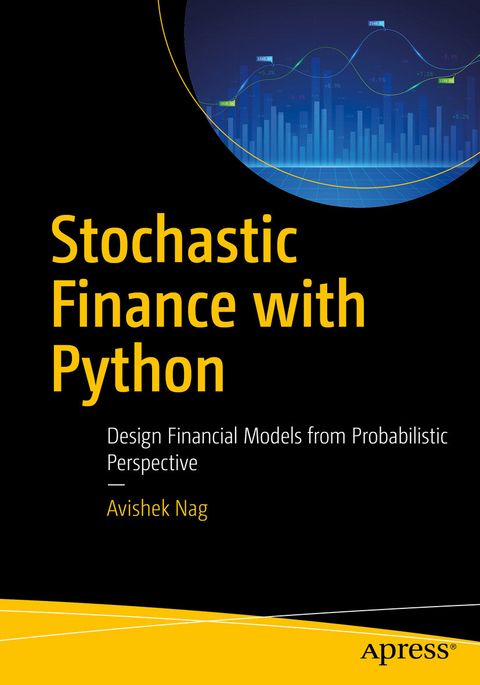
Journey through the world of stochastic finance from learning theory, underlying models, and derivations of financial models (stocks, options, portfolios) to the almost production-ready Python components under cover of stochastic finance. This book will show you the techniques to estimate potential financial outcomes using stochastic processes implemented with Python.
The book starts by reviewing financial concepts, such as analyzing different asset types like stocks, options, and portfolios. It then delves into the crux of stochastic finance, providing a glimpse into the probabilistic nature of financial markets. You'll look closely at probability theory, random variables, Monte Carlo simulation, and stochastic processes to cover the prerequisites from the applied perspective. Then explore random walks and Brownian motion, essential in understanding financial market dynamics. You'll get a glimpse of two vital modelling tools used throughout the book - stochastic calculus and stochastic differential equations (SDE).
Advanced topics like modeling jump processes and estimating their parameters by Fourier-transform-based density recovery methods can be intriguing to those interested in full-numerical solutions of probability models. Moving forward, the book covers options, including the famous Black-Scholes model, dissecting it from both risk-neutral probability and PDE perspectives. A chapter at the end also covers the discovery of portfolio theory, beginning with mean-variance analysis and advancing to portfolio simulation and the efficient frontier.
What You Will Learn
- Understand applied probability and statistics with finance
- Design forecasting models of the stock price with the stochastic process, Monte-Carlo simulation.
- Option price estimation with both risk-neutral probabilistic and PDE-driven approach.
- Use Object-oriented Python to design financial models with reusability.
Who This Book Is For
Data scientists, quantitative researchers and practitioners, software engineers and AI architects interested in quantitative finance
Journey through the world of stochastic finance from learning theory, underlying models, and derivations of financial models (stocks, options, portfolios) to the almost production-ready Python components under cover of stochastic finance. This book will show you the techniques to estimate potential financial outcomes using stochastic processes implemented with Python.The book starts by reviewing financial concepts, such as analyzing different asset types like stocks, options, and portfolios. It then delves into the crux of stochastic finance, providing a glimpse into the probabilistic nature of financial markets. You ll look closely at probability theory, random variables, Monte Carlo simulation, and stochastic processes to cover the prerequisites from the applied perspective. Then explore random walks and Brownian motion, essential in understanding financial market dynamics. You ll get a glimpse of two vital modelling tools used throughout the book - stochastic calculus and stochastic differential equations (SDE). Advanced topics like modeling jump processes and estimating their parameters by Fourier-transform-based density recovery methods can be intriguing to those interested in full-numerical solutions of probability models. Moving forward, the book covers options, including the famous Black-Scholes model, dissecting it from both risk-neutral probability and PDE perspectives. A chapter at the end also covers the discovery of portfolio theory, beginning with mean-variance analysis and advancing to portfolio simulation and the efficient frontier.What You Will Learn Understand applied probability and statistics with finance Design forecasting models of the stock price with the stochastic process, Monte-Carlo simulation. Option price estimation with both risk-neutral probabilistic and PDE-driven approach. Use Object-oriented Python to design financial models with reusability.Who This Book Is For Data scientists, quantitative researchers and practitioners, software engineers and AI architects interested in quantitative finance
| Erscheint lt. Verlag | 13.12.2024 |
|---|---|
| Zusatzinfo | XIV, 396 p. 103 illus. |
| Sprache | englisch |
| Themenwelt | Informatik ► Programmiersprachen / -werkzeuge ► Python |
| Mathematik / Informatik ► Mathematik ► Wahrscheinlichkeit / Kombinatorik | |
| Recht / Steuern ► Wirtschaftsrecht | |
| Wirtschaft ► Betriebswirtschaft / Management ► Finanzierung | |
| Schlagworte | applied probability • Bayesian • Finance • Options and futures • Python • Simulation • stochastic finance • Stochastic process |
| ISBN-13 | 979-8-8688-1052-7 / 9798868810527 |
| Informationen gemäß Produktsicherheitsverordnung (GPSR) | |
| Haben Sie eine Frage zum Produkt? |
 PDF (Wasserzeichen)
Größe: 14,8 MB
DRM: Digitales Wasserzeichen
Dieses eBook enthält ein digitales Wasserzeichen und ist damit für Sie personalisiert. Bei einer missbräuchlichen Weitergabe des eBooks an Dritte ist eine Rückverfolgung an die Quelle möglich.
Dateiformat: PDF (Portable Document Format)
Mit einem festen Seitenlayout eignet sich die PDF besonders für Fachbücher mit Spalten, Tabellen und Abbildungen. Eine PDF kann auf fast allen Geräten angezeigt werden, ist aber für kleine Displays (Smartphone, eReader) nur eingeschränkt geeignet.
Systemvoraussetzungen:
PC/Mac: Mit einem PC oder Mac können Sie dieses eBook lesen. Sie benötigen dafür einen PDF-Viewer - z.B. den Adobe Reader oder Adobe Digital Editions.
eReader: Dieses eBook kann mit (fast) allen eBook-Readern gelesen werden. Mit dem amazon-Kindle ist es aber nicht kompatibel.
Smartphone/Tablet: Egal ob Apple oder Android, dieses eBook können Sie lesen. Sie benötigen dafür einen PDF-Viewer - z.B. die kostenlose Adobe Digital Editions-App.
Buying eBooks from abroad
For tax law reasons we can sell eBooks just within Germany and Switzerland. Regrettably we cannot fulfill eBook-orders from other countries.
aus dem Bereich