


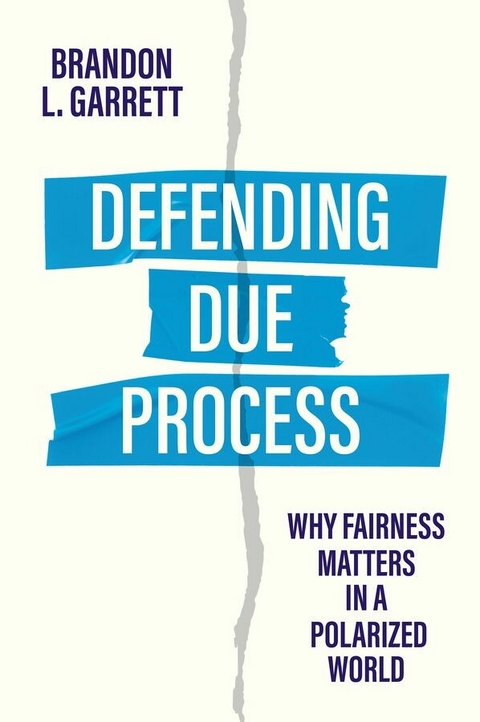
Defending Due Process (eBook)
330 Seiten
Polity (Verlag)
978-1-5095-6388-3 (ISBN)
Why is process under so much pressure? Brandon Garrett exposes widening fault lines. One division lies within our own attitudes, and he explores why we are tempted to put desired outcomes before fair process. Another lies in government, as judges adopt toothless due process rules. People are trapped in debt for unpaid traffic fines; sheriffs seize and forfeit belongings; algorithms suspend teachers' employment; officials use flawed data to cancel healthcare; and magistrates order arrestees jailed because they cannot pay cash bail. Meanwhile, the rise of AI threatens what remains of due process with black box technology.
To fight against such unfairness, lawyers try to challenge unjust systems, researchers demonstrate why such processes are so counterproductive, and lawmakers try to enact new protections. Common ground matters now more than ever to mend political polarization, cool simmering distrust of government, prevent counterproductive errors, and safeguard constitutional rights. A revival of due process is long overdue.
Brandon L. Garrett is the L. Neil Williams, Jr. Professor of Law at Duke University.
We all feel unfairness deeply when treated in rash ways. We expect, and the law requires, government officials to take fairness seriously, giving us notice and an opportunity to be heard before taking our rights away. That is why the U.S. Constitution commands, twice, that no one shall be deprived of life, liberty, or property without due process of law. Yet, in overheated debates, people argue that others do not deserve any presumption of innocence. In courtrooms and colleges, police stations and jails, restaurants and libraries, print and online, the democratic value of due process is up for grabs. Why is due process under so much pressure? Brandon Garrett exposes widening fault lines. One division lies within our own attitudes, and he explores why we are tempted to put desired outcomes before fair process. Another lies in government, as judges adopt toothless due process rules. People are trapped in debt for unpaid traffic fines; sheriffs seize and forfeit belongings; algorithms suspend teachers employment; officials use flawed data to cancel healthcare; and magistrates order arrestees to be jailed because they cannot pay cash bail. Meanwhile, the rise of AI threatens what remains of due process with black-box technology. To fight against such unfairness, lawyers try to challenge unjust systems, researchers demonstrate why such processes are so counterproductive, and lawmakers try to enact new protections. Common ground matters now more than ever to mend political polarization, cool simmering distrust of government, prevent injudicious errors, and safeguard constitutional rights. A revival of due process is long overdue.
1
Introduction
Do you remember the first truly unfair thing that happened to you? Did you ever mutter “not fair” when an elementary school teacher, without giving you a warning or a chance to explain, punished you for something small, like talking in class to ask a classmate a question? Did you think that the teacher judged you too hastily? Did you lose respect for the teacher as a result?
Even at a young age, we feel unfairness deeply. When we feel that we have been treated unfairly, we aren’t always upset just by the outcome alone. We may also feel frustrated that we did not get to share our point of view, explain what happened, or contest the other person’s version of the facts. In short, we are upset that we did not receive a fair process.
If we are treated unfairly, sometimes we can do something about it. “Due process” is the legal term for a decision-making process that is fair. Due process entitles us to fair treatment from the government, and it is an important part of the court system. It is the basis, for example, of the right to a fair trial. We can insist on our due process rights, including in court, and in criminal and civil matters.
Although due process is very important, we also have a human tendency to want to deny it to people, particularly those we find unworthy. Take the trial of former Minneapolis police officer Derek Chauvin, convicted of George Floyd’s murder, in one of the most notorious police killings in American history. Some thought Chauvin did not deserve to receive a lengthy criminal trial, given that the killing was captured on video, for all to see. One college student put it this way: “I understand the due process of the law, but blatant murder cases like this should go over without a single question or moment’s hesitation of whether Chauvin would be convicted or not.”1 Many people likely shared that view.
A fair process in a court of law is important even when the facts seem incontrovertible. It is not just about getting the right outcome, but also showing that we are committed to making sure the process is fair. After the guilty verdict, Minnesota Attorney General Keith Ellison, who brought the prosecution, said he was “grateful we have a system where everyone, no matter how egregious their offense, is entitled to due process and fair treatment.”2 That sentiment is not always a very popular one, though. In this book, I explore how due process has come under pressure, and how to escape a battleground mentality to defend fairness for all.
What is due process?
It is not an accident that the concept of due process is central to many different important debates. Fairness matters to us personally and it matters to society. Today, complaints abound that people are given too much or too little due process in courtrooms and colleges, police stations and jails, restaurants, and libraries, in print media and online. While people may feel unfairness in any of those settings, our system is particularly concerned with protecting people from unfair treatment by the government, which the U.S. Constitution protects in two important clauses.
The concept of due process is as old as our nation. In 1789, the first U.S. Congress quickly adopted, and the states ratified, a group of amendments to the Constitution, which we call the Bill of Rights. The Fifth Amendment safeguards the pre-existing English concept of due process, stating that the federal government may not “deprive any person of life, liberty, or property without due process of law.” Due process rights are so important that they were repeated in a later amendment to the Constitution. Ratified after the Civil War, the Fourteenth Amendment filled an important gap by commanding that state governments, like the federal government, may not deprive persons of due process.3 As Supreme Court Justice Felix Frankfurter put it: “The history of American freedom is, in no small measure, the history of procedure.”4
Constitutions throughout the world reflect the same principles, as does international law. As the Universal Declaration of Human Rights puts it: “Everyone is entitled in full equality to a fair and public hearing by an independent and impartial tribunal.”5 The 1966 International Covenant on Civil and Political Rights (ICCPR), ratified by 170 countries, provides: “In the determination of any criminal charge against him, or of his rights and obligations in a suit at law, everyone shall be entitled to a fair and public hearing by a competent, independent and impartial tribunal established by law.”6 And the European Convention on Human Rights states: “Everyone is entitled to a fair and public hearing within a reasonable time by an independent and impartial tribunal established by law.”7 Whether it is called due process or the right to a fair trial, the concept is foundational around the world.
Due process, or fair trial rights, require that governments provide three fundamental protections to people: (1) notice of an accusation by the government, (2) an opportunity for a person to be heard in response, and (3) a neutral and impartial person – often, a judge – who will hear both sides before reaching a decision. Despite these protections, we continue to see examples of serious due process violations.
A due process breakdown
Take, for example, the challenges faced by a Florida resident, Chianne, when trying to keep her Medicaid health benefits. She was first alerted to a problem when she called her health plan, United Healthcare, to change her provider, three months after giving birth. The agent informed her that her coverage would be terminated at the end of the month. Chianne panicked – her 1-year-old child had been on Medicaid since being diagnosed with cystic fibrosis, a serious disease affecting the lungs and other organs.8 In addition to caring for her newborn baby, Chianne was caring for her toddler around the clock, while also being a full-time student. Without Medicaid, Chianne and her husband could not afford physical therapy, a nebulizer and chest compression vest to assist breathing, and life-saving prescription drugs that cost $26,000 a month without insurance. Given the high stakes of this government decision, due process protections should be very strong.
Imagine how you might design this process to make it more fair at the outset. Perhaps you would make sure that the government told the person that their health care coverage was about to end, why, and what they could do about it. Especially for people with urgent health needs, that should not be too hard or too costly.
Now consider what happened next to Chianne. After getting off the phone with the agent, she checked her Florida Department of Health online portal and saw a twelve-page document titled “Notice of Case Action.” Reading it, she was more confused. The document listed all four people in her household as ineligible, stating: “YOU ARE RECEIVING THE SAME TYPE OF ASSISTANCE FROM ANOTHER PROGRAM.” Chianne was unaware of what that might refer to. Additional language said: “YOUR HOUSEHOLD’S INCOME IS TOO HIGH TO QUALIFY FOR THIS PROGRAM.” It did not explain why their income was too high. Finding the rest of the letter equally bewildering, Chianne recalled writing down “17 or 18 questions that I had regarding the inconsistencies and confusing language.”
If you were in that situation, what would you do?
The next day, Chianne called the state information line to see if a conscientious state employee could fix the problem. The agent said: “I’m not going to sit here and answer your questions,” and “I don’t know why you’re not getting this.” When Chianne asked specific questions, the agent responded, “I have a rule that says I cannot talk to you for more than 20 minutes.” Talking to a person clearly did not help.
Now what would you do? You might try to appeal. However, the online document Chianne read included a threat: “You will be responsible to repay any benefits if the hearing decision is not in your favor.” This too was false: a state is only allowed to seek money back from a person who has engaged in intentional fraud.9 But Chianne did not know that, could not afford a lawyer, and did not request an appeal.
Did Chianne receive any of the three elements of due process? The first element requires adequate notice of the government’s action. Chianne had no idea her family might lose health coverage. The state did post a confusing document on the online health portal. Should due process also make sure that the reasons stated be understandable and accurate? Indeed, federal law requires sending the person a “clear statement of the specific reasons” before altering or ending Medicaid benefits. That is how the law complies with the requirement of due process.10 Turning to the second element, an opportunity to be heard, Chianne did not request a hearing, fearing a further financial penalty. As a result, she never benefited from the third element of due process, an impartial judicial officer, who could have considered her evidence. In sum, there are good reasons to think Chianne failed to receive due process.
You could no doubt come up with a process much fairer than the one Chianne experienced. A fairer process for reviewing people’s eligibility for health care coverage might include a much clearer...
| Erscheint lt. Verlag | 13.11.2024 |
|---|---|
| Sprache | englisch |
| Themenwelt | Recht / Steuern ► Allgemeines / Lexika |
| Recht / Steuern ► EU / Internationales Recht | |
| Schlagworte | AI • Artificial Intelligence • Brandon Garrett • Brandon L Garrett • constitutional rights • Defending Due Process • Defending Due Process Why Fairness Matters in a Polarized World • Due Process • Due process of law • Fair hearing • fair trial • Garrett • Inequality • Law • Law Studies • Legal systems • legal theory • Political Polarization • unfairness • Why Fairness Matters in a Polarized World |
| ISBN-10 | 1-5095-6388-1 / 1509563881 |
| ISBN-13 | 978-1-5095-6388-3 / 9781509563883 |
| Informationen gemäß Produktsicherheitsverordnung (GPSR) | |
| Haben Sie eine Frage zum Produkt? |
 EPUB (Adobe DRM)
Kopierschutz: Adobe-DRM
Adobe-DRM ist ein Kopierschutz, der das eBook vor Mißbrauch schützen soll. Dabei wird das eBook bereits beim Download auf Ihre persönliche Adobe-ID autorisiert. Lesen können Sie das eBook dann nur auf den Geräten, welche ebenfalls auf Ihre Adobe-ID registriert sind.
Details zum Adobe-DRM
Dateiformat: EPUB (Electronic Publication)
EPUB ist ein offener Standard für eBooks und eignet sich besonders zur Darstellung von Belletristik und Sachbüchern. Der Fließtext wird dynamisch an die Display- und Schriftgröße angepasst. Auch für mobile Lesegeräte ist EPUB daher gut geeignet.
Systemvoraussetzungen:
PC/Mac: Mit einem PC oder Mac können Sie dieses eBook lesen. Sie benötigen eine
eReader: Dieses eBook kann mit (fast) allen eBook-Readern gelesen werden. Mit dem amazon-Kindle ist es aber nicht kompatibel.
Smartphone/Tablet: Egal ob Apple oder Android, dieses eBook können Sie lesen. Sie benötigen eine
Geräteliste und zusätzliche Hinweise
Buying eBooks from abroad
For tax law reasons we can sell eBooks just within Germany and Switzerland. Regrettably we cannot fulfill eBook-orders from other countries.
aus dem Bereich


