


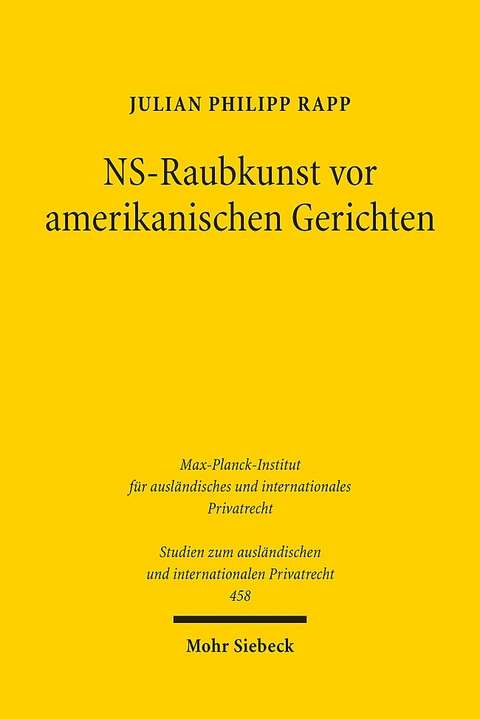
NS-Raubkunst vor amerikanischen Gerichten
Aktuelle Entwicklungen der "restitution litigation" in den USA
Seiten
The restitution of art lost during or shortly after World War II is a difficult matter - not only from an ethical and historical perspective, but above all from a legal point of view. While the restitution litigation of Nazi looted art in Germany has largely come to an end and questions concerning the restitution of war-related losses are being dealt with on a political level or by means of alternative dispute resolution mechanisms, a different approach can be observed in the USA. Since restitution claims can still be successfully asserted in court - even 75 years after World War II -, restitution litigation has recently experienced a renaissance. Julian Philipp Rapp examines how US courts handle restitution claims of Nazi looted art.
The restitution of art lost during or shortly after World War II is a difficult matter - not only from an ethical and historical perspective, but above all from a legal point of view. While the restitution litigation of Nazi looted art in Germany has largely come to an end and questions concerning the restitution of war-related losses are being dealt with on a political level or by means of alternative dispute resolution mechanisms, a different approach can be observed in the USA. Since restitution claims can still be successfully asserted in court - even 75 years after World War II -, restitution litigation has recently experienced a renaissance. Julian Philipp Rapp examines how US courts handle restitution claims of Nazi looted art.
The restitution of art lost during or shortly after World War II is a difficult matter - not only from an ethical and historical perspective, but above all from a legal point of view. While the restitution litigation of Nazi looted art in Germany has largely come to an end and questions concerning the restitution of war-related losses are being dealt with on a political level or by means of alternative dispute resolution mechanisms, a different approach can be observed in the USA. Since restitution claims can still be successfully asserted in court - even 75 years after World War II -, restitution litigation has recently experienced a renaissance. Julian Philipp Rapp examines how US courts handle restitution claims of Nazi looted art.
Geboren 1988; 2013 Erstes Juristisches Staatsexamen; 2015 Zweites Juristisches Staatsexamen; 2017 Master of Laws (LL.M.), University of Cambridge; 2017-18 Anwaltliche Tätigkeit in einer Revisionskanzlei am Bundesgerichtshof; 2018 Promotion; 2023 Habilitation; Privatdozent am Institut für deutsches und ausländisches Zivilprozessrecht, Abt. 2. der Universität Freiburg i.Br.
| Erscheinungsdatum | 19.12.2020 |
|---|---|
| Reihe/Serie | Studien zum ausländischen und internationalen Privatrecht |
| Verlagsort | Tübingen |
| Sprache | deutsch |
| Maße | 157 x 232 mm |
| Gewicht | 429 g |
| Themenwelt | Recht / Steuern ► Allgemeines / Lexika |
| Recht / Steuern ► EU / Internationales Recht | |
| Recht / Steuern ► Privatrecht / Bürgerliches Recht ► Internationales Privatrecht | |
| Recht / Steuern ► Privatrecht / Bürgerliches Recht ► Zivilverfahrensrecht | |
| Schlagworte | Ersitzung • Herausgabeklagen • Kunstrestitution • Staatenimmunität • Verjährung |
| ISBN-10 | 3-16-159971-3 / 3161599713 |
| ISBN-13 | 978-3-16-159971-2 / 9783161599712 |
| Zustand | Neuware |
| Informationen gemäß Produktsicherheitsverordnung (GPSR) | |
| Haben Sie eine Frage zum Produkt? |
Mehr entdecken
aus dem Bereich


aus dem Bereich
der Pflichtstoff
Buch | Softcover (2025)
C.H.Beck (Verlag)
CHF 41,70
Buch | Softcover (2025)
C.H.Beck (Verlag)
CHF 48,85
bildende Kunst, Architektur, Design und Fotografie im deutschen und …
Buch | Hardcover (2024)
Mohr Siebeck (Verlag)
CHF 124,60


