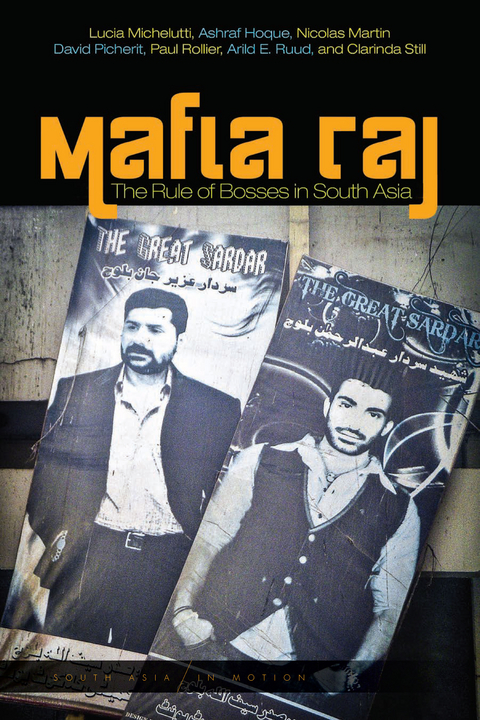
Mafia Raj (eBook)
352 Seiten
Stanford University Press (Verlag)
978-1-5036-0732-3 (ISBN)
"e;The authors . . . illustrate the 'art of bossing'-techniques and methods used by such figures to climb to power and maintain their sovereignty."e; -A. Y. Lee, Choice "e;Mafia"e; has become an indigenous South Asian term. Like Italian mobsters, the South Asian "e;gangster politicians"e; are known for inflicting brutal violence while simultaneously upholding vigilante justice inspiring fear and fantasy. But the term also refers to the diffuse spheres of crime, business, and politics operating within a shadow world that is popularly referred to as the rule of the mafia, or "e;Mafia Raj."e; Through intimate stories of the lives of powerful and aspiring bosses in India, Pakistan, and Bangladesh, this book illustrates their personal struggles for sovereignty as they climb the ladder of success. Ethnographically tracing the particularities of the South Asian case, the authors theorize what they call "e;the art of bossing,"e; providing nuanced ideas about crime, corruption, and the lure of the strongman across the world. "e;Through meticulous and uniquely collaborative ethnography, Mafia Raj opens readers' eyes to the murky world of bosses in South Asia. With unforgettable portraits of the gangsters, politicians, hustlers, and extortionists dotting the region, this is the rare scholarly account that upends our commonly accepted notions of democracy, formality, and legitimacy."e; Milan Vaishnav, author of When Crime Pays: Money and Muscle in Indian Politics "e;Why does the figure of 'the boss,' in its various guises, loom so large in South Asia? In answering this question, the authors of this engagingly written book make a path-breaking contribution to the study of South Asian politics."e; John Harriss, author of India: Continuity and Change in the Twenty-First Century
Lucia Michelutti is Professor of Anthropology at the University College London. Ashraf Hoque is Teaching Fellow in the Department of Anthropology at the University College London. Nicolas Martin is Assistant Professor at the University of Zurich. David Picherit is Research Fellow at the French National Centre for Scientific Research. Paul Rollier is Assistant Professor in South Asian Studies at the University of St. Gallen. Arild E. Ruud is Professor of South Asian Studies at the University of Oslo. Clarinda Still is Researcg Associate at the University College London.
Contents and AbstractsIntroduction: Introduction chapter abstractThis chapter introduces the analytical framework of the book. It centers on the concept of the "figure" of the boss and unpacks some of the key terms used in the rest of the book, such as "bossism," "Mafia Raj," "the art of bossing," and "mafia-owned democracy."1Backdrops chapter abstractChapter 1 maps the peculiar South Asian backdrop against which the bosses of this book stand out as figures of bossism in the first decade of the twenty-first century. It illustrates the criminal political economies at the heart of Mafia Raj; how vernacularized ideas and practice of democracy are used to pursue mafia-like businesses; the role of party machines in forging bosses' careers; and the multiple sources of protection that bosses need to cultivate to obtain and maintain impunity. It also outlines how "the art of making do" (jugad) transmogrifies into the art of bossing and how the informal economy brushes with organized crime.2The Rookie chapter abstractSet in provincial Bangladesh against the background of sprawling criminal activities from smuggling to money laundering and drugs, Chapter 2 shows how a well-educated young man uses his actor's skills and capacity for violence to become a mastan (enforcer) with a longer-term project to become an elected political "godfather." It describes a young entrepreneur at the very start of his career and the difficulties he encounters establishing his "will to boss."3The Bluffer chapter abstractChapter 3 is set in rural Indian Punjab. It features a lower-caste self-appointed boss who through bluffs and hustling, and by portraying himself as a Robin Hood who steals from corrupt politicians to provide for the poor, is trying to carve out for himself some authority in the local environment of power. During this process he is profiting by siphoning off state resources and acting as a vote contractor. His performances illustrate how the fantasy of the boss is deeply shaping the lives of ordinary people across South Asia and inspiring a craving for power.4The Henchman chapter abstractChapter 4 analyzes the volatile role of aides and associates in the management of bossism in Andhra Pradesh, South India. It shows how henchmen are bosses in their own rights and how they rule over their "jurisdictions," It also highlights how factionalism, class, and caste dynamics shape bossism hierarchies and how bosses control people or resources by subcontracting coercive control to their henchmen and runners.5The Adjudicators chapter abstractChapter 5 examines how criminal bosses seek to style themselves as informal adjudicators in Lahore's working-class neighborhoods. A variety of small-time and influential strongmen are presented to capture the distinctive appeal of extralegal forms of adjudication. The chapter illustrates how these men draw on popular fantasies of power rooted in the ideal of the "genteel gangster" to become informal adjudicators and to discipline through their capacity to kill with relative impunity. Contrary to other cases presented in this book, this chapter suggests that, depending on the political environment in which they operate, criminal formations in South Asia may also strive to maintain a distance from electoral politics.6Lady Dabang chapter abstractChapter 6 explores the rise of a town boss in what is popularly viewed as an extremely misogynist and muscular political world but is also one of the most vibrant laboratories of Indian democracy since independence: the state of Uttar Pradesh. It unravels the transition from traditional protectors to contemporary mafia-style bosses (dabang). The story brings to light the masculine character of bossism and the way women navigate through muscular and macho systems of governance and, in the process, develop particular bossing styles and statecraft techniques to enhance their authority.7The Godfather chapter abstractReturning to Bangladesh, in Chapter 7 we meet the "godfather," a typical figure in Bangladesh's politics. The chapter is about an elected Member of Parliament who is well known for using brutality and extortion to bolster his position and intimidate opponents and for having unsavory associates. He has used this combination of the licit and the illicit with success to the extent that he is now the unquestioned boss of his hometown southeast of Dhaka with a population of eight hundred thousand.8The Legend chapter abstractChapter 8 is the last of the ethnographic chapters. It takes up again in the South Indian state of Andhra Pradesh and examines the creation of a "boss-hero." Known as "the legend," Ravi is the exemplar Robin Hood figure who steals from his opponents and from the state and gives back to his own people. Born into the violent factional politics of the southern region of Andhra Pradesh, he was the deadly rival of a man in the opposing caste and the opposition party. Ravi's assassination in 2005 immortalized him as an icon of the Telugu Desam Party, and his widow upholds his political legacy in her ministerial position in the state cabinet today.Conclusion: The Art of Bossing chapter abstractThe concluding chapter sums up what we learned about the art of bossing and what we could learn in the future by focusing analytically on the figures of bossism. We argue that this prism has the potential to bridge fields of inquiry that have generally been studied and theorized separately, such as democracy, the state, business, violence, and crime. Such a holistic approach offers the possibility of further understanding the ways violence, coercion, crime, and money are embedded in social relations and how such relations contribute to creating charismatic forms of authority in South Asia and beyond.
| Erscheint lt. Verlag | 25.12.2018 |
|---|---|
| Reihe/Serie | South Asia in Motion | South Asia in Motion |
| Zusatzinfo | 3 halftones, 2 tables |
| Sprache | englisch |
| Themenwelt | Geisteswissenschaften ► Geschichte ► Regional- / Ländergeschichte |
| Recht / Steuern ► Strafrecht ► Kriminologie | |
| Sozialwissenschaften ► Ethnologie | |
| Sozialwissenschaften ► Pädagogik | |
| Sozialwissenschaften ► Politik / Verwaltung ► Staat / Verwaltung | |
| Sozialwissenschaften ► Soziologie | |
| Schlagworte | bossism • Democracy • leadership and authority • mafias |
| ISBN-10 | 1-5036-0732-1 / 1503607321 |
| ISBN-13 | 978-1-5036-0732-3 / 9781503607323 |
| Informationen gemäß Produktsicherheitsverordnung (GPSR) | |
| Haben Sie eine Frage zum Produkt? |
 EPUB (Adobe DRM)
Kopierschutz: Adobe-DRM
Adobe-DRM ist ein Kopierschutz, der das eBook vor Mißbrauch schützen soll. Dabei wird das eBook bereits beim Download auf Ihre persönliche Adobe-ID autorisiert. Lesen können Sie das eBook dann nur auf den Geräten, welche ebenfalls auf Ihre Adobe-ID registriert sind.
Details zum Adobe-DRM
Dateiformat: EPUB (Electronic Publication)
EPUB ist ein offener Standard für eBooks und eignet sich besonders zur Darstellung von Belletristik und Sachbüchern. Der Fließtext wird dynamisch an die Display- und Schriftgröße angepasst. Auch für mobile Lesegeräte ist EPUB daher gut geeignet.
Systemvoraussetzungen:
PC/Mac: Mit einem PC oder Mac können Sie dieses eBook lesen. Sie benötigen eine
eReader: Dieses eBook kann mit (fast) allen eBook-Readern gelesen werden. Mit dem amazon-Kindle ist es aber nicht kompatibel.
Smartphone/Tablet: Egal ob Apple oder Android, dieses eBook können Sie lesen. Sie benötigen eine
Geräteliste und zusätzliche Hinweise
Buying eBooks from abroad
For tax law reasons we can sell eBooks just within Germany and Switzerland. Regrettably we cannot fulfill eBook-orders from other countries.
aus dem Bereich