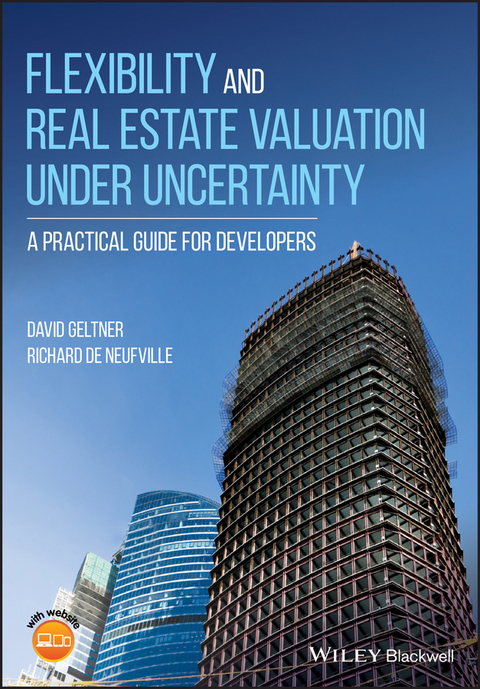
Flexibility and Real Estate Valuation under Uncertainty (eBook)
John Wiley & Sons (Verlag)
978-1-119-10648-7 (ISBN)
This book takes a practical 'engineering' approach to the valuation of options and flexibility in real estate. It presents simple simulation models built in universal spreadsheet software such as Microsoft Excel®. These realistically reflect the varying and erratic sources of uncertainty and price dynamics that uniquely characterize real estate. The text covers new analytic procedures that are valuable for existing properties and enable a new, more profitable perspective on the planning, design, operation, and evaluation of large-scale, multi-phase development projects. The book thereby aims to significantly improve valuation and investment decision making.
Flexibility and Real Estate Valuation under Uncertainty: A Practical Guide for Developers is presented at 3 levels. First, it introduces and explains the concepts underlying the approach at a basic level accessible to non-technical and non-specialized readers. Its introductory and concluding chapters present the important 'big picture' implications of the analysis for economics and valuation and for project design and investment decision making.
At a second level, the book presents a framework, a roadmap for the prospective analyst. It describes the practical tools in detail, taking care to go through the elements of the approach step-by-step for clarity and easy reference.
The third level includes more technical details and specific models. An Appendix discusses the technical details of real estate price dynamics. Associated web pages provide electronic spreadsheet templates for the models used as examples in the book.
Some features of the book include:
• Concepts and tools that are simple and accessible to a broad audience of practitioners;
• An approach relevant for all development projects;
• Complementarity with the author's Commercial Real Estate Analysis & Investments-the most-cited real estate investments textbook on the market.
Flexibility and Real Estate Valuation under Uncertainty: A Practical Guide for Developers is for everyone studying or concerned with the implementation of large-scale or multi-phase real estate development projects, as well as property investment and valuation more generally.
DAVID GELTNER, PhD is Professor of Real Estate Finance in the MIT Department of Urban Studies & Planning. He has taught for over 15 years in the MIT Center for Real Estate, playing a lead role in its Master of Science in Real Estate Development (MSRED) program. Geltner is a winner of the prestigious Pension Real Estate Association's Graaskamp Award for excellence and influence in the real estate investment industry.
RICHARD DE NEUFVILLE, PhD is Professor of Engineering Systems at the Massachusetts Institute of Technology. He has received many international professional and teaching awards, including the Sizer Award for the Most Significant Contribution to MIT Education.
Provides a revolutionary conceptual framework and practical tools to quantify uncertainty and recognize the value of flexibility in real estate developmentThis book takes a practical "e;engineering"e; approach to the valuation of options and flexibility in real estate. It presents simple simulation models built in universal spreadsheet software such as Microsoft Excel . These realistically reflect the varying and erratic sources of uncertainty and price dynamics that uniquely characterize real estate. The text covers new analytic procedures that are valuable for existing properties and enable a new, more profitable perspective on the planning, design, operation, and evaluation of large-scale, multi-phase development projects. The book thereby aims to significantly improve valuation and investment decision making.Flexibility and Real Estate Valuation under Uncertainty: A Practical Guide for Developers is presented at 3 levels. First, it introduces and explains the concepts underlying the approach at a basic level accessible to non-technical and non-specialized readers. Its introductory and concluding chapters present the important big picture implications of the analysis for economics and valuation and for project design and investment decision making.At a second level, the book presents a framework, a roadmap for the prospective analyst. It describes the practical tools in detail, taking care to go through the elements of the approach step-by-step for clarity and easy reference.The third level includes more technical details and specific models. An Appendix discusses the technical details of real estate price dynamics. Associated web pages provide electronic spreadsheet templates for the models used as examples in the book. Some features of the book include: Concepts and tools that are simple and accessible to a broad audience of practitioners; An approach relevant for all development projects; Complementarity with the author's Commercial Real Estate Analysis & Investments the most-cited real estate investments textbook on the market.Flexibility and Real Estate Valuation under Uncertainty: A Practical Guide for Developers is for everyone studying or concerned with the implementation of large-scale or multi-phase real estate development projects, as well as property investment and valuation more generally.
DAVID GELTNER, PhD is Professor of Real Estate Finance in the MIT Department of Urban Studies & Planning. He has taught for over 15 years in the MIT Center for Real Estate, playing a lead role in its Master of Science in Real Estate Development (MSRED) program. Geltner is a winner of the prestigious Pension Real Estate Association's Graaskamp Award for excellence and influence in the real estate investment industry. RICHARD DE NEUFVILLE, PhD is Professor of Engineering Systems at the Massachusetts Institute of Technology. He has received many international professional and teaching awards, including the Sizer Award for the Most Significant Contribution to MIT Education.
Authors’ Preface
What this book is about, and how to use it.
This book is a groundbreaking text for real estate developers and investors. It is about uncertainty: “unknown unknowns.” It shows how the flexibility that exists in real estate investments and development projects unlocks hidden value, and it provides easy‐to‐use tools to quantify that hidden value. If you are a developer or investor, you know that uncertainty pervades your decision‐making, and you intuitively realize the importance of flexibility for dealing with unexpected future outcomes. Flexibility includes such capabilities as the ability to sell a property whenever you choose, to delay a second phase of construction, or to change from building a hotel to building apartments. This book describes an approach to realistically quantifying the nature and effect of future uncertainty, and to putting a monetary value on these types of flexibilities.
Our approach is easy to use because it is based on the industry‐standard spreadsheets of discounted cash flow analysis. It efficiently calculates the values of flexibilities and options, and quantifies the nature of risks and opportunities. In contrast to the complex, highly mathematical procedures that academics and some Wall Street or City “rocket scientists” often use to calculate option value, the approach we present is intuitive, transparent, easy to implement, and, we think, more informative for real estate decision‐makers. The procedures described in this book are direct analogs of management decision‐making, not academic economic models of market equilibrium. In the real world of real estate investment decision‐making, this approach adds fundamental and crucial aspects of reality that are currently too much ignored or treated only with seat‐of‐the‐pants intuition. Namely, we include the explicit and quantitative consideration of uncertainty and flexibility.
The text presents and describes in detail this innovative and simple approach to valuing the types of real estate flexibility that commonly exist in real‐world investment and development. Building naturally and easily on the familiar current practice of project valuation and financial analysis, the procedure we present completes the analysis and makes it much more powerful and useful. It enhances one’s capability to evaluate the multiple, interacting options and contingencies that arise from market changes. Importantly, it does more than calculate the expected, or average, value of real estate options. It describes the range of possible outcomes, and so informs users about the possible risks and rewards, quantifying the “downside” and the “upside.” We believe it does so with sufficient depth and realism to usefully inform project planning and design decisions.
Essentially, we exploit the power of modern personal computers, combined with knowledge derived from newly available empirical data about real estate markets. Instead of using complex mathematical computations based on limited assumptions about the nature of uncertainty (for example, the random walk assumption), we use laptops to explore in detail what may actually occur. The procedure simulates the effects of the many different kinds of uncertainties that may exist, and considers the implications of a range of possible decisions that managers might take. This enables users to explore strategies of management and development in the light of a sophisticated valuation of the flexibility that exists. You can think of our approach as providing a way for decision‐makers—with more, or less, experience—to transform their intuitive sense of managing risks and exploiting opportunities into more solid, defensible, quantitative economic valuations of real estate options. Our approach is:
- Valuable: It unlocks added value by exploring options that might provide a significant increase in expected value; this may be done by exploiting upside opportunities, avoiding downside risks, and, in some cases, decreasing initial costs;
- Practical: It simply extends the standard spreadsheet‐based discounted cash flow analyses for valuing real estate projects that practitioners are already at ease with, requiring no additional special software; and
- Realistic: It builds on over 30 years of collaboration between the commercial real estate industry and the Center for Real Estate at the Massachusetts Institute of Technology (MIT), and over 90 years of combined professional investment, engineering, and teaching experience of the authors.
The Value Proposition
The book enables real‐world practitioners—managers, investors, and developers of real estate properties and projects—to evaluate their real estate options quantitatively. Practitioners can use this book to identify opportunities to increase their expected value using various types of flexibilities that can exist in real estate investment, and particularly in development projects. These opportunities arise from the possibilities to:
- Time the start, stop, or sale of developments or investments to their advantage;
- Change the mix of uses, or even the scale and density, in a development in accordance with changing market priorities; and
- In general, manage and develop properties’ flexibilities to exploit opportunities as they arise, while also avoiding risks that may crop up.
Taken together, these options allow developers to deal proactively with the many uncertainties that inevitably confront the development of real estate projects.
The use of options in real estate can significantly increase the expected value of real estate development in three ways. It can enable decision‐makers to:
- Exploit new opportunities arising from favorable upticks in market conditions;
- Reduce or avoid the downward consequences associated with unfavorable circumstances; and
- Increase the rate of return while reducing the risk in the return on investments, or reduce their initial capital requirements—for example, by delaying the implementation of project stages until the market becomes more favorable, or by resizing the initial investment to consider future expansion possibilities.
Users taking advantage of the flexibility of real options can put themselves ahead of the competition. The ability to identify greater value in investment and development projects will enable practitioners to win more opportunities. The capability to deploy innovative designs that enhance the value of new developments by incorporating valuable options should improve investment performance.
Using this approach to quantitatively document the value of options can strengthen the case for certain projects. In other cases, scenario exploration can reveal cautionary considerations that are important for investors and principals to take into account before launching the project. The methods in this book can help test the intuitive sense of opportunities and, where appropriate, demonstrate the value of options that developers are considering for a project. Reducing uncertainty by shining a more quantitative “light” on the nature of the risks faced by the developer, scenario and simulation analysis can better facilitate financing of potential projects (or weed out more risky projects). Overall, the solid analysis and the use of real estate options give practitioners an advantage over any competitors who ignore this new capability.
This innovative book is inherently future‐oriented. It describes how real estate valuation can evolve, learning from, but not repeating, the past. It’s for the new generation used to living in a world of “big data.”
Accessibility
Our approach is eminently accessible. It builds on the standard spreadsheet analyses that industry practitioners already use to evaluate projects. It extends this method to the valuation of options through commonsense and logic. It simply exploits the power of modern computers to search through a range of possibilities, to calculate the results of alternative actions, and to display those results in intuitively understandable ways. The process thus avoids the use of complicated mathematics.
We have designed the presentation for easy learning and adoption. We provide a suite of practical, realistic tools to value real estate options in different circumstances. We present this material in easy‐to‐read, bite‐sized steps. These steps build up from simple demonstrations to examples that have a degree of realism useful for actual business decision‐making. Illustrative cases and simple worked‐out examples guide users through the process. Beyond the book, an accompanying website provides spreadsheet templates that practitioners can download and adapt to their own needs.
The approach presented here results from the collaboration of two leading teachers at MIT, David Geltner and Richard de Neufville. Professor Geltner is the principal author of a leading industry text, Commercial Real Estate Analysis and Investments (3rd edition, OnCourse Learning). Professor de Neufville is the lead author of Flexibility in Engineering Design (MIT Press) and six other textbooks on systems analysis, planning, and design.
How to Use this Book
Before diving in, please take a moment to look at how we have structured the text. We have designed this book to smoothly and easily introduce real estate managers, investors, and...
| Erscheint lt. Verlag | 23.2.2018 |
|---|---|
| Sprache | englisch |
| Themenwelt | Recht / Steuern ► Wirtschaftsrecht |
| Wirtschaft ► Betriebswirtschaft / Management ► Rechnungswesen / Bilanzen | |
| Betriebswirtschaft / Management ► Spezielle Betriebswirtschaftslehre ► Immobilienwirtschaft | |
| Schlagworte | Business & Management • Call Option • David Geltner • Decision Rules • defensive and offensive options • delay options • Discounted Cash Flow • Discount Rate • distribution of results • Economics • Excel • expected net present value (ENPV) • expected value • Finance & Investments • Finanz- u. Anlagewesen • flaw of averages • flexibility • Forecast errors • Immobilien u. Grundbesitz • Internal Rate of Return (IRR) • Modular Production • Monte Carlo • multi-phase projects • multi-phase real estate projects • National Council of Real Estate Investment Fiduciaries (NCREIF) • net present value (NPV) • Ökonomie in Städten, ländlichen Räumen u. Regionen • operation of multi-phase real estate projects • opportunity cost of capital (OCC) • phasing options • Practical Guide for Developers • pricing factors • Product Mix • product options • pro forma cash flow • project evaluation • project start options • Property & Real Estate • Property valuation • Put Option • Real Estate • real estate design • Real Estate Development • Real Estate Investment • real estate options • real estate planning • Real Estate Valuation Under Uncertainty • Real Options • residual value of land • Richard de Neufville • Risk Aversion • scatterplots • Simulation • spreadsheet • target curves • timing options • trigger values • Urban, Rural & Regional Economics • valuation of real estate options • Value at risk • Volatility • Volkswirtschaftslehre • Wirtschaft u. Management |
| ISBN-10 | 1-119-10648-6 / 1119106486 |
| ISBN-13 | 978-1-119-10648-7 / 9781119106487 |
| Informationen gemäß Produktsicherheitsverordnung (GPSR) | |
| Haben Sie eine Frage zum Produkt? |
 EPUB (Adobe DRM)
Kopierschutz: Adobe-DRM
Adobe-DRM ist ein Kopierschutz, der das eBook vor Mißbrauch schützen soll. Dabei wird das eBook bereits beim Download auf Ihre persönliche Adobe-ID autorisiert. Lesen können Sie das eBook dann nur auf den Geräten, welche ebenfalls auf Ihre Adobe-ID registriert sind.
Details zum Adobe-DRM
Dateiformat: EPUB (Electronic Publication)
EPUB ist ein offener Standard für eBooks und eignet sich besonders zur Darstellung von Belletristik und Sachbüchern. Der Fließtext wird dynamisch an die Display- und Schriftgröße angepasst. Auch für mobile Lesegeräte ist EPUB daher gut geeignet.
Systemvoraussetzungen:
PC/Mac: Mit einem PC oder Mac können Sie dieses eBook lesen. Sie benötigen eine
eReader: Dieses eBook kann mit (fast) allen eBook-Readern gelesen werden. Mit dem amazon-Kindle ist es aber nicht kompatibel.
Smartphone/Tablet: Egal ob Apple oder Android, dieses eBook können Sie lesen. Sie benötigen eine
Geräteliste und zusätzliche Hinweise
Buying eBooks from abroad
For tax law reasons we can sell eBooks just within Germany and Switzerland. Regrettably we cannot fulfill eBook-orders from other countries.
aus dem Bereich