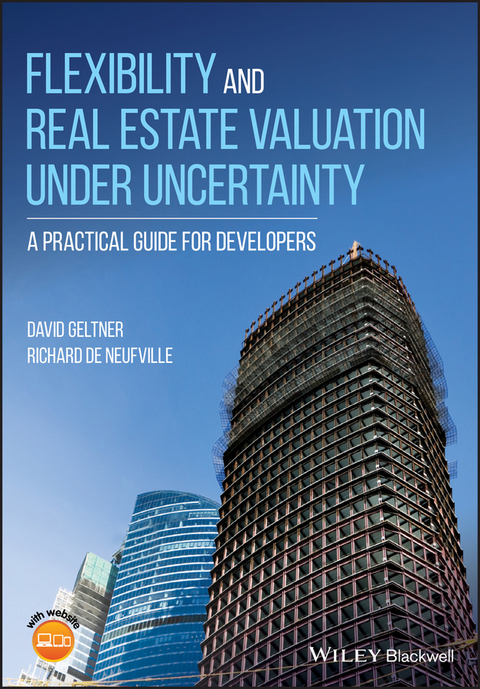
Flexibility and Real Estate Valuation under Uncertainty (eBook)
John Wiley & Sons (Verlag)
978-1-119-10645-6 (ISBN)
This book takes a practical 'engineering' approach to the valuation of options and flexibility in real estate. It presents simple simulation models built in universal spreadsheet software such as Microsoft Excel®. These realistically reflect the varying and erratic sources of uncertainty and price dynamics that uniquely characterize real estate. The text covers new analytic procedures that are valuable for existing properties and enable a new, more profitable perspective on the planning, design, operation, and evaluation of large-scale, multi-phase development projects. The book thereby aims to significantly improve valuation and investment decision making.
Flexibility and Real Estate Valuation under Uncertainty: A Practical Guide for Developers is presented at 3 levels. First, it introduces and explains the concepts underlying the approach at a basic level accessible to non-technical and non-specialized readers. Its introductory and concluding chapters present the important 'big picture' implications of the analysis for economics and valuation and for project design and investment decision making.
At a second level, the book presents a framework, a roadmap for the prospective analyst. It describes the practical tools in detail, taking care to go through the elements of the approach step-by-step for clarity and easy reference.
The third level includes more technical details and specific models. An Appendix discusses the technical details of real estate price dynamics. Associated web pages provide electronic spreadsheet templates for the models used as examples in the book.
Some features of the book include:
• Concepts and tools that are simple and accessible to a broad audience of practitioners;
• An approach relevant for all development projects;
• Complementarity with the author's Commercial Real Estate Analysis & Investments-the most-cited real estate investments textbook on the market.
Flexibility and Real Estate Valuation under Uncertainty: A Practical Guide for Developers is for everyone studying or concerned with the implementation of large-scale or multi-phase real estate development projects, as well as property investment and valuation more generally.
DAVID GELTNER, PhD is Professor of Real Estate Finance in the MIT Department of Urban Studies & Planning. He has taught for over 15 years in the MIT Center for Real Estate, playing a lead role in its Master of Science in Real Estate Development (MSRED) program. Geltner is a winner of the prestigious Pension Real Estate Association's Graaskamp Award for excellence and influence in the real estate investment industry.
RICHARD DE NEUFVILLE, PhD is Professor of Engineering Systems at the Massachusetts Institute of Technology. He has received many international professional and teaching awards, including the Sizer Award for the Most Significant Contribution to MIT Education.
Provides a revolutionary conceptual framework and practical tools to quantify uncertainty and recognize the value of flexibility in real estate developmentThis book takes a practical "e;engineering"e; approach to the valuation of options and flexibility in real estate. It presents simple simulation models built in universal spreadsheet software such as Microsoft Excel . These realistically reflect the varying and erratic sources of uncertainty and price dynamics that uniquely characterize real estate. The text covers new analytic procedures that are valuable for existing properties and enable a new, more profitable perspective on the planning, design, operation, and evaluation of large-scale, multi-phase development projects. The book thereby aims to significantly improve valuation and investment decision making.Flexibility and Real Estate Valuation under Uncertainty: A Practical Guide for Developers is presented at 3 levels. First, it introduces and explains the concepts underlying the approach at a basic level accessible to non-technical and non-specialized readers. Its introductory and concluding chapters present the important big picture implications of the analysis for economics and valuation and for project design and investment decision making.At a second level, the book presents a framework, a roadmap for the prospective analyst. It describes the practical tools in detail, taking care to go through the elements of the approach step-by-step for clarity and easy reference.The third level includes more technical details and specific models. An Appendix discusses the technical details of real estate price dynamics. Associated web pages provide electronic spreadsheet templates for the models used as examples in the book. Some features of the book include: Concepts and tools that are simple and accessible to a broad audience of practitioners; An approach relevant for all development projects; Complementarity with the author's Commercial Real Estate Analysis & Investments the most-cited real estate investments textbook on the market.Flexibility and Real Estate Valuation under Uncertainty: A Practical Guide for Developers is for everyone studying or concerned with the implementation of large-scale or multi-phase real estate development projects, as well as property investment and valuation more generally.
DAVID GELTNER, PhD is Professor of Real Estate Finance in the MIT Department of Urban Studies & Planning. He has taught for over 15 years in the MIT Center for Real Estate, playing a lead role in its Master of Science in Real Estate Development (MSRED) program. Geltner is a winner of the prestigious Pension Real Estate Association's Graaskamp Award for excellence and influence in the real estate investment industry. RICHARD DE NEUFVILLE, PhD is Professor of Engineering Systems at the Massachusetts Institute of Technology. He has received many international professional and teaching awards, including the Sizer Award for the Most Significant Contribution to MIT Education.
Title Page 5
Copyright Page 6
Contents 9
Foreword 15
Authors’ Preface 19
Acknowledgments 23
About the Companion Website 25
Chapter 1 Discounted Cash Flow Valuation: The Basic Procedures and Concepts Underlying Spreadsheet Valuation Constitute the Springboard to our Approach of Analyzing Flexibility Under Uncertainty 27
1.1 Why the Focus on the Discounted Cash Flow Model? 28
1.2 Structure of a Discounted Cash Flow Spreadsheet 29
1.3 The Cash Flow Projection 31
1.4 Discount Rate 33
1.5 Market Value and Forward-Looking (Ex-Ante) Analysis 33
1.6 Backward-Looking (Ex-Post) Analysis 35
1.7 Conclusion 35
Chapter 2 Economics of the Discounted Cash Flow Valuation Model: Understanding the Discount Rate is Critical 37
2.1 Choice of Discount Rate 37
2.2 Differences between Discount Rate, Opportunity Cost of Capital, and Internal Rate of Return 39
2.3 Net Present Value 40
2.4 Relationship between Discount Rate, Growth Rate, and Income Yield 41
2.5 Relationship between Discount Rate and Risk 44
2.6 Conclusion 45
Chapter 3 Future Scenarios Matter: We Need to Recognize that Future Projections are Uncertain 47
3.1 The Standard Discounted Cash Flow Model Appears to be Deterministic 47
3.2 We Live in a World of Uncertainty 49
3.3 Discounted Cash Flow Pro Forma Cash Flows Are Expectations 50
3.4 Flexibility and Options 52
3.5 Conclusion 52
Chapter 4 Scenario Analysis: Future Scenarios can Significantly and Surprisingly Affect the Present Value 53
4.1 Discounted Cash Flow Scenario Analysis 53
4.2 Scenarios Affect Value 55
4.3 Flexibility Has Value 56
4.4 Conclusion 58
Chapter 5 Future Outcomes Cover a Range of Possibilities: We Can Describe Uncertainties in Real Estate Using Probability Distributions of Possible Future Outcomes 59
5.1 Distribution of Future Outcomes 60
5.2 Quantifying Input Distributions 60
5.3 Distributions of Outcomes Differ from Distributions of Inputs 64
5.4 Flaw of Averages 65
5.5 Conclusion 66
Chapter 6 Simulation of Outcomes: Simulation is a Practical, Efficient Way to Explore Uncertainty and to choose between Alternative Strategies for Managing it 67
6.1 Generating Scenarios 67
6.2 Real Estate Simulation in a Nutshell 68
6.3 Simulation Is an Efficient Process 69
6.4 Number of Trials 70
6.5 Conclusion 71
Chapter 7 Modeling Price Dynamics: Using Pricing Factors to Model the Dynamics of Real Estate Markets 73
7.1 Pricing Factors 73
7.2 Random Walks 75
7.3 Real Estate Pricing Factor Dynamics 77
7.4 Conclusion 78
Chapter 8 Interpreting Simulation Results: Target Curves and Scatterplots can be used to Graph the Distribution of the Sample Output 79
8.1 Target Curves 79
8.2 Comparing Target Curves 83
8.3 Value at Risk 83
8.4 Scatterplots 83
8.5 Conclusion 85
Chapter 9 Resale Timing Decision: Analysis: Let’s See what happens when we apply the Tools of Flexibility Analysis to a Classical Investment Decision: when to sell the Property 87
9.1 The Resale Timing Problem 88
9.2 Extending the Time Horizon of the Discounted Cash Flow Model 88
9.3 IF Statements 89
9.4 Trigger Value for Stop-Gain Rule 90
9.5 Value of Example Stop-Gain Rule 90
9.6 Conclusion 94
Chapter 10 Resale Timing Decision: Discussion: Let’s think about Additional Insights we can get from Simulation 95
10.1 Sensitivity Analysis 95
10.2 When to Use the Stop-Gain Rule 96
10.3 Implications of Flexibility for Property Valuation 97
10.4 Conclusion 98
Chapter 11 Development Project Valuation: This Chapter Looks at Valuation of Development Projects From an Investment Perspective, Considering Uncertainty, Flexibility, and Time-to-Build 99
11.1 Time-to-Build Difference between Development Projects and Existing Assets 100
11.2 Lower Opportunity Cost of Capital for Construction Costs 101
11.3 Illustrative Example 103
11.4 Residual Value of Development Land 104
11.5 Investment Risk in Development Project 105
11.6 Conclusion 106
Chapter 12 Basic Flexibility in Development Projects: The Most Basic Flexibility in Real Estate Development is the Option to Choose whether and when to Build 109
12.1 Review of Call (and Put) Options 110
12.2 Land as a Call Option on Development 111
12.3 Drivers of Option Value 111
12.4 A Practical Example of a Call (and Put) Option 112
12.5 Flexibility and Scenario Analysis for Development Projects 114
12.6 Conclusion 116
Chapter 13 Option Dichotomies: We Introduce a Typology of Flexibility in Development Projects 117
13.1 Three Dichotomies for Thinking Generally about Development Options 117
13.2 Defensive versus Offensive Options 118
13.3 Options “On” and “In” Projects 119
13.4 Timing Options versus Product Options 120
13.5 Conclusion 120
Chapter 14 Product Options in Development: We Discuss Three types of Product Options 121
14.1 Concept of Base Plan 121
14.2 Product Expansion Flexibility 122
14.3 Product Mix Flexibility 124
14.4 Conclusion 124
Chapter 15 Timing Options in Development: Now we Turn to the Types of Timing Options 125
15.1 Project Start-Timing Flexibility (The Delay Option) 125
15.2 Project Production Timing Flexibility 126
15.3 Modular Production Timing Flexibility 128
15.4 Phasing Timing Flexibility 129
15.5 Types of Phasing 129
15.6 Recognizing Defensive and Offensive Options in Simulation Results 130
15.7 Conclusion 133
Chapter 16 Garden City: An Example Multi-Asset Development Project: We Present the Traditional DCF Valuation Spreadsheet Model for the Example Development Project We use in the Rest of Book 135
16.1 Overview of Multi?Asset Development Project 136
16.2 Structure of a Realistic Multi-Asset Spreadsheet Pro Forma 137
16.3 Cash Flows for the Example Pro Forma 139
16.4 Temporal Profile for Base Case 141
16.5 Expected Economics of the Garden City Project 142
16.6 Conclusion 144
Chapter 17 Effect of Uncertainty without Flexibility in Development Project Evaluation: We Re-analyze the Garden City Project by Reflecting Uncertainty Without Flexibility 145
17.1 Modeling Uncertainty for the Multi-Asset Development Project 146
17.2 Generating Random Future Scenarios 148
17.3 Outcomes Reflecting Uncertainty for the Multi-Asset Development 149
17.4 Effect of Different Probability Inputs Assumptions 153
17.5 Conclusion 155
Chapter 18 Project Start-Delay Flexibility: We Model the Value of the Most Basic and Widely Available Development Project Option 157
18.1 Project Start-Delay Option 158
18.2 Option Exercise Decision Rule 158
18.3 Defining “Profit” in the Decision Model 160
18.4 Value of Start-Delay Flexibility in the Garden City Project 160
18.5 Conclusion 164
Chapter 19 Decision Rules and Value Implications: We Further Explore the Option to Delay the Project Start 165
19.1 Simple Myopic Delay Rule 166
19.2 Trigger Values 166
19.3 Value Implications of the Decision Rules 167
19.4 Effect of Trigger Values (Start or Delay Bias) 169
19.5 Review the Meaning of Flexibility Value 171
19.6 Conclusion 172
Chapter 20 Modular Production Timing Flexibility: We Explore the Timing Option to Pause and Restart the Project Any Time After its Commencement 173
20.1 Modular Production Timing Flexibility 174
20.2 Modeling the Modular Production Option 174
20.3 Value of Modular Production Timing Flexibility 176
20.4 Effect of Trigger Values (Bias toward Pause or Continue) 178
20.5 Effect of Combining Start-Delay and Modular Production Delay Flexibility 180
20.6 Conclusion 183
Chapter 21 Product Mix Flexibility: This Chapter Presents the Option to Change Product Mix, and Examines the Effect of Volatility on Option Value 185
21.1 Product Mix Flexibility 186
21.2 Modeling the Product Mix Option 186
21.3 Value of Product Mix Flexibility 187
21.4 Effect of Combining Product Mix Flexibility and Timing Options 191
21.5 Effect of Correlation in the Product Markets on the Value of Product Mix Flexibility 193
21.6 Effect of Volatility on the Value of Flexibility 195
21.7 Conclusion 198
Chapter 22 Project Phasing Flexibility: We Show How to Model and Evaluate the Delay Flexibility Inherent in Project Phasing 199
22.1 Modeling the Sequential Phase Delay Option 199
22.2 Modifying the Garden City Project Plan 200
22.3 Project Economics 203
22.4 The Delay Decision Model 204
22.5 Exploring the Value of Project Phasing Flexibility 205
22.6 Conclusion 208
Chapter 23 Optimal Phasing: We Now look at Adding Phases, Delineating Phases, and Distinguishing them from Expansion Options 209
23.1 Effect of Increasing the Number of Phases 210
23.2 Principles for Optimal Phasing 212
23.3 What Is the Difference between a Phase and an Expansion Option? 216
23.4 Conclusion 217
Chapter 24 Overall Summary: We summarize the Main Takeaway Points from this Book 219
Appendix: Quantifying Real Estate Uncertainty: Let’s Think about the Inputs for Real Estate Simulation Models 223
A.1 The Real Estate System 224
A.2 Sources of Uncertainty and Some Practical Advice for Simulation 225
A.3 The Nature of Real Estate Price Dynamics and Uncertainty 227
A.4 PuttingIt All Together 235
Glossary 239
Acronyms and Symbols 245
Index 247
EULA 258
| Erscheint lt. Verlag | 19.2.2018 |
|---|---|
| Sprache | englisch |
| Themenwelt | Recht / Steuern ► Wirtschaftsrecht |
| Wirtschaft ► Betriebswirtschaft / Management ► Rechnungswesen / Bilanzen | |
| Betriebswirtschaft / Management ► Spezielle Betriebswirtschaftslehre ► Immobilienwirtschaft | |
| Schlagworte | Business & Management • Call Option • David Geltner • Decision Rules • defensive and offensive options • delay options • Discounted Cash Flow • Discount Rate • distribution of results • Economics • Excel • expected net present value (ENPV) • expected value • Finance & Investments • Finanz- u. Anlagewesen • flaw of averages • flexibility • Forecast errors • Immobilien u. Grundbesitz • Internal Rate of Return (IRR) • Modular Production • Monte Carlo • multi-phase projects • multi-phase real estate projects • National Council of Real Estate Investment Fiduciaries (NCREIF) • net present value (NPV) • Ökonomie in Städten, ländlichen Räumen u. Regionen • operation of multi-phase real estate projects • opportunity cost of capital (OCC) • phasing options • Practical Guide for Developers • pricing factors • Product Mix • product options • pro forma cash flow • project evaluation • project start options • Property & Real Estate • Property valuation • Put Option • Real Estate • real estate design • Real Estate Development • Real Estate Investment • real estate options • real estate planning • Real Estate Valuation Under Uncertainty • Real Options • residual value of land • Richard de Neufville • Risk Aversion • scatterplots • Simulation • spreadsheet • target curves • timing options • trigger values • Urban, Rural & Regional Economics • valuation of real estate options • Value at risk • Volatility • Volkswirtschaftslehre • Wirtschaft u. Management |
| ISBN-10 | 1-119-10645-1 / 1119106451 |
| ISBN-13 | 978-1-119-10645-6 / 9781119106456 |
| Informationen gemäß Produktsicherheitsverordnung (GPSR) | |
| Haben Sie eine Frage zum Produkt? |
 PDF (Adobe DRM)
Kopierschutz: Adobe-DRM
Adobe-DRM ist ein Kopierschutz, der das eBook vor Mißbrauch schützen soll. Dabei wird das eBook bereits beim Download auf Ihre persönliche Adobe-ID autorisiert. Lesen können Sie das eBook dann nur auf den Geräten, welche ebenfalls auf Ihre Adobe-ID registriert sind.
Details zum Adobe-DRM
Dateiformat: PDF (Portable Document Format)
Mit einem festen Seitenlayout eignet sich die PDF besonders für Fachbücher mit Spalten, Tabellen und Abbildungen. Eine PDF kann auf fast allen Geräten angezeigt werden, ist aber für kleine Displays (Smartphone, eReader) nur eingeschränkt geeignet.
Systemvoraussetzungen:
PC/Mac: Mit einem PC oder Mac können Sie dieses eBook lesen. Sie benötigen eine
eReader: Dieses eBook kann mit (fast) allen eBook-Readern gelesen werden. Mit dem amazon-Kindle ist es aber nicht kompatibel.
Smartphone/Tablet: Egal ob Apple oder Android, dieses eBook können Sie lesen. Sie benötigen eine
Geräteliste und zusätzliche Hinweise
Buying eBooks from abroad
For tax law reasons we can sell eBooks just within Germany and Switzerland. Regrettably we cannot fulfill eBook-orders from other countries.
aus dem Bereich