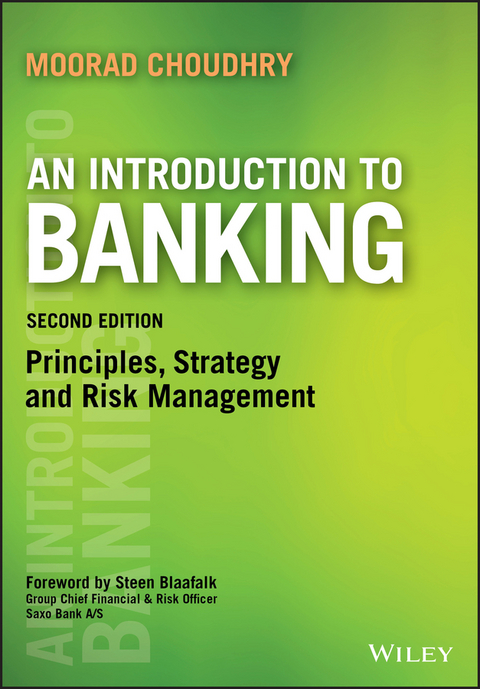
An Introduction to Banking (eBook)
John Wiley & Sons (Verlag)
978-1-119-11591-5 (ISBN)
Introduction to Banking, Second Edition is a comprehensive and jargon-free guide to the banking operation. Written at the foundational level, this book provides a broad overview of banking to give you an all-around understanding that allows you to put your specialty work into context within the larger picture of your organization. With a specific focus on risk components, this second edition covers all key elements with new chapters on reputational risk, credit risk, stress testing and customer service, including an updated chapter on sustainability. Practical material includes important topics such as the yield curve, trading and hedging, asset liability management, loan origination, product marketing, reputational risk and regulatory capital.
This book gives you the context you need to understand how modern banks are run, and the key points operation at all levels.
- Learn the critical elements of a well-structured banking operation
- Examine the risk components inherent in banking
- Understand operational topics including sustainability and stress testing
- Explore service-end areas including product marketing and customer service
Banks continue to be the heart of the modern economy, despite the global financial crisis -they have however become more complex. Multiple layers and a myriad of functions contribute to the running of today's banks, and it's critical for new and aspiring bankers to understand the full breadth of the operation and where their work fits in. Introduction to Banking, Second Edition provides an accessible yet complete primer, with emphasis on the areas that have become central to sustainable banking operation.
Professor Moorad Choudhry lectures on the MSc Finance programme at University of Kent Business School. He was previously Treasurer, Corporate Banking Division at The Royal Bank of Scotland, Head of Treasury at Europe Arab Bank, Head of Treasury at KBC Financial Products, Vice President in structured finance services at JPMorgan Chase and a gilt-edged market maker at ABN Amro Hoare Govett Ltd. He is a Fellow of the Chartered Institute for Securities & Investment, a Fellow of the London Institute of Banking and Finance, a Fellow of the Global Association of Risk Professionals and a Fellow of the Institute of Directors.
Professor Moorad Choudhry lectures on the MSc Finance programme at University of Kent Business School. He was previously Treasurer, Corporate Banking Division at The Royal Bank of Scotland, Head of Treasury at Europe Arab Bank, Head of Treasury at KBC Financial Products, Vice President in structured finance services at JPMorgan Chase and a gilt-edged market maker at ABN Amro Hoare Govett Ltd. He is a Fellow of the Chartered Institute for Securities & Investment, a Fellow of the London Institute of Banking and Finance, a Fellow of the Global Association of Risk Professionals and a Fellow of the Institute of Directors.
Cover 1
Title Page 5
Copyright 6
Contents 9
Foreword 11
Preface 13
Preface to the First Edition 17
Acknowledgements 19
About the Author 21
Part I: Bank Business and the Markets 23
Chapter 1: Bank Business and Capital 25
The Basic Bank Business Model 26
Banking Business 29
Scope of Banking Activities 31
Banking Products 36
Capital Markets 41
Financial Statements and Ratios 43
Bibliography 50
Chapter 2: Customer Services and Marketing for Bank Products 51
Marketing Financial Services 54
Customer Service 58
Product Development 63
Product Pricing 64
Conclusion 69
Chapter 3: Credit Assessment and Managing Credit Risk 71
Part 1 72
Credit Process 72
Loan Origination Process Standards 74
Qualitative Factors: Retail and Non-Retail Exposures 76
Internal Ratings 78
Counterparty Risk Parameters 82
Defaults Events and Measures 84
Product Credit Risk Measurement 87
Credit Risk Terminology 88
Model Development 91
Risk Monitoring and Model Validation 93
Trading Book Credit Exposures 94
Part 2 98
Conclusions 115
Chapter 4: The Money Markets 117
Introduction 118
Securities Quoted on a Yield Basis 121
Securities Quoted on a Discount Basis 128
Commercial Paper 131
Repo 135
The Classic Repo 136
Repo Collateral 140
Legal Treatment 141
Margin 141
Foreign Exchange 143
FX Balance Sheet Hedging 150
Currencies Using Money Market Year Base of 365 Days 152
Chapter 5: The Yield Curve 153
Importance of the Yield Curve 154
Using the Yield Curve 155
Yield-to-Maturity Yield Curve 156
Analysing and Interpreting the Yield Curve 158
Theories of the Yield Curve 159
The Zero-Coupon Yield Curve 166
Constructing the bank's Internal Yield Curve 171
Calculation Illustrations 178
Understanding Forward Rates 180
Sonia Yield Curve 181
Conclusions 183
Appendix 184
Bibliography 188
Chapter 6: Introduction to Money Market Dealing and Hedging 189
Money Market Approach 190
ALM in a Negative Yield Curve Environment 192
Credit Intermediation by the Repo Desk 193
Interest-Rate Hedging Tools 198
Bibliography 224
Part II: Asset-Liability Management and Liquidity Risk 227
Chapter 7: Bank Asset and Liability Management I 229
Basic Concepts 231
Liquidity Gap 234
Managing Liquidity 238
Liquidity Management 249
The ALM Desk 256
Critique of the Traditional Approach to ALM 263
Strategic ALM 264
Conclusions 266
Bibliography 267
Chapter 8: Asset and Liability Management II: The ALCO 269
Traditional ALCO Mission 270
ALCO Governance Best-Practice Principles 273
Conclusions 280
Appendix 8.1: 281
ALCO Recommended Terms of Reference 281
Chapter 9: Bank Liquidity Risk Management I 287
Best-Practice Liquidity Risk Management Framework 288
The Liquidity Policy Statement 296
Conclusion 308
Chapter 10: Liquidity Risk Management II: Basel III Liquidity, Liabilities Strategy, Stress Testing, Collateral Management and the HQLA 309
Basel III Liquidity Metrics 310
Optimum Liabilities Strategy and Managing the High-Quality Liquid Assets (HQLA) Portfolio 315
The Liquid Asset Buffer 322
Liquidity Reporting, Stress Testing, ILAAP, and Asset Encumbrance Policy 325
Liquidity Stress Testing 328
Individual Liquidity Adequacy Assessment Process 330
Intra-Day Liquidity Risk 331
Asset Encumbrance 334
Collateral Funding Management, FVA, and Central Clearing for OTC Derivatives 336
Conclusions 350
Chapter 11: Business Best-Practice Bank Internal Funds Transfer Pricing Policy 351
Background 352
Setting the bank Policy Standard 353
The Term Liquidity Premium 353
Template FTP Regimes 357
Conclusions 363
Chapter 12: Net Interest Income (NII), Net Interest Margin (NIM) and the Management of Interest-Rate Risk in the Banking Book 365
Net Interest Income 366
Net Interest Margin 366
Interest-Rate Risk in the Banking book 375
Simulation Analysis 383
The Management of Gap Risk 384
The Management of Basis and Option Risks 386
The Management of Prepayment Risk 389
The Management of Pipeline Risk 391
The Management of Cap and Floor Risk 392
Basel Committee: High-Level Principles for Interest-Rate Risk in the Banking Book 392
Conclusions 396
Chapter 13: Securitisation Mechanics for Balance Sheet Management 397
The Parties to a Securitisation 398
Structural Features of ABS 403
Practical Issues with Originating an Own-Asset Securitisation Transaction 404
Summary and Conclusions 410
Bibliography 411
Part III: Strategy, Regulatory Capital and Case Studies 413
Chapter 14: Strategy Setting 415
The Strategic Planning Process 417
Considerations in the Development of Strategy 420
Strategy and the Bank Business Model 424
Evaluation of the Strategic Plan 438
Conclusion 439
Bibliography 440
Chapter 15: Bank Regulatory Capital, Basel Rules and ICAAP 441
The Banking Model and Capital 442
Key Capital Considerations 449
Capital Management Policy 457
Capital Adequacy and Stress Testing 461
ICAAP Process – Worked Example of Presentation 476
Stress Testing 484
Dividend Policy 490
Case Study: Internal Capital Assessment 491
Conclusions 512
Bibliography 513
Chapter 16: Managing Operational Risk 515
Operational Risk Overview 516
Conduct Risk 518
Operational Risk Measurement 519
Operational Risk Measurement Concepts 519
Basel Operational Risk Framework 522
Standardised Approach 522
Qualitative Input and Model Validation 522
Operational Risk Management Framework 524
Conclusions 525
Chapter 17: Advice and Problem Solving: Case Studies 527
How to Study this Chapter 528
Appendix A: Financial Markets Arithmetic 553
Interest: Present and Future Value 554
Multiple Cash Flows 561
Corporate Finance Project Appraisal 565
Interpolation and Extrapolation 569
Appendix B: Abbreviations and Acronyms 571
Index 575
EULA 587
| Erscheint lt. Verlag | 19.2.2018 |
|---|---|
| Reihe/Serie | Securities and Investment Institute |
| Securities and Investment Institute | Securities Institute |
| Vorwort | Steen Blaafalk |
| Sprache | englisch |
| Themenwelt | Recht / Steuern ► Wirtschaftsrecht |
| Wirtschaft ► Betriebswirtschaft / Management ► Finanzierung | |
| Betriebswirtschaft / Management ► Spezielle Betriebswirtschaftslehre ► Bankbetriebslehre | |
| Schlagworte | bank functions • Banking Operations • banking overview • banking primer • banking principles • banking risk components • banking textbook • Bank Management • bank mechanics • beginner banking • critical banking elements • customer-side banking • elementary banking • Finance & Investments • Financial Services • Finanz- u. Anlagewesen • Finanzwesen • foundations of banking • fundamentals of banking • Geld u. Bankwesen • how banks work • introduction to banking • Introduction to Banking 2e: From Asset And Liability Management To The Yield Curve • key banking functions • Money & Banking • Moorad Choudhry • operational banking • Sustainable Banking • well-structured bank |
| ISBN-10 | 1-119-11591-4 / 1119115914 |
| ISBN-13 | 978-1-119-11591-5 / 9781119115915 |
| Informationen gemäß Produktsicherheitsverordnung (GPSR) | |
| Haben Sie eine Frage zum Produkt? |
 PDF (Adobe DRM)
Kopierschutz: Adobe-DRM
Adobe-DRM ist ein Kopierschutz, der das eBook vor Mißbrauch schützen soll. Dabei wird das eBook bereits beim Download auf Ihre persönliche Adobe-ID autorisiert. Lesen können Sie das eBook dann nur auf den Geräten, welche ebenfalls auf Ihre Adobe-ID registriert sind.
Details zum Adobe-DRM
Dateiformat: PDF (Portable Document Format)
Mit einem festen Seitenlayout eignet sich die PDF besonders für Fachbücher mit Spalten, Tabellen und Abbildungen. Eine PDF kann auf fast allen Geräten angezeigt werden, ist aber für kleine Displays (Smartphone, eReader) nur eingeschränkt geeignet.
Systemvoraussetzungen:
PC/Mac: Mit einem PC oder Mac können Sie dieses eBook lesen. Sie benötigen eine
eReader: Dieses eBook kann mit (fast) allen eBook-Readern gelesen werden. Mit dem amazon-Kindle ist es aber nicht kompatibel.
Smartphone/Tablet: Egal ob Apple oder Android, dieses eBook können Sie lesen. Sie benötigen eine
Geräteliste und zusätzliche Hinweise
Buying eBooks from abroad
For tax law reasons we can sell eBooks just within Germany and Switzerland. Regrettably we cannot fulfill eBook-orders from other countries.
aus dem Bereich