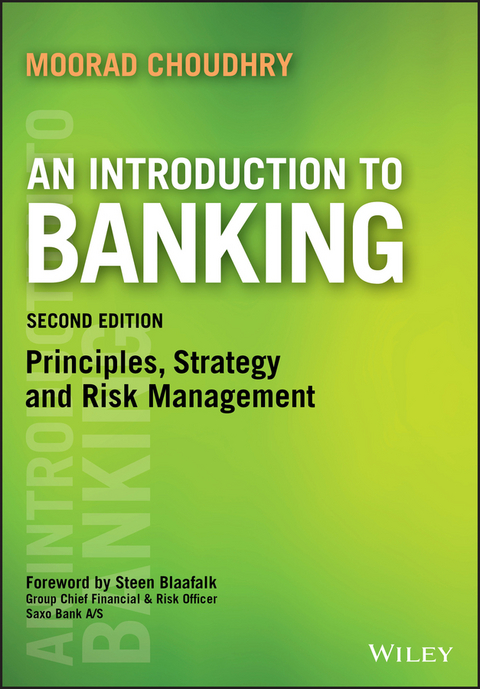
An Introduction to Banking (eBook)
John Wiley & Sons (Verlag)
978-1-119-11590-8 (ISBN)
Introduction to Banking, Second Edition is a comprehensive and jargon-free guide to the banking operation. Written at the foundational level, this book provides a broad overview of banking to give you an all-around understanding that allows you to put your specialty work into context within the larger picture of your organization. With a specific focus on risk components, this second edition covers all key elements with new chapters on reputational risk, credit risk, stress testing and customer service, including an updated chapter on sustainability. Practical material includes important topics such as the yield curve, trading and hedging, asset liability management, loan origination, product marketing, reputational risk and regulatory capital.
This book gives you the context you need to understand how modern banks are run, and the key points operation at all levels.
- Learn the critical elements of a well-structured banking operation
- Examine the risk components inherent in banking
- Understand operational topics including sustainability and stress testing
- Explore service-end areas including product marketing and customer service
Banks continue to be the heart of the modern economy, despite the global financial crisis -they have however become more complex. Multiple layers and a myriad of functions contribute to the running of today's banks, and it's critical for new and aspiring bankers to understand the full breadth of the operation and where their work fits in. Introduction to Banking, Second Edition provides an accessible yet complete primer, with emphasis on the areas that have become central to sustainable banking operation.
Professor Moorad Choudhry lectures on the MSc Finance programme at University of Kent Business School. He was previously Treasurer, Corporate Banking Division at The Royal Bank of Scotland, Head of Treasury at Europe Arab Bank, Head of Treasury at KBC Financial Products, Vice President in structured finance services at JPMorgan Chase and a gilt-edged market maker at ABN Amro Hoare Govett Ltd. He is a Fellow of the Chartered Institute for Securities & Investment, a Fellow of the London Institute of Banking and Finance, a Fellow of the Global Association of Risk Professionals and a Fellow of the Institute of Directors.
A practical primer to the modern banking operation Introduction to Banking, Second Edition is a comprehensive and jargon-free guide to the banking operation. Written at the foundational level, this book provides a broad overview of banking to give you an all-around understanding that allows you to put your specialty work into context within the larger picture of your organization. With a specific focus on risk components, this second edition covers all key elements with new chapters on reputational risk, credit risk, stress testing and customer service, including an updated chapter on sustainability. Practical material includes important topics such as the yield curve, trading and hedging, asset liability management, loan origination, product marketing, reputational risk and regulatory capital. This book gives you the context you need to understand how modern banks are run, and the key points operation at all levels. Learn the critical elements of a well-structured banking operation Examine the risk components inherent in banking Understand operational topics including sustainability and stress testing Explore service-end areas including product marketing and customer service Banks continue to be the heart of the modern economy, despite the global financial crisis they have however become more complex. Multiple layers and a myriad of functions contribute to the running of today's banks, and it's critical for new and aspiring bankers to understand the full breadth of the operation and where their work fits in. Introduction to Banking, Second Edition provides an accessible yet complete primer, with emphasis on the areas that have become central to sustainable banking operation.
Professor Moorad Choudhry lectures on the MSc Finance programme at University of Kent Business School. He was previously Treasurer, Corporate Banking Division at The Royal Bank of Scotland, Head of Treasury at Europe Arab Bank, Head of Treasury at KBC Financial Products, Vice President in structured finance services at JPMorgan Chase and a gilt-edged market maker at ABN Amro Hoare Govett Ltd. He is a Fellow of the Chartered Institute for Securities & Investment, a Fellow of the London Institute of Banking and Finance, a Fellow of the Global Association of Risk Professionals and a Fellow of the Institute of Directors.
Foreword ix
Preface xi
Preface to the First Edition xv
Acknowledgements xvii
About the Author xix
Part I Bank Business and the Markets 1
1 Bank Business and Capital 3
2 Customer Services and Marketing for Bank Products 29
3 Credit Assessment and Managing Credit Risk 49
4 the Money Markets 95
5 the Yield Curve 131
6 Introduction to Money Market Dealing and Hedging 167
Part II Asset-liability Management and Liquidity Risk 205
7 Bank Asset and Liability Management I 207
8 Asset and Liability Management II: the Alco 247
9 Bank Liquidity Risk Management I 265
10 Liquidity Risk Management II: Basel III Liquidity, Liabilities Strategy, Stress Testing, Collateral Management and the HQLA 287
11 Business Best-practice Bank Internal Funds Transfer Pricing Policy 329
12 Net Interest Income (NII), Net Interest Margin (NIM) and the Management of Interest-rate Risk in the Banking Book 343
13 Securitisation Mechanics for Balance Sheet Management 375
Part III Strategy, Regulatory Capital and Case Studies 391
14 Strategy Setting 393
15 Bank Regulatory Capital, Basel Rules and ICAAP 419
16 Managing Operational Risk 493
17 Advice and Problem Solving: Case Studies 505
Appendix A Financial Markets Arithmetic 531
Appendix B Abbreviations and Acronyms 549
Index 553
Chapter 1
BANK BUSINESS AND CAPITAL
Banking has a long and honourable history. Today, it encompasses a wide range of activities of varying degrees of complexity. Whatever the precise business undertaken by specific individual banks, the common denominator of all banking activities is that of bringing together those who require funding with those who possess surplus funding, and acting as a transmission mechanism for the processing of payments. That is in essence all that banks do, and while it isn't a complex service provision, it is nevertheless an important one. Societal and economic development worldwide relies on efficient banking service provision.
In this introductory chapter we describe the financial markets, the basic banking business model, and the concept of bank capital. We begin with a look at the business of banking. We then consider the different types of revenue generated by a bank, the concept of the banking book and the trading book, financial statements, and the concept of provisions. We also introduce the different products offered by banks to their customers.
THE BASIC BANK BUSINESS MODEL
The basic bank business model has remained unchanged ever since banks became an integral part of modern society.1 Of course, as it is more of an art than a science, the model parameters themselves can be set to suit the specific strategy of the individual bank, depending on whether the strategy operates at a higher or lower risk–reward profile. However, the basic model is identical across all banks. In essence, banking involves taking risks, followed by effective management of that risk. This risk can be categorised as follows:
- Managing the bank's capital;
- Managing the liquidity mismatch – a fundamental ingredient of banking is “maturity transformation”, the recognition that loans (assets) generally have a longer tenor than deposits (liabilities).
If we wished to summarise the basic ingredients of the historical bank model, we might describe it in the following terms:
- Leverage: A small capital base is levered up into an asset pool that can be 10 to 30 times greater (sometimes even higher);
- The “gap”: Essentially, funding short to lend long is a function of the conventional positive‐sloping yield curve and is dictated by recognition of the asset–liability mismatch noted above;
- Liquidity: An assumption that a bank will always be able to roll over funding as it falls due;
- Risk management: An understanding of credit or default risk.
These fundamentals remain unchanged. The critical issue for bank management, however, is that some of the assumptions behind the application of these fundamentals have changed, as demonstrated by the crash of 2007–2008. The changed landscape in the wake of the crisis has resulted in some hitherto “safe” or profitable business lines being viewed as risky. Although favourable conditions for banking may well return in due course, for the foreseeable future the challenge for banks will be to set their strategy only after first arriving at a true and full understanding of economic conditions as they exist today. The first subject for discussion is to consider what a realistic, sustainable return on the capital target level should be and to ensure that it is commensurate with the level of risk aversion desired by the Board. The Board should also consider the bank's capital availability and what amount of business this could realistically support. These two issues need to be addressed before the remainder of the bank's strategy can be considered.
Strategy
The most important function that a bank's Board can undertake is to set the bank's strategy. This is not as obvious as it sounds. It is vital that banks have a coherent, articulated strategy in place that sets the tone for the entire business from the top down.
In the first instance, the Board must take into account the current regulatory environment. This includes the requirements of the Basel III rules. A bank cannot formulate strategy without a clear understanding of the environment in which it operates. Once this is achieved – before proceeding with a formal strategy – the bank needs to determine what markets it wishes to operate in, and establish what products and what class of customer it wants to service. All its individual business lines should be set up to operate within the main strategy, once markets and customers have been identified.
In other words, a bank cannot afford to operate by simply meandering along, noting its peer group market share and Return on Equity (RoE) and making up its strategy as it goes along. This approach, although it would never be admitted, is evidently what many banks do indeed follow – however inadvertently – and results in a senior management and Board that is not fully aware of what the bank's liabilities and risk exposures are.
The first task is to understand one's operating environment. The bank also needs to incorporate a specific target market and product suite as the basis of its strategy. Concurrent with this, the bank must set its RoE target, which drives much of the bank's culture and ethos. It is important to get this part of the process right at the start. Prior to the crash, it was common for banks to seek to increase revenue by adding to their risk exposure. Assets were added to the balance sheet, or higher risk assets were taken on. In the bull market environment of 2001–2007 – allied to low funding costs as a result of low base interest rates – this resulted in ever higher RoE figures, to the point where it was common for even Tier 2 banks to target levels of 22–25% RoE in their business appraisal. This process was of course not tenable in the long run.
The second task – following on immediately from the first – is to set a realistic RoE target and one that is sustainable over the entire business cycle. This cannot be done without educating Board directors as well as shareholders, who must appreciate new, lower RoE targets. Managing expectations will contribute to a more dispassionate review of strategy. Just as importantly, risk‐adjusted RoE should also be set at a realistic level and not be allowed to increase. Hence, the Board and shareholders must accept that lower RoE levels will become the standard. This should also be allied to lower leverage levels and higher capital ratios.
Concurrently with the above process, a bank must ask itself where its strengths lie and formulate its strategy around that. In other words, it is important to focus on core competencies. Again, the experience of the crash has served to demonstrate that many banks found themselves with risk exposures that they did not understand. This may simply have been the holding of assets (such as structured finance securities) whose credit exposures, valuation, and secondary market liquidity they did not understand, or embarking on investment strategies such as negative basis trading without being aware of all the measurement parameters of such strategies.2 To implement a coherent, articulate strategy properly, a bank needs to be aware of exactly what it does have (or does not have) expertise for undertaking, and not operate in products or markets in which it has no genuine knowledge base.
Allied to an understanding of core competence is a review of core and non‐core assets. Bank strategy is not a static process or document, but rather a dynamic one. Regular reviews of the balance sheet need to be undertaken to identify any non‐core assets, which can then be assessed to determine whether they remain compatible with the strategy. If they are not, then a realistic disposal process would need to be drawn up. In the long run, this is connected with an understanding of where the bank's real strengths lie. Long‐term core assets may well differ from core assets, but this needs to be articulated explicitly. The decision on whether an asset is core or non‐core, or short‐term core or long‐term core, is a function of the bank's overall strategy – based on its expertise – and what markets and customers it wishes to service. This will be embedded in the strategy and the bank's business model. This drives the choice of products and business lines to which the bank feels it can add value.
BANKING BUSINESS
Banking operations encompass a wide range of activities, all of which contribute to the asset and liability profile of a bank. Table 1.1 shows selected banking activities and the type of risk exposure they represent. The terms used in the table, such as “market risk”, are explained elsewhere in this book. In another chapter we discuss the elementary aspects of financial analysis – using key financial ratios – that are used to examine the profitability and asset quality of a bank. We also discuss bank regulation and the concept of bank capital.
Table 1.1 Selected banking activities and services
| Service or function | Revenue generated | Risk |
| Lending |
| – Retail | Interest income, fees | Credit, market |
| – Commercial | Interest income, fees | Credit, market |
| – Mortgage | Interest income,... |
| Erscheint lt. Verlag | 20.2.2018 |
|---|---|
| Reihe/Serie | Securities and Investment Institute |
| Securities and Investment Institute | Securities Institute |
| Vorwort | Steen Blaafalk |
| Sprache | englisch |
| Themenwelt | Recht / Steuern ► Wirtschaftsrecht |
| Wirtschaft ► Betriebswirtschaft / Management ► Finanzierung | |
| Betriebswirtschaft / Management ► Spezielle Betriebswirtschaftslehre ► Bankbetriebslehre | |
| Schlagworte | bank functions • Banking Operations • banking overview • banking primer • banking principles • banking risk components • banking textbook • Bank Management • bank mechanics • beginner banking • critical banking elements • customer-side banking • elementary banking • Finance & Investments • Financial Services • Finanz- u. Anlagewesen • Finanzwesen • foundations of banking • fundamentals of banking • Geld u. Bankwesen • how banks work • introduction to banking • Introduction to Banking 2e: From Asset And Liability Management To The Yield Curve • key banking functions • Money & Banking • Moorad Choudhry • operational banking • Sustainable Banking • well-structured bank |
| ISBN-10 | 1-119-11590-6 / 1119115906 |
| ISBN-13 | 978-1-119-11590-8 / 9781119115908 |
| Informationen gemäß Produktsicherheitsverordnung (GPSR) | |
| Haben Sie eine Frage zum Produkt? |
 EPUB (Adobe DRM)
Kopierschutz: Adobe-DRM
Adobe-DRM ist ein Kopierschutz, der das eBook vor Mißbrauch schützen soll. Dabei wird das eBook bereits beim Download auf Ihre persönliche Adobe-ID autorisiert. Lesen können Sie das eBook dann nur auf den Geräten, welche ebenfalls auf Ihre Adobe-ID registriert sind.
Details zum Adobe-DRM
Dateiformat: EPUB (Electronic Publication)
EPUB ist ein offener Standard für eBooks und eignet sich besonders zur Darstellung von Belletristik und Sachbüchern. Der Fließtext wird dynamisch an die Display- und Schriftgröße angepasst. Auch für mobile Lesegeräte ist EPUB daher gut geeignet.
Systemvoraussetzungen:
PC/Mac: Mit einem PC oder Mac können Sie dieses eBook lesen. Sie benötigen eine
eReader: Dieses eBook kann mit (fast) allen eBook-Readern gelesen werden. Mit dem amazon-Kindle ist es aber nicht kompatibel.
Smartphone/Tablet: Egal ob Apple oder Android, dieses eBook können Sie lesen. Sie benötigen eine
Geräteliste und zusätzliche Hinweise
Buying eBooks from abroad
For tax law reasons we can sell eBooks just within Germany and Switzerland. Regrettably we cannot fulfill eBook-orders from other countries.
aus dem Bereich