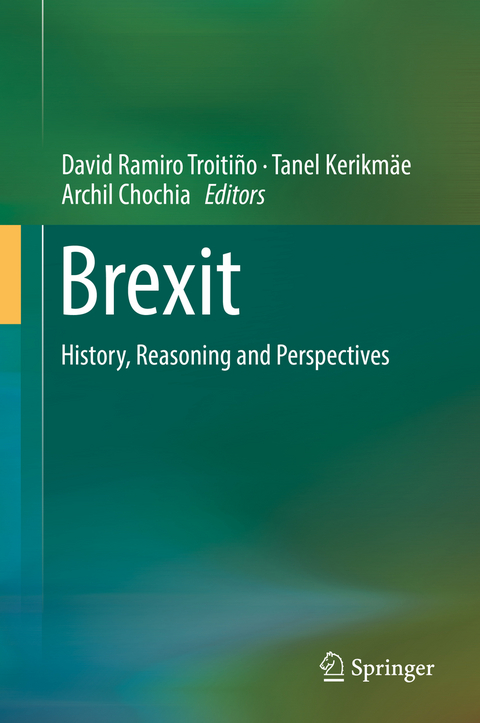
Brexit (eBook)
XVI, 283 Seiten
Springer International Publishing (Verlag)
978-3-319-73414-9 (ISBN)

David Ramiro Troitiño is a senior lecturer at Tallinn Law School of Tallinn University of Technology.Tanel Kerikmäe is Director of Tallinn Law School at Tallinn University of Technology.Archil Chochia is a researcher at Tallinn Law School of Tallinn University of Technology.
Foreword 5
Introduction 10
Contents 12
List of Contributors 14
Part I: Historical Approach of UK to the European Integration 16
First European and Pan-European Integration Efforts and British Reluctance 17
1 The First European Integration Proposals 17
2 The WWI, Jean Monnet and the Allied Maritime Transport Council 23
2.1 The Allied Maritime Transport Council 25
3 Coudenhove-Kalergi´s Pan-European Movement 28
References 33
The First Attempts to Unify Europe for Specific Purposes and British Flexibility 35
1 Aristide Briand and Memorandum on European Unity 35
2 WWII and a Franco-British Union 40
References 45
Cooperation or Integration? Churchill´s Attitude Towards Organization of Europe 47
1 Winston Churchill: Eurosceptic or European Integration Supporter? 47
1.1 Churchill. Personal and Historical Context 49
1.2 Political Ideas and Main Contributions 51
1.3 Churchill´s Main Ideas and Contributions to the European Integration 55
1.4 Winston Churchill and the European Building Process 55
2 Churchill´s Idea of Cooperation Versus Integration 57
3 Churchill´s Model of Europe 64
References 69
Part II: British Strategy to the European Communities Before Accession 71
The First European Community and the British Position 72
1 Introduction 72
2 The Treaty of Rome 75
3 The EFTA As an Alternative Plan 81
4 The First and Second Petitions of Membership 88
References 92
De Gaulle and the British Membership in the European Communities 95
1 Introduction 95
2 Facts About de Gaulle 96
3 De Gaulle and Europe 98
4 The Enlargement to the United Kingdom 100
5 The Empty Chair Crisis 103
6 Common Agricultural Policy 105
7 The Fouchet Proposals 107
8 Conclusions 108
References 109
Great Britain and Differentiated Integration in Europe 110
1 Introduction 111
2 Differentiated Integration As a Scholarly Concept 112
3 Referendum As a British Way of Formulating Its European Policies 115
4 Conclusion 120
References 122
Part III: The UK Inside the European Communities/Union 124
Enlargement to the UK, the Referendum of 1975 and Position of Margaret Thatcher 125
1 Introduction 125
2 Enlargement to the United Kingdom 127
3 The Referendum of 1975 131
4 The Vision of Margaret Thatcher About European Communities 133
4.1 Facts About Thatcher 134
4.2 Europe and the EU 135
4.3 The Cold War, the USA, and the EU 137
4.4 The European Communities Belong to All Its Members 138
4.5 The Community Is Not an End in Itself 139
4.6 National Power Against Supranational Constructions 139
4.7 Weak Bureaucracy 141
4.8 Policies of the EU 142
4.9 European Market 142
4.10 European Defence 144
4.11 Relations Between Europe and the USA 145
5 Conclusion 146
References 147
The British Rebate and the Single European Act: Political Ramifications of an Economic Reform 150
1 Introduction 150
2 The Crises and European Integration in the 1980s 152
3 The Spinelli Project and Genscher-Colombo Report: Setting the Path for European Integration 153
4 National Leaders as European Visionaries 155
5 The Single European Act (1986) 156
6 The Single Market and Political Integration 158
References 159
British Approach to the European Union: From Tony Blair to David Cameron 161
1 Introduction 161
2 Tony Blair and his Exceptionalist Doctrine 164
3 Cooperative Security Dilemma in Europe 166
4 From British Otherness to Re-Birth of English Nationalism 170
5 The Failure of Gordon Brown 173
6 The Pyrrhic Politics of David Cameron 175
7 Conclusions 178
References 179
The Single Currency and the UK 182
1 Introduction 182
2 Economic and Monetary Union 183
2.1 Single Currency 183
2.2 Primary Objective 184
2.3 Central Bank Independence 185
2.4 Independence in National Tasks 185
2.5 Monetary Financing Prohibition 186
2.6 Consultation of National Laws with the ECB 187
2.7 Subjecting the Bank of England Under the ECB´s Supervision 187
2.8 Banking Union 188
2.9 Coordination of Economic Policies 190
References 192
The British Role in the Emergence of Multi-Speed Europe and Enhanced Cooperation 193
1 Instruments of Differentiation in Integration 193
2 Enhanced Cooperation 196
3 Multi-Speed Europe 198
References 200
Part IV: The British and European Future 202
Article 50 of the Treaty on European Union: How to Understand the `Right´ of the Member State to Withdraw the European Union? 203
1 Introduction: The Problem of the Withdrawal from the EU Nowadays 203
2 Setting the Scene: The Situation Before Lisbon 207
3 An Express ``Exit Clause´´: A Birth That Lasted Twenty-Five Years 210
4 Two Alternatives of Withdrawal? Really? 213
4.1 The Unilateral Withdrawal 213
4.2 The Withdrawal Agreement 214
5 Conclusion 216
References 217
From EFTA to EC/EU and Back to EFTA? The European Economic Area (EEA) As a Possible Scenario for the UK-EU Relations After Bre... 219
1 Introduction: What Could Life After Brexit Look Like? 219
2 A Scenario for Institutionalising Brexit: The Legal Framework of the EEA 221
2.1 Institutional Law of the EFTA/EEA 222
2.1.1 The EFTA 223
2.1.2 The EEA 226
2.1.2.1 Bodies 226
2.1.2.2 EEA-Law and Decision-Making 227
2.2 Substantive EEA Law 229
2.2.1 Norms Regulating the EEA Internal Market 229
2.2.2 Homogeneity and Effect of EEA Law 230
2.2.2.1 Homogeneity 231
2.2.2.2 Direct Effect and Primacy of EEA-Law? 232
2.3 Potential Consequences of the UK´s Accession to the EEA 233
2.3.1 What Would Change for the UK in the EEA? 233
2.3.2 What Would Change for the EU with the UK in the EEA? 235
2.3.3 How About the Non-EU EEA Parties? 236
3 Is There a (Orderly) Life after Brexit? 236
References 237
The Brexit and Private International Law: An Outlook from the Consumer Insolvency Perspective 240
1 Introduction 240
2 What Follows the Brussels Regime? 241
2.1 Determining International Jurisdiction 241
2.2 Determining Applicable Substantial Law 242
2.2.1 Contracts 242
2.2.2 Non-Contractual Obligations 243
3 Practical Consequences at the Example of Consumer Insolvency Tourism 244
3.1 The Brexit´s Impact on Trans-Border Insolvency Proceedings 244
3.2 Special Focus: Consumer Insolvency Tourism 246
3.2.1 Background 246
3.2.2 Recognition of a Discharge Granted in the UK 247
3.2.3 The Brexit´s Impact on the Consumer Insolvency Tourism 248
4 Conclusion 250
References 250
Impact of the Article 50 of TEU on Migration of the EU Workers in Case of Brexit 252
1 Introduction 252
2 Application of Art. 50 of TEU 253
3 The EU Citizenship, Workers, and the Derived Rights 256
4 Impact of Brexit on Migration of Workers 260
5 Alternative Solutions for Rights of the EU Workers´ After Brexit 264
6 Conclusion 265
References 266
Legislation 267
Cases 267
Websites 267
The Scope and Specificity of Economic Relations Between the EU and the United Kingdom in Brexit Case 268
1 Introduction 269
2 Role of the UK in the Origins of European Communities: Period `til 1952 270
3 The UK Foreign European Economic Policy from 1952 `til 1973 272
4 Economic Aspects of the UK Membership in the EU 274
5 Identification of the Most Likely Brexit Strategy 279
6 Theoretical Implications of the Presumable EU-UK Free Trade Agreement 280
7 Theoretical Implications of Economic Relations Based on World Trade Organization Rules 282
8 Empirical Approach to the Further Economic Relations Between the EU and the UK 284
9 Conclusions 285
References 285
| Erscheint lt. Verlag | 19.2.2018 |
|---|---|
| Zusatzinfo | XVI, 283 p. 4 illus. in color. |
| Verlagsort | Cham |
| Sprache | englisch |
| Themenwelt | Geisteswissenschaften ► Geschichte ► Regional- / Ländergeschichte |
| Recht / Steuern ► EU / Internationales Recht | |
| Sozialwissenschaften ► Politik / Verwaltung | |
| Schlagworte | EU Integration • Euroscepticism • EU - UK relations • International Relations • Perspectives of the UK and the EU |
| ISBN-10 | 3-319-73414-8 / 3319734148 |
| ISBN-13 | 978-3-319-73414-9 / 9783319734149 |
| Informationen gemäß Produktsicherheitsverordnung (GPSR) | |
| Haben Sie eine Frage zum Produkt? |
 PDF (Wasserzeichen)
DRM: Digitales Wasserzeichen
Dieses eBook enthält ein digitales Wasserzeichen und ist damit für Sie personalisiert. Bei einer missbräuchlichen Weitergabe des eBooks an Dritte ist eine Rückverfolgung an die Quelle möglich.
Dateiformat: PDF (Portable Document Format)
Mit einem festen Seitenlayout eignet sich die PDF besonders für Fachbücher mit Spalten, Tabellen und Abbildungen. Eine PDF kann auf fast allen Geräten angezeigt werden, ist aber für kleine Displays (Smartphone, eReader) nur eingeschränkt geeignet.
Systemvoraussetzungen:
PC/Mac: Mit einem PC oder Mac können Sie dieses eBook lesen. Sie benötigen dafür einen PDF-Viewer - z.B. den Adobe Reader oder Adobe Digital Editions.
eReader: Dieses eBook kann mit (fast) allen eBook-Readern gelesen werden. Mit dem amazon-Kindle ist es aber nicht kompatibel.
Smartphone/Tablet: Egal ob Apple oder Android, dieses eBook können Sie lesen. Sie benötigen dafür einen PDF-Viewer - z.B. die kostenlose Adobe Digital Editions-App.
Buying eBooks from abroad
For tax law reasons we can sell eBooks just within Germany and Switzerland. Regrettably we cannot fulfill eBook-orders from other countries.
aus dem Bereich