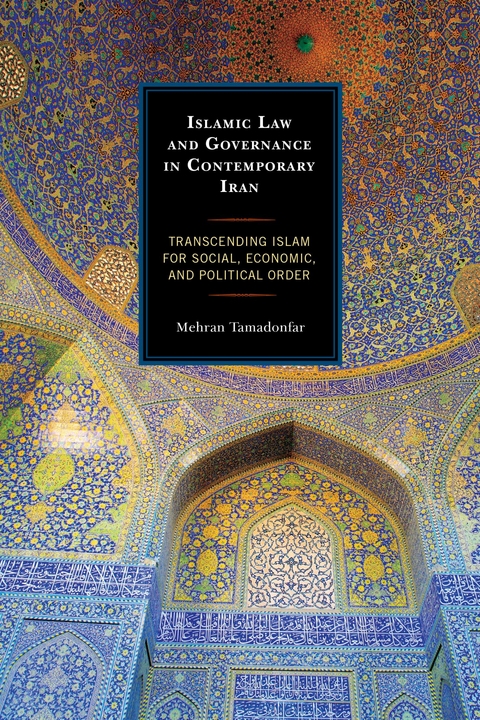
Islamic Law and Governance in Contemporary Iran (eBook)
386 Seiten
Rowman & Littlefield (Verlag)
978-1-4985-0757-8 (ISBN)
The current rise of Islamism throughout the Muslim world, Islamists' demand for the establishment of Islamic states, and their destabilizing impact on regional and global orders have raised important questions about the origins of Islamism and the nature of an Islamic state. Beginning with the Iranian revolution of the late 1970s and the establishment of the Islamic Republic to today's rise of ISIS to prominence, it has become increasingly apparent that Islamism is a major global force in the twenty-first century that demands acknowledgment and answers.As a highly-integrated belief system, the Islamic worldview rejects secularism and accounts for a prominent role for religion in the politics and laws of Muslim societies. Islam is primarily a legal framework that covers all aspects of Muslims' individual and communal lives. In this sense, the Islamic state is a logical instrument for managing Muslim societies. Even moderate Muslims who genuinely, but not necessarily vociferously, challenge the extremists' strategies are not dismissive of the political role of Islam and the viability of an Islamic state. However, sectarian and scholastic schisms within Islam that date back to the prophet's demise do undermine any possibility of consensus about the legal, institutional, and policy parameters of the Islamic state. Within its Shi'a sectarian limitations, this book attempts to offer some answers to questions about the nature of the Islamic state. Nearly four decades of experience with the Islamic Republic of Iran offers us some insights into such a state's accomplishments, potentials, and challenges. While the Islamic worldview offers a general framework for governance, this framework is in dire need of modification to be applicable to modern societies. As Iranians have learned, in the realm of practical politics, transcending the restrictive precepts of Islam is the most viable strategy for building a functional Islamic state. Indeed, Islam does provide both doctrinal and practical instruments for transcending these restrictions. This pursuit of pragmatism could potentially offer impressive strategies for governance as long as sectarian, scholastic, and autocratic proclivities of authorities do not derail the rights of the public and their demand for an orderly management of their societies.
Mehran Tamadonfar is associate professor of political science at the University of Nevada, Las Vegas.
Part I: The Islamic WorldviewVali-e Faqih or Rahbar)Chapter Six: The Governmental System: Power Imbalances and Extraordinary Checks Chapter Seven: Nuclear and Missile Programs, Policies, and the Sanctions RegimeConclusion
| Erscheint lt. Verlag | 20.5.2015 |
|---|---|
| Zusatzinfo | 6 Illustrations including: - 4 Charts; - 2 Tables. |
| Verlagsort | Lanham |
| Sprache | englisch |
| Themenwelt | Geisteswissenschaften ► Geschichte ► Regional- / Ländergeschichte |
| Geisteswissenschaften ► Religion / Theologie ► Islam | |
| Recht / Steuern ► Allgemeines / Lexika | |
| Recht / Steuern ► EU / Internationales Recht | |
| Sozialwissenschaften ► Soziologie ► Spezielle Soziologien | |
| Schlagworte | Doctrine of maslaht • Government and Politics in Iran • Iranian Constitution • Iran's nuclear policies • Islamic family law • Islamic Revolutionary Guards Corp • Islamism • Islamization of the law • Judicalization of politics • legal pragmatism in Islam • Shi'a jurisprudence |
| ISBN-10 | 1-4985-0757-3 / 1498507573 |
| ISBN-13 | 978-1-4985-0757-8 / 9781498507578 |
| Informationen gemäß Produktsicherheitsverordnung (GPSR) | |
| Haben Sie eine Frage zum Produkt? |
 EPUB (Adobe DRM)
Kopierschutz: Adobe-DRM
Adobe-DRM ist ein Kopierschutz, der das eBook vor Mißbrauch schützen soll. Dabei wird das eBook bereits beim Download auf Ihre persönliche Adobe-ID autorisiert. Lesen können Sie das eBook dann nur auf den Geräten, welche ebenfalls auf Ihre Adobe-ID registriert sind.
Details zum Adobe-DRM
Dateiformat: EPUB (Electronic Publication)
EPUB ist ein offener Standard für eBooks und eignet sich besonders zur Darstellung von Belletristik und Sachbüchern. Der Fließtext wird dynamisch an die Display- und Schriftgröße angepasst. Auch für mobile Lesegeräte ist EPUB daher gut geeignet.
Systemvoraussetzungen:
PC/Mac: Mit einem PC oder Mac können Sie dieses eBook lesen. Sie benötigen eine
eReader: Dieses eBook kann mit (fast) allen eBook-Readern gelesen werden. Mit dem amazon-Kindle ist es aber nicht kompatibel.
Smartphone/Tablet: Egal ob Apple oder Android, dieses eBook können Sie lesen. Sie benötigen eine
Geräteliste und zusätzliche Hinweise
Buying eBooks from abroad
For tax law reasons we can sell eBooks just within Germany and Switzerland. Regrettably we cannot fulfill eBook-orders from other countries.
aus dem Bereich