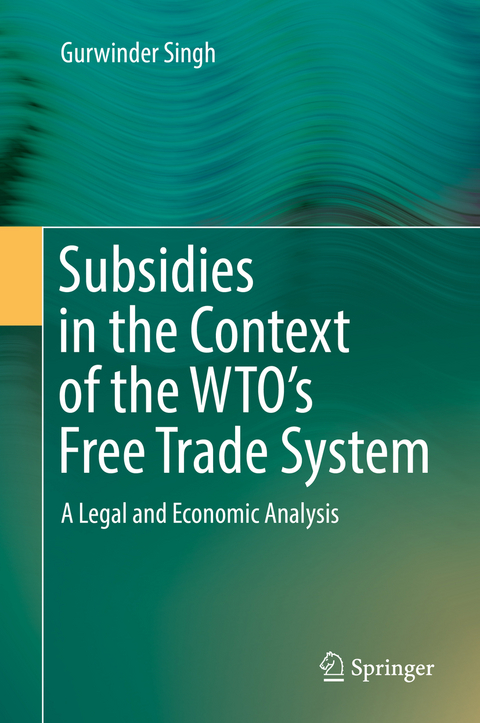
Subsidies in the Context of the WTO's Free Trade System (eBook)
XIX, 351 Seiten
Springer International Publishing (Verlag)
978-3-319-62422-8 (ISBN)
This book analyses subsidies from various perspectives and creates a model that determines whether or not their use is justified. Further, it analyses the various causes of trade distortion, trade-discriminatory practices, and other issues associated with unregulated subsidies. In addition, the book considers how these issues fall within the scope of subsidies described under the SCM Agreement.
The primary discussion from the perspective of WTO objective concerns the trade practice of awarding subsidies, for exports and also for protectionist purposes. Here, the terms justifiable and non-justifiable are used as hypothetical parameters to determine the extent of state support, considering the country classification based on economic and technological criteria, and their objectives for development. These parameters are distinct from Prohibited, Actionable, and Non-Actionable subsidies, as classified under the SCM Agreement.
Subsidies awarded for the purposes of development and for welfare are considered as justifiable, whereas subsidies for the promotion of exports or state measures adopted for protectionist purposes are non-justifiable. Lastly, the book addresses the implications of such subsidies on the core objectives of the WTO and in connection with fair trade values.
Acknowledgements and Thanks Giving 5
Contents 8
List of Abbreviations 13
Chapter 1: Regulating Free Trade from the WTO Perspective 18
1.1 General Discussion on Trading Activity from the Historical and Modern Perspective 19
1.2 Previous Trade Regulating Institutions Before the WTO, the ITO and GATT 20
1.3 What Is the WTO? 22
1.3.1 From the Perspective of the WTO Objectives 24
1.4 International Law Norms and the WTO 24
1.4.1 The WTO and the Domestic Legal System 28
1.4.2 Flexibility at the Normative Level, an Economic Necessity 28
1.5 The Political Economy Dimension 29
1.5.1 Free Trade Promoting Efficient Production 31
1.5.2 The Relationship Between the IMF and the WTO Identifying the Need for International Financial Coordination
1.6 The WTO System Based on Country Classification The Developing, Developed and Less-Developed Countries
1.6.1 The Less-Developed Countries 37
1.6.2 The Developing Countries 38
1.7 Free Trade and Fair Trade A Brief Discussion
1.8 Subsidies as a State Support Between Free Trade and Fair Trade 41
1.8.1 The Underlying Features of Fair Trade 41
1.8.2 MFN Clause for Promoting Free Trade 42
1.9 Subsidies for Development and Welfare A Brief Discussion
1.9.1 State Support Whether Justifiable or Non-justifiable 47
1.10 Subsidies from the WTO Perspective 49
1.10.1 The Regulation of Subsidies from the WTO Perspective 50
1.11 Conclusions 50
References 51
Cases 52
Reports and Electronic Sources 52
Chapter 2: Subsidies in International Trade from the WTO Perspective 53
2.1 New Trends in International Trade 53
2.1.1 Practices Versus Obligations 54
2.2 Subsidy and State-Aid, General Discussion. The WTO and EU as an Instance 55
2.2.1 State-Aid and Subsidy, the EU Approach (General Comparison) 57
2.3 Economic Aspects for Checking Subsidies 63
2.3.1 Subsidies in Relation to Production Function 69
2.3.2 Between Efficiency and Welfare 70
2.4 Subsidies Under GATT/WTO 71
2.4.1 Subsidies from GATT Onwards, a Brief Discussion 71
2.4.2 Party to SCM Agreement and Subsidies in Relations to the WTO 81
2.4.2.1 The Key Features of the WTO Subsidy Agreement 83
2.4.2.1.1 Financial Contribution 84
2.4.2.1.2 Benefit 91
2.4.2.1.3 The Recipients of Benefits or ``the Question of Specificity´´ 95
2.5 Classification of Subsidies 100
2.5.1 Prohibited Subsidies 101
2.5.1.1 Export Promoting Subsidies 101
2.5.1.1.1 Explaining Briefly the Illustrative List of Export Subsidies Under Annex I of the SCM Agreement 102
2.5.1.2 Subsidies Contingent upon the Use of Domestic over Imported Goods 108
2.6 Actionable Subsidies 109
2.6.1 Serious-Prejudice Article 6 112
2.7 Non-actionable Subsidies 115
2.8 Subsidies for Development 117
2.8.1 Commitments of the Industrialized Economies Under the GSP 117
2.8.2 Special and Differential Treatment, Article 27 of the SCM Agreement 119
2.8.2.1 Other Opinion (Critical of the Approach Adopted by the Appellate Body) 122
2.9 The North South Divides on ``Subsidies´´ 125
2.9.1 The Practices Followed by the Developed Countries 126
2.9.2 The WTO Ministerial Conferences 129
2.9.2.1 The Doha Conference 2001 130
2.9.2.2 The Hong Kong Conference in 2005 131
2.9.2.3 Bali Conference 2013 132
2.10 The Airbus-Boeing Dispute (Raising New-Milestones) 133
2.10.1 The Issue of Trade Subsidies and Background Information About the Companies 133
2.10.2 Case (i): European Communities and Certain Member States-Measures Affecting Trade in Large Civil Aircraft (WT/DS316/R) 135
2.10.3 Case (ii): United States-Measures Affecting Trade in Large Civil Aircraft (WT/DS353/R) 140
2.11 Conclusions 145
References 146
Cases 148
Reports and Electronic Sources 149
Chapter 3: Discussing Agriculture Subsidies from the WTO Perspective
3.1 Free Trade Versus Subsidies for the Agricultural Sector 151
3.1.1 Subsidies for Agriculture A Crucial Issue for the Member States
3.1.1.1 Price Volatility 156
3.1.1.2 Food Security 156
3.2 The Agreement on Agriculture and the WTO Subsidies Agreement 157
3.3 The Approach for Agriculture Subsidies During GATT and the Need for Classification 159
3.3.1 Agriculture Subsidies Can Be Classified in Three Categories Amber, Blue and Green Boxes: A General Discussion 161
3.3.1.1 Amber Box 165
3.3.1.2 Blue Box 168
3.3.1.3 Green Box 169
3.4 The Agreement on Agriculture with ``lex specialis´´ Status 172
3.5 Farm Subsidies as a Tug of War Between Developed and Developing Economies 177
3.5.1 Developed Countries 182
3.5.1.1 A Brief Note on EU Agriculture Policy 183
3.5.2 Developing Countries 188
3.5.3 Less-Developed Countries 190
3.5.3.1 Taking the Case of Africa Specifically 191
3.6 Discussion on Agricultural Subsidies Under the Doha Development Agenda and Further Consultations During the Bali 193
3.6.1 Bali Conference 195
3.7 Market Socialism as an Alternative for the Developing and Less-Developed Countries 197
3.8 The Relationship Between Subsidies for Biofuels and Agricultural Subsidies 200
3.8.1 Downsides of Biofuels Cropping 201
3.8.1.1 Example of Biofuels in Malaysia 202
3.8.1.2 As an Instance of Developed Country the US Is Taken Here as an Example 204
3.8.1.3 The Effect of Bio-Fuel in Africa 205
3.9 Conclusions 206
References 208
Cases 209
Reports and Electronic Sources 210
Chapter 4: Subsidies for Dumping 212
4.1 Subsidies for Dumping: A Market Domination Strategy in the Free Trade System 213
4.1.1 The Trade Practice of Dumping and Subsidies. Causing Price Suppression and Price Depression 214
4.2 The Background Conditions for Dumping 217
4.2.1 The Role of Subsidies in Predatory-Dumping and Strategic Dumping 221
4.2.2 EU Law Safeguard Measures in Comparison to the WTO System 222
4.2.3 Subsidies for Predatory Pricing, Beyond the Scope of Justifiable Limits 225
4.3 Adoption of Competition Policy as an Alternative to Restrict Unfair Trade Practices 227
4.4 Subsidies for the Promotion of Export by the Developing Countries: Does This Constitute Dumping? 229
4.5 Subsidies for Dumping Agricultural Products 233
4.6 Conclusions 235
References 236
Cases 237
Reports and Electronic Sources 237
Chapter 5: Unfolding the Intricacies of Trade Subsidies Through the WTO Rules of Origin 238
5.1 General Explanation About Free Trade and Rules of Origin 239
5.1.1 Rules of Origin and Free Trade Objectives, an Interface 240
5.1.2 Free Trade Between Developed and Developing Countries and the Rules of Origin 242
5.2 The Classification of Rules of Origin 247
5.2.1 Preferential Rules of Origin 247
5.2.2 Non-preferential Rules of Origin 249
5.3 Need for the Rules of Origin and the Promotion of Cross Border Trade 250
5.3.1 The Trade Relationship Between Developed and Developing Countries and the New Forms of Cost Advantages 253
5.4 Rules of Origin and the Trade Subsidy Relationship 258
5.4.1 Trading Through Preferential Trade Agreements in the Multilateral Trading System 261
5.4.1.1 The Question of Trade Subsidies. An Example from NAFTA 263
5.5 Applying the Rules of Origin in Two Dimensions Between Legality and Trade Benefits
5.6 Ascertaining Subsidies for Dumping, Through the Rules of Origin 271
5.7 Conclusions 272
References 275
Cases 275
Reports and Electronic Sources 275
Chapter 6: The Impact of Trade Subsidies on the Environment: A Problem for the WTO Trading System 277
6.1 Free Trade and Sustainable Development, a Hard Choice 278
6.2 Tax, Subsidy and Environment: A Matter of Economic Choices 280
6.2.1 NAFTA 283
6.3 Trade Subsidies Affecting the Environment 285
6.3.1 The Paper Industry 287
6.4 Concerning Trade-Benefits and the Environment a Choice of Values and Standards
6.4.1 Dismantling of Ships: Environment Standards a Hard Choice for the Nations 291
6.5 The Choice Between Free Trade and Sustainable Development 293
6.5.1 Trade Restriction for Environmental Protection 295
6.5.2 The North-South Divide on Environment Issues 298
6.5.3 Balancing Trade and Environment: A Complex Issue for the WTO 299
6.6 A Critique of Free Trade Policy, the Case of Subsidies for Fisheries 305
6.7 Conclusions 309
References 311
Cases 311
Reports and Electronic Sources 311
Chapter 7: Remedies: The Procedural Measures 313
7.1 Introduction 313
7.1.1 Aims and Purpose 314
7.2 The Parties, Amicus Curiae and Third Party 316
7.3 The DSU as Dispute Resolving System 319
7.3.1 The Dispute Resolution by the DSB 320
7.3.1.1 Panel Body After Consultations 321
7.3.1.2 Establishment of the Appellate Body 323
7.4 Constructive Remedies 324
7.5 Compliance 326
7.6 Procedure for Remedies in the Case of Trade Subsidies 326
7.6.1 Procedural Steps in the Case of Obtaining Remedies for Prohibited Subsidies 327
7.6.2 Procedural Steps in the Case of Obtaining Remedies for Actionable Subsidies 327
7.7 The Countervailing Measures 328
7.7.1 Imposition of Countervailing Duties 330
7.8 The Puzzle of Double Remedies 331
7.9 Arbitration 335
7.10 Conclusions 335
References 336
Cases 336
Reports and Electronic Sources 337
Chapter 8: Conclusions and Suggestions 338
List of Cited Cases 343
WTO Appellate Body Decisions 343
WTO Panel Decisions 346
GATT Panel Decisions 349
EU/EC Cases Cited 349
Cases Cited from US Courts 350
Other Sources 350
List of Agreements and Treaties Referred 351
Important Statutes Referred 352
Annex I: Appendix to be Read with Agreement on Agriculture 353
Annex II: Structural Overview of EC/EU Farming 354
Annex III: The EU´S Classification of AB and C Sugar 355
Annex IV 356
Appendix 358
An Instance of a Business Loan Provided by the Government 360
| Erscheint lt. Verlag | 4.9.2017 |
|---|---|
| Zusatzinfo | XIX, 351 p. 1 illus. |
| Verlagsort | Cham |
| Sprache | englisch |
| Themenwelt | Recht / Steuern ► EU / Internationales Recht |
| Recht / Steuern ► Wirtschaftsrecht | |
| Schlagworte | Fair Trade • food security • Free Trade • protectionist • Subsidies and state-aid |
| ISBN-10 | 3-319-62422-9 / 3319624229 |
| ISBN-13 | 978-3-319-62422-8 / 9783319624228 |
| Informationen gemäß Produktsicherheitsverordnung (GPSR) | |
| Haben Sie eine Frage zum Produkt? |
 PDF (Wasserzeichen)
DRM: Digitales Wasserzeichen
Dieses eBook enthält ein digitales Wasserzeichen und ist damit für Sie personalisiert. Bei einer missbräuchlichen Weitergabe des eBooks an Dritte ist eine Rückverfolgung an die Quelle möglich.
Dateiformat: PDF (Portable Document Format)
Mit einem festen Seitenlayout eignet sich die PDF besonders für Fachbücher mit Spalten, Tabellen und Abbildungen. Eine PDF kann auf fast allen Geräten angezeigt werden, ist aber für kleine Displays (Smartphone, eReader) nur eingeschränkt geeignet.
Systemvoraussetzungen:
PC/Mac: Mit einem PC oder Mac können Sie dieses eBook lesen. Sie benötigen dafür einen PDF-Viewer - z.B. den Adobe Reader oder Adobe Digital Editions.
eReader: Dieses eBook kann mit (fast) allen eBook-Readern gelesen werden. Mit dem amazon-Kindle ist es aber nicht kompatibel.
Smartphone/Tablet: Egal ob Apple oder Android, dieses eBook können Sie lesen. Sie benötigen dafür einen PDF-Viewer - z.B. die kostenlose Adobe Digital Editions-App.
Buying eBooks from abroad
For tax law reasons we can sell eBooks just within Germany and Switzerland. Regrettably we cannot fulfill eBook-orders from other countries.
aus dem Bereich