Conservation Criminology (eBook)
John Wiley & Sons (Verlag)
978-1-118-93549-1 (ISBN)
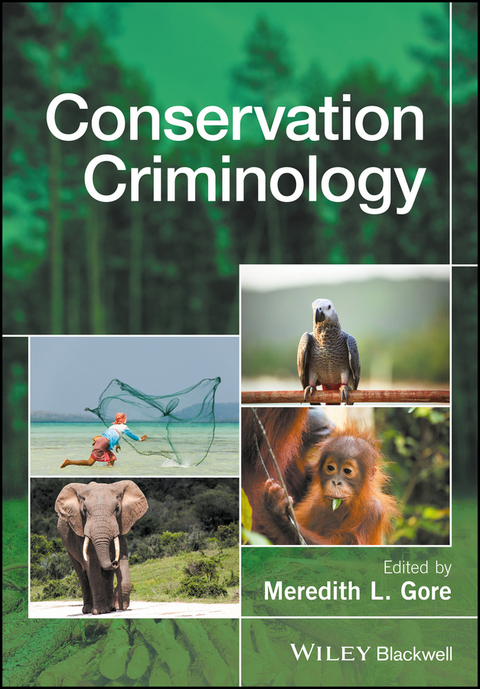
This important new text introduces conservation criminology as the interdisciplinary study of environmental exploitation and risks at the intersection of human and natural systems. Taking an interdisciplinary approach, the book enhances understanding of the various human and organizational behaviors that pose risks to the environment, humans, and drive conservation crime. As human population growth, global market economies, climate change, deforestation, and illegal exploitation of natural resources continue to increase, academic research from numerous disciplines is needed to address these challenges.
Conservation Criminology promotes thinking about how unsustainable natural resources exploitation is a cause and a consequence of social conflict. Case studies profiled in the book demonstrate this cause and effect type situation, as well as innovative approaches for reducing risks to people and the environment. This text encourages readers to consider how humans behave in response to environmental risks and the various mechanisms that constitute effective and ineffective approaches to enforcement of wildlife crimes, including environmental and conservation policy. Case studies from the USA, Latin America, Africa, and Asia highlight corruption in conservation, global trade in electronic waste, illegal fishing, illegal logging, human-wildlife conflict, technology and space, water insecurity, wildlife disease, and wildlife poaching. Taken together, chapters expand the reader's perspective and employ tools to understand and address environmental crimes and risks, and to provide novel empirical evidence for positive change. With established contributors providing interdisciplinary and global perspectives, this book establishes a foundation for the emerging field of conservation criminology.
About the editor
Meredith L. Gore is a conservation social scientist whose interdisciplinary research explores relationships between human behavior and the environment. She is an Associate Professor in the Department of Fisheries & Wildlife and School of Criminal Justice at Michigan State University (MSU) and Jefferson Science Fellow with the US Department of State. Dr. Gore is a MSU Global Research Fellow and President of the Society for Conservation Biology's Social Science Working Group.
This important new text introduces conservation criminology as the interdisciplinary study of environmental exploitation and risks at the intersection of human and natural systems. Taking an interdisciplinary approach, the book enhances understanding of the various human and organizational behaviors that pose risks to the environment, humans, and drive conservation crime. As human population growth, global market economies, climate change, deforestation, and illegal exploitation of natural resources continue to increase, academic research from numerous disciplines is needed to address these challenges. Conservation Criminology promotes thinking about how unsustainable natural resources exploitation is a cause and a consequence of social conflict. Case studies profiled in the book demonstrate this cause and effect type situation, as well as innovative approaches for reducing risks to people and the environment. This text encourages readers to consider how humans behave in response to environmental risks and the various mechanisms that constitute effective and ineffective approaches to enforcement of wildlife crimes, including environmental and conservation policy. Case studies from the USA, Latin America, Africa, and Asia highlight corruption in conservation, global trade in electronic waste, illegal fishing, illegal logging, human-wildlife conflict, technology and space, water insecurity, wildlife disease, and wildlife poaching. Taken together, chapters expand the reader s perspective and employ tools to understand and address environmental crimes and risks, and to provide novel empirical evidence for positive change. With established contributors providing interdisciplinary and global perspectives, this book establishes a foundation for the emerging field of conservation criminology.
About the editor Meredith L. Gore is a conservation social scientist whose interdisciplinary research explores relationships between human behavior and the environment. She is an Associate Professor in the Department of Fisheries & Wildlife and School of Criminal Justice at Michigan State University (MSU) and Jefferson Science Fellow with the US Department of State. Dr. Gore is a MSU Global Research Fellow and President of the Society for Conservation Biology's Social Science Working Group.
Title Page 5
Copyright Page 6
Contents 9
Notes on Contributors 15
Preface 23
Acknowledgments 25
Chapter 1 Global Risks, Conservation, and Criminology 27
1.1 Conservation Crimes Are a Global Problem 27
1.2 Three Foundational Fields of Conservation Criminology 30
1.3 Foundation 1: Natural Resource Management and Policy 30
1.3.1 Different Values Underlie Natural Resource Management and Conservation 30
1.3.2 The Precautionary Principle and Prevention 32
1.3.3 Community-Based Conservation 32
1.3.4 Protected Areas 33
1.4 Foundation 2: Criminology, Crime Science, and Criminal Justice 34
1.4.1 Opportunity Structures of Crime 35
1.4.2 Crime Prevention 36
1.4.3 Criminological Typologies 37
1.5 Foundation 3: Risk and Decision Science 37
1.5.1 Risk Assessment and Perception 39
1.5.2 Risk Communication 40
1.5.3 Risk Governance 40
1.6 Combining the Three Foundations: Conservation Criminology 41
1.6.1 Strengths 42
1.6.2 Shortcomings 42
1.7 How to “Do” Conservation Criminology 43
1.8 Roadmap 44
References 46
Part I Conceptual Advancements in Conservation Criminology 51
Chapter 2 Conservation Crime Science 53
2.1 Exploitation of Natural Resources in a Globalized World 53
2.2 The Limits of Criminology for Conservation Practice 54
2.3 Overcoming the Limits of Criminology with Crime Science 56
2.4 State of Knowledge: Conservation Criminology and Conservation Crime Science 57
2.4.1 Describing the Literature 58
2.5 Limitations 62
2.6 Utility of Using Conservation Crime Science 63
2.7 Setting Expectations for Conservation Crime Science 64
2.8 Conclusion 65
References 67
Chapter 3 Deterrence, Legitimacy, and Wildlife Crime in Protected Areas 71
3.1 Wildlife Crime in Protected Areas 72
3.2 Criminological and Criminal Justice Perspectives on Deterrence 72
3.2.1 Theoretical Foundations 72
3.3 Empirical Findings 74
3.4 Limitations with Deterrence?based Approaches in Protected Areas 74
3.5 Legitimacy and Its Role in Establishing Normative and Instrumental Forms of Compliance in Conservation 77
3.6 Alternatives to Deterrence?Based Approaches 78
3.6.1 Enhancing Legitimacy 78
3.7 Future Considerations 79
References 80
Part II Case Studies and Examples 85
Chapter 4 Governance for Conservation Risks and Crime 87
4.1 Defining Governance 87
4.2 General Concepts of Governance for Conservation Risks 88
4.3 Strict Enforcement by Official Authorities and Governments 89
4.4 International Movement of Electronic Waste 89
4.5 Regulatory Efforts to Limit E-waste Trade 91
4.6 People-Centered Approaches Focused Local Livelihoods 93
4.7 Limits to Enforcement Actions in Chiquibul National Park, Belize 94
4.8 Limits of Alternative Livelihood Strategies 94
4.9 Unintended Effects and Collateral Impacts of Conservation Governance 95
4.10 Conclusion 97
References 97
Chapter 5 Gaining Compliance and Cooperation with Regulated Wildlife Harvest 103
5.1 Importance of Compliance and Cooperation 104
5.2 What Drives Violations of Natural Resource Regulations? 106
5.3 Unintentional Violations 107
5.4 Intentional Violations 107
5.5 Violations Motivated by Direct Personal Gains 108
5.6 Violations Motivated by Indirect Personal Gains 109
5.7 Violations and Instrumental Judgments of Government Policy and Regulators 110
5.8 Violations and Normative Influence 111
5.9 What Drives Cooperation? 112
5.10 Considerations for Increasing Compliance and Cooperation 113
5.10.1 Applying Regulations to Influence Compliance 114
5.10.2 Applying Economic Instruments to Influence Compliance and Cooperation 115
5.10.3 Applying Communication to Influence Compliance and Cooperation 116
5.10.4 Communication to Influence Instrumental Judgments 116
5.10.5 Communication to Influence Behavior Through Norms 117
5.10.6 Communication to Influence Procedural Justice 117
5.11 Conclusion 118
References 118
Chapter 6 Corruption and Organized Crime in Conservation 123
6.1 Connecting Corruption and Organized Crime to Conservation 125
6.1.1 Defining Corruption and Organized Crime 125
6.1.2 The Role and Extent of Corruption and Organized Crime in Conservation Crime 126
6.1.3 Why do Environmental Black Markets Exist? 128
6.2 Case Study on Abalone Poaching 128
6.2.1 The Context of Bureaucratic Corruption and Presence of Criminal Groups 128
6.2.2 The Investigation 130
6.2.3 Non-Corrupt Inspectors are Threatened 130
6.3 Case Study on Illegal Trade in Russian Raptors 131
6.4 A Policy-Oriented Discussion of Solutions 133
6.4.1 Supporting Non-Corrupt Officials That Receive Threats 133
6.4.2 Complement Merit-Based Reforms with External Monitoring Mechanisms 133
6.4.3 Public Awareness Campaigns May Help Decrease Demand for Illicit Goods 134
6.4.4 A Cooperative Network Approach to Combating Organized Crime 135
6.5 Conclusion 135
References 136
Chapter 7 Problem-Oriented Policing for Natural Resource Conservation 141
7.1 What is Problem-Oriented Policing? 141
7.2 The Opportunity for POP in Natural Resource Management 145
7.3 A Case Study of Australian Commonwealth Fisheries Management 146
7.3.1 The Australian Fisheries Management Authority 146
7.3.2 Scanning 149
7.3.3 Analysis 150
7.3.4 Response 151
7.3.5 Assessment 152
7.4 Adapting POP for More Effective Conservation 153
7.5 Conclusion 155
References 155
Chapter 8 Exploring the Sociology of Wildlife Tourism, Global Risks, and Crime 159
8.1 Wildlife Tourism 160
8.1.1 Types of Wildlife Tourism 160
8.1.2 Benefits of Wildlife Tourism Link Biodiversity Conservation and Livelihood Preservation 160
8.1.3 Risks Associated with Wildlife Tourism 161
8.2 Conservation Criminology and Wildlife Tourism 162
8.2.1 Natural Resources Management and Conservation Biology 163
8.2.2 Risk and Decision Science 163
8.2.3 Criminology 164
8.3 Theoretical Insights on Wildlife Tourism from Sociology 165
8.3.1 Wildlife Tourism and Power 165
8.3.2 Authenticity as a Sociological Aspect of Tourism 167
8.4 Elephant Tourism and Crime in Thailand 170
8.4.1 Elephant Tourism in Thailand 170
8.4.2 Wild Live Elephant Trafficking 170
8.4.3 Illegal Ivory Trade 171
8.4.4 Animal Welfare 171
8.4.5 Elephant Tourism and Crime: Insights From Conservation Criminology and Sociological Theory 174
8.5 Conclusion 176
References 177
Part III Models and Innovations 181
Chapter 9 Technological Innovations Supporting Wildlife Crime Detection, Deterrence, and Enforcement 183
9.1 Challenges for Wildlife Crime Detection and Enforcement 184
9.2 Technological Advances in Conservation 186
9.3 Spatial Monitoring and Reporting Tool (SMART) 187
9.3.1 Limitations of SMART Technology and Opportunities for Future Improvements 189
9.4 Conservation Drones 190
9.4.1 Limitations of Drone Technology and Opportunities for Future Improvements 192
9.5 Mobile Device Applications 193
9.5.1 Limitations of Mobile App Technology and Opportunities for Future Improvements 194
9.6 Conservation Forensics 197
9.6.1 Limitations of Forensic Technology and Opportunities for Future Improvements 199
9.7 Conclusion 200
References 201
Chapter 10 PAWS: Game Theory Based Protection Assistant for Wildlife Security 205
10.1 Applying Game Theoretic Analysis to Poaching 206
10.2 Modeling Human Behavior to Create Optimal Patrol Strategies 207
10.3 Domain Feature Modeling 207
10.4 The Genesis of PAWS from Synthesizing Conservation, Computer science, and Criminology 208
10.4.1 Describing the Poaching Domain to Create Patrols that Prevent Poaching 210
10.5 The PAWS Model 211
10.5.1 The Basis of Game-Theoretic Analysis in PAWS 212
10.5.2 Modeling Human Behavior for PAWS 214
10.5.3 Incorporating Learning into the Behavioral Model 215
10.6 PAWS-Learn 215
10.6.1 Domain Feature Modeling 216
10.6.1.1 Terrain information 216
10.6.1.2 Patrolling constraint 217
10.6.1.3 Uncertainty in Animal Distribution 217
10.7 Discussion 218
References 219
Chapter 11 Estimating Poaching Opportunity and Potential 223
11.1 Understanding Attitudes and Behaviors of Realized and Potential Poachers 224
11.2 Social Psychological Approaches for Understanding the Potential to Poach 226
11.3 Case Study on Wolf poaching 226
11.3.1 Theoretical Approach and Sampling 226
11.3.2 Methods 229
11.3.3 Study Site 229
11.3.4 Study Respondents 230
11.3.5 Survey Items 230
11.3.6 Inclination to Poach 231
11.3.7 Modeling Potential to Poach 231
11.4 Results 232
11.4.1 Potential to Poach 232
11.4.2 Effects on Wolf Population 233
11.4.3 Implications for Theory and Practice 233
11.4.4 Deer Hunters 234
11.4.5 Complainant Sample 235
11.5 Theoretical Considerations on the Causes of Poaching 236
References 238
Index 243
EULA 251
| Erscheint lt. Verlag | 14.3.2017 |
|---|---|
| Sprache | englisch |
| Themenwelt | Naturwissenschaften ► Biologie ► Ökologie / Naturschutz |
| Naturwissenschaften ► Geowissenschaften ► Geologie | |
| Recht / Steuern ► EU / Internationales Recht | |
| Recht / Steuern ► Öffentliches Recht ► Umweltrecht | |
| Technik | |
| Schlagworte | Biowissenschaften • climate change • conservation corruption • conservation crime • conservation criminology • conservation policy • Conservation Science • Criminology • deforestation • Electronic waste • Environmental Crimes • environmental exploitation • Environmental Offenses • Environmental Policy • environment risks • Exploitation of natural resources • global market economy • global trade • Human Population Growth • Human systems • Human-Wildlife Conflict • illegal exploitation • Illegal fishing • illegal logging • Kriminologie • Law • Life Sciences • Natural resource exploitation • natural resources • natural systems • Naturschutzbiologie • Rechtswissenschaft • Risks to the Environment • social conflict • Umweltdelikte • unsustainable natural resources • Water insecurity • wildlife crimes • wildlife disease • wildlife poaching |
| ISBN-10 | 1-118-93549-7 / 1118935497 |
| ISBN-13 | 978-1-118-93549-1 / 9781118935491 |
| Informationen gemäß Produktsicherheitsverordnung (GPSR) | |
| Haben Sie eine Frage zum Produkt? |
 PDF (Adobe DRM)
Kopierschutz: Adobe-DRM
Adobe-DRM ist ein Kopierschutz, der das eBook vor Mißbrauch schützen soll. Dabei wird das eBook bereits beim Download auf Ihre persönliche Adobe-ID autorisiert. Lesen können Sie das eBook dann nur auf den Geräten, welche ebenfalls auf Ihre Adobe-ID registriert sind.
Details zum Adobe-DRM
Dateiformat: PDF (Portable Document Format)
Mit einem festen Seitenlayout eignet sich die PDF besonders für Fachbücher mit Spalten, Tabellen und Abbildungen. Eine PDF kann auf fast allen Geräten angezeigt werden, ist aber für kleine Displays (Smartphone, eReader) nur eingeschränkt geeignet.
Systemvoraussetzungen:
PC/Mac: Mit einem PC oder Mac können Sie dieses eBook lesen. Sie benötigen eine
eReader: Dieses eBook kann mit (fast) allen eBook-Readern gelesen werden. Mit dem amazon-Kindle ist es aber nicht kompatibel.
Smartphone/Tablet: Egal ob Apple oder Android, dieses eBook können Sie lesen. Sie benötigen eine
Geräteliste und zusätzliche Hinweise
Buying eBooks from abroad
For tax law reasons we can sell eBooks just within Germany and Switzerland. Regrettably we cannot fulfill eBook-orders from other countries.
aus dem Bereich