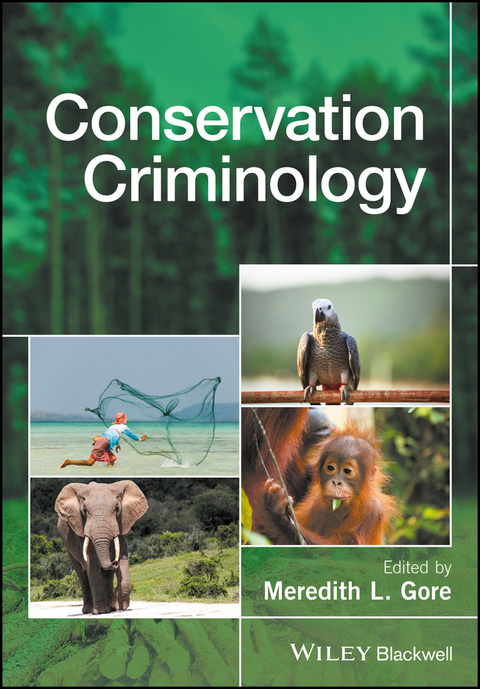
Conservation Criminology (eBook)
John Wiley & Sons (Verlag)
978-1-118-93550-7 (ISBN)

This important new text introduces conservation criminology as the interdisciplinary study of environmental exploitation and risks at the intersection of human and natural systems. Taking an interdisciplinary approach, the book enhances understanding of the various human and organizational behaviors that pose risks to the environment, humans, and drive conservation crime. As human population growth, global market economies, climate change, deforestation, and illegal exploitation of natural resources continue to increase, academic research from numerous disciplines is needed to address these challenges.
Conservation Criminology promotes thinking about how unsustainable natural resources exploitation is a cause and a consequence of social conflict. Case studies profiled in the book demonstrate this cause and effect type situation, as well as innovative approaches for reducing risks to people and the environment. This text encourages readers to consider how humans behave in response to environmental risks and the various mechanisms that constitute effective and ineffective approaches to enforcement of wildlife crimes, including environmental and conservation policy. Case studies from the USA, Latin America, Africa, and Asia highlight corruption in conservation, global trade in electronic waste, illegal fishing, illegal logging, human-wildlife conflict, technology and space, water insecurity, wildlife disease, and wildlife poaching. Taken together, chapters expand the reader's perspective and employ tools to understand and address environmental crimes and risks, and to provide novel empirical evidence for positive change. With established contributors providing interdisciplinary and global perspectives, this book establishes a foundation for the emerging field of conservation criminology.
About the editor
Meredith L. Gore is a conservation social scientist whose interdisciplinary research explores relationships between human behavior and the environment. She is an Associate Professor in the Department of Fisheries & Wildlife and School of Criminal Justice at Michigan State University (MSU) and Jefferson Science Fellow with the US Department of State. Dr. Gore is a MSU Global Research Fellow and President of the Society for Conservation Biology's Social Science Working Group.
This important new text introduces conservation criminology as the interdisciplinary study of environmental exploitation and risks at the intersection of human and natural systems. Taking an interdisciplinary approach, the book enhances understanding of the various human and organizational behaviors that pose risks to the environment, humans, and drive conservation crime. As human population growth, global market economies, climate change, deforestation, and illegal exploitation of natural resources continue to increase, academic research from numerous disciplines is needed to address these challenges. Conservation Criminology promotes thinking about how unsustainable natural resources exploitation is a cause and a consequence of social conflict. Case studies profiled in the book demonstrate this cause and effect type situation, as well as innovative approaches for reducing risks to people and the environment. This text encourages readers to consider how humans behave in response to environmental risks and the various mechanisms that constitute effective and ineffective approaches to enforcement of wildlife crimes, including environmental and conservation policy. Case studies from the USA, Latin America, Africa, and Asia highlight corruption in conservation, global trade in electronic waste, illegal fishing, illegal logging, human-wildlife conflict, technology and space, water insecurity, wildlife disease, and wildlife poaching. Taken together, chapters expand the reader s perspective and employ tools to understand and address environmental crimes and risks, and to provide novel empirical evidence for positive change. With established contributors providing interdisciplinary and global perspectives, this book establishes a foundation for the emerging field of conservation criminology.
About the editor Meredith L. Gore is a conservation social scientist whose interdisciplinary research explores relationships between human behavior and the environment. She is an Associate Professor in the Department of Fisheries & Wildlife and School of Criminal Justice at Michigan State University (MSU) and Jefferson Science Fellow with the US Department of State. Dr. Gore is a MSU Global Research Fellow and President of the Society for Conservation Biology's Social Science Working Group.
Notes on Contributors
Dr. Mark A. Axelrod is Associate Professor in Michigan State University’s James Madison College and Department of Fisheries and Wildlife. His teaching and research center around comparative and international environmental law and politics, with a particular focus on India. His recent work is published in The Journal of Environment & Development, Environmental Policy & Governance, and the European Journal of International Relations. Mark is also active with the United Planet Faith & Science Initiative, and serves on the editorial board of the journal Global Environmental Politics.
Dr. Christine Browne‐Nuñez received her Ph.D. in Wildlife Ecology and Conservation from the University of Florida, MS in Human Dimensions of Natural Resources from Colorado State University, and BA in Education from the University of Missouri. As a post‐doctoral research associate at the University of Wisconsin‐Madison Nelson Institute for Environmental Studies, she applied social science theory and methods to identify predictors of social tolerance of wolves. Christine served the Associate Director of Community‐Based Conservation at the San Diego Zoo Institute for Conservation Research. Currently, as a conservation social scientist with the U.S. Fish and Wildlife Service, Christine works to build human dimensions capacity in the agency through training, research, and technical support.
Dr. Julia Novak Colwell earned her Ph.D. in Fisheries & Wildlife at Michigan State University (2016) where she also earned her MSc (2013). She is currently Visiting Assistant Professor in the Pennoni Honors College at Drexel University. Her research has focused on the unintended impacts of resource management regulations, particularly pertaining to the fisheries sector in Tamil Nadu, India. Her current research aims to identify how underrepresented segments of the fisherfolk population, particularly women, are affected by management hierarchies and fisheries regulations and how those impacts feedback to influence resource use and resource health.
Dr. Fei Fang received her Ph.D. from the Department of Computer Science at the University of Southern California. She received her bachelor degree from the Department of Electronic Engineering, Tsinghua University in July 2011. Her research lies in the field of artificial intelligence and multi‐agent systems, focusing on computational game theory with applications to security and sustainability domains. Her work has won the Deployed Application Award at Innovative Applications of Artificial Intelligence, the Outstanding Paper Award in Computational Sustainability Track at the International Joint Conferences on Artificial Intelligence. She is the recipient of WiSE Merit Fellowship, and she has been awarded the Meritorious Team Commendation from Commandant of the US Coast Guard and Flag Letter of Appreciation from Vice Admiral. Her work has led to real‐world applications that have fundamentally altered current practices of security resource allocation. Her work on “Protecting Moving Targets with Mobile Resources” has been deployed by the US Coast Guard for protecting the Staten Island Ferry in New York City since April 2013. Her work on designing patrol strategies to combat illegal poaching has lead to the deployment of PAWS application in a conservation area in Southeast Asia for protecting tigers.
Austin Flowers received his B.A. in International Relations from James Madison College at Michigan State University. His research focuses on criminal exploitation growth in the electronic waste trade to find possible deterrence strategies through legislating financial and criminal penalties. He is preparing for law school in the fall of 2017 while investigating entrepreneurial opportunities in electronic waste recycling.
Dr. David Foran is the Director of the Forensic Science Graduate Program at Michigan State University, which was founded in 1947. He is a Fellow of the American Academy of Forensic Sciences, is on the Editorial Board of The Journal of Forensic Sciences, and is court qualified as an expert on both nuclear and mitochondrial DNA profiling. He obtained his PhD in molecular genetics from the University of Michigan, was a post‐doctoral fellow at McGill University in Montreal, and was a research associate at the University of California at Santa Cruz. Dr. Foran’s area of expertise is forensic biology, focusing on human and animal identification using both nuclear and mitochondrial DNA. His research has been funded by the National Institutes of Justice, the Technical Support Working Group, the Department of Defense, and other agencies. He and his graduate students aid a variety of local, state, and federal agencies with specialized casework, are advisors to the Michigan Innocence Project, and conduct research on historical cases of broad interest.
Benjamin Ford is a fourth year Ph.D. student of Computer Science at the University of Southern California's Viterbi School of Engineering. He joined the Teamcore research group in August 2013 and is advised by Professor Milind Tambe. Previously, he completed his B.S. and M.S. in Computer Science at the University of Massachusetts Dartmouth in 2008 and 2010, respectively. After graduation and prior to joining Teamcore, he worked at the Naval Undersea Warfare Center in Newport, RI as a Software Engineer. Ben's primary research interests are in the application of concepts from the social sciences of Psychology, Criminology, Sociology, and Anthropology to improve the algorithms and solutions of Computer Science. Specifically, he is interested in applying human behavioral models to multi‐agent systems with a large focus on human decision making. Since joining Teamcore, he has also developed an interest in applying Behavioral Game Theory to the Wildlife Conservation domain.
Dr. Jacinta M. Gau is an associate professor in the Department of Criminal Justice at the University of Central Florida. Her research is primarily in policing, with an emphasis on racial issues, police–community relations, procedural justice, and police legitimacy. Her work has appeared in journals such as Justice Quarterly, Criminal Justice and Behavior, Crime and Delinquency, and Journal of Criminal Justice.
Mark C. G. Gibson is a doctoral student at the School of Criminal Justice, Michigan State University. He has an MA in Economics and Environmental Policy from the School of Advanced International Studies, Johns Hopkins, and a BA in International Relations from the University of Pennsylvania. Prior to starting his PhD program, Mark supported World Wildlife Fund’s on‐the‐ground work to reform Latin American fisheries management, and the Pew Charitable Trusts to advocate for conservation of vulnerable deep‐sea ecosystems globally. His research interests include wildlife and fisheries crime, data‐poor compliance assessment, organizational theory of conservation enforcement, and voluntary compliance drivers.
Dr. Meredith L. Gore is a conservation social scientist whose interdisciplinary research explores relationships between human behavior and the environment. She is an Associate Professor in the Department of Fisheries & Wildlife and School of Criminal Justice at Michigan State University (MSU). She is a National Academies of Science Jefferson Science Fellow serving as a Senior Science Advisor in the Office of the Geographer and Global Issues at the U.S. Department of State. Dr. Gore is a MSU Global Research Fellow and President of the Society for Conservation Biology’s Social Science Working Group. Her research interests focus on community‐based natural resource management and enhancing understanding of risk concepts and their application to biodiversity conservation. Dr. Gore co‐developed the Conservation Criminology research framework and teaching certificate program at MSU; the interdisciplinary approach synthesizes natural resource policy, risk and decision analysis, and crime science. Her leadership in this field has resulted in new scientific insight regarding conservation of species such as white sharks, lemurs, cranes, sea turtles, rhinos, elephants, ploughshare tortoises, double‐crested cormorants, black bears and gray wolves. Dr. Gore received her PhD in Natural Resource Policy and Management from Cornell University, MA in Environment and Resource Policy from George Washington University, and BA in Anthropology and Environmental Studies from Brandeis University. Phi Kappa Phi has recognized Dr. Gore's leadership in interdisciplinary research.
Katherine Groff received her MS from the Department of Fisheries and Wildlife at Michigan State University. Under the advisement of Dr. Mark Axelrod, she studied the conflicts between community development and conservation goals in resource management across national borders. Her interests lie in science policy and animal protection, and she currently applies.
Jamie Hogberg earned her MS in Conservation Biology at UW Madison, and is academic staff for the Nelson Institute for Environmental Studies’ Environmental Conservation Professional Masters Program. She also directs the Society for Conservation Biology – North America’s biennial North American congress (2016). Her research focuses on human–wolf conflict, management, and policy in the mid western U.S. Her prior work includes avian and tropical conservation in the Western U.S. and South America.
Jessica S. Kahler is a PhD candidate at Michigan State University, researching...
| Erscheint lt. Verlag | 14.3.2017 |
|---|---|
| Sprache | englisch |
| Themenwelt | Naturwissenschaften ► Biologie ► Ökologie / Naturschutz |
| Naturwissenschaften ► Geowissenschaften ► Geologie | |
| Recht / Steuern ► EU / Internationales Recht | |
| Recht / Steuern ► Öffentliches Recht ► Umweltrecht | |
| Technik | |
| Schlagworte | Biowissenschaften • climate change • conservation corruption • conservation crime • conservation criminology • conservation policy • Conservation Science • Criminology • deforestation • Electronic waste • Environmental Crimes • environmental exploitation • Environmental Offenses • Environmental Policy • environment risks • Exploitation of natural resources • global market economy • global trade • Human Population Growth • Human systems • Human-Wildlife Conflict • illegal exploitation • Illegal fishing • illegal logging • Kriminologie • Law • Life Sciences • Natural resource exploitation • natural resources • natural systems • Naturschutzbiologie • Rechtswissenschaft • Risks to the Environment • social conflict • Umweltdelikte • unsustainable natural resources • Water insecurity • wildlife crimes • wildlife disease • wildlife poaching |
| ISBN-10 | 1-118-93550-0 / 1118935500 |
| ISBN-13 | 978-1-118-93550-7 / 9781118935507 |
| Informationen gemäß Produktsicherheitsverordnung (GPSR) | |
| Haben Sie eine Frage zum Produkt? |
 EPUB (Adobe DRM)
Kopierschutz: Adobe-DRM
Adobe-DRM ist ein Kopierschutz, der das eBook vor Mißbrauch schützen soll. Dabei wird das eBook bereits beim Download auf Ihre persönliche Adobe-ID autorisiert. Lesen können Sie das eBook dann nur auf den Geräten, welche ebenfalls auf Ihre Adobe-ID registriert sind.
Details zum Adobe-DRM
Dateiformat: EPUB (Electronic Publication)
EPUB ist ein offener Standard für eBooks und eignet sich besonders zur Darstellung von Belletristik und Sachbüchern. Der Fließtext wird dynamisch an die Display- und Schriftgröße angepasst. Auch für mobile Lesegeräte ist EPUB daher gut geeignet.
Systemvoraussetzungen:
PC/Mac: Mit einem PC oder Mac können Sie dieses eBook lesen. Sie benötigen eine
eReader: Dieses eBook kann mit (fast) allen eBook-Readern gelesen werden. Mit dem amazon-Kindle ist es aber nicht kompatibel.
Smartphone/Tablet: Egal ob Apple oder Android, dieses eBook können Sie lesen. Sie benötigen eine
Geräteliste und zusätzliche Hinweise
Buying eBooks from abroad
For tax law reasons we can sell eBooks just within Germany and Switzerland. Regrettably we cannot fulfill eBook-orders from other countries.
aus dem Bereich