


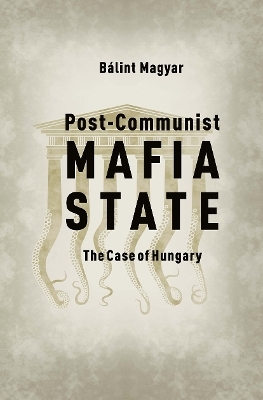
Post-Communist Mafia State
The Case of Hungary
Seiten
2016
Central European University Press (Verlag)
978-615-5513-54-1 (ISBN)
Central European University Press (Verlag)
978-615-5513-54-1 (ISBN)
Introducing the concept of the post-communist mafia state, Balint Magyar has established a new interpretative framework and vocabulary to describe the Orban regime, which has become equally central to the main lines of argument in both scientific debate and public discourse.
In an article in 2001 the author analyzed the way Fidesz, the party on government for the first time then, was eliminating the institutional system of the rule of law. At that time, many readers doubted the legitimacy of the new approach, whose key categories were the 'organized over-world', the 'state employing mafia methods' and the 'adopted political family'. Critics considered these categories metaphors rather than elements of a coherent conceptual framework. Ten years later Fidesz won a two-third majority in Parliament at the 2010 elections: the institutional obstacles of exerting power were thus largely removed. Just like the party, the state itself was placed under the control of a single individual, who since then has applied the techniques used within his party to enforce submission and obedience onto society as a whole. While in many post-communist systems a segment of the party and secret service became the elite in possession of not only political power but also of wealth, Fidesz, as a late-coming new political predator, was able to occupy this position through an aggressive change of elite. The actions of the post-communist mafia state model are led by the logic of power and wealth concentration in the hands of the clan. But while the classical mafia channeled wealth and economic players into its spheres of interest by means of direct coercion, the mafia state does the same by means of parliamentary legislation, legal prosecution, tax authority, police forces and secret service. The new conceptual framework is important and timely not only for Hungary, but also for other post-communist countries subjected to autocratic rules.
In an article in 2001 the author analyzed the way Fidesz, the party on government for the first time then, was eliminating the institutional system of the rule of law. At that time, many readers doubted the legitimacy of the new approach, whose key categories were the 'organized over-world', the 'state employing mafia methods' and the 'adopted political family'. Critics considered these categories metaphors rather than elements of a coherent conceptual framework. Ten years later Fidesz won a two-third majority in Parliament at the 2010 elections: the institutional obstacles of exerting power were thus largely removed. Just like the party, the state itself was placed under the control of a single individual, who since then has applied the techniques used within his party to enforce submission and obedience onto society as a whole. While in many post-communist systems a segment of the party and secret service became the elite in possession of not only political power but also of wealth, Fidesz, as a late-coming new political predator, was able to occupy this position through an aggressive change of elite. The actions of the post-communist mafia state model are led by the logic of power and wealth concentration in the hands of the clan. But while the classical mafia channeled wealth and economic players into its spheres of interest by means of direct coercion, the mafia state does the same by means of parliamentary legislation, legal prosecution, tax authority, police forces and secret service. The new conceptual framework is important and timely not only for Hungary, but also for other post-communist countries subjected to autocratic rules.
Bálint Magyar is Research Fellow at CEU Democracy Institute, working on the subject of patronalism in post-communist countries. He was a member of the Hungarian Parliament (1990-2010). As a Minister of Education (1996-1998; 2002-2006) he initiated and carried out reforms in public and higher education.
1. The system we live under, 2. The disintegration of the Third Hungarian Republic in 2010, 3. Approaches of interpretation: from the functional disorders of democracy to a critique of the system, 4. Definition of the post-communist mafia state, 5. Specific features of the mafia state: a subtype of autocratic regimes
| Erscheinungsdatum | 23.10.2016 |
|---|---|
| Verlagsort | Budapest |
| Sprache | englisch |
| Maße | 152 x 229 mm |
| Gewicht | 620 g |
| Themenwelt | Geschichte ► Allgemeine Geschichte ► Zeitgeschichte |
| Geisteswissenschaften ► Geschichte ► Regional- / Ländergeschichte | |
| Recht / Steuern ► Strafrecht ► Kriminologie | |
| Sozialwissenschaften ► Politik / Verwaltung ► Politische Systeme | |
| Sozialwissenschaften ► Politik / Verwaltung ► Politische Theorie | |
| ISBN-10 | 615-5513-54-6 / 6155513546 |
| ISBN-13 | 978-615-5513-54-1 / 9786155513541 |
| Zustand | Neuware |
| Informationen gemäß Produktsicherheitsverordnung (GPSR) | |
| Haben Sie eine Frage zum Produkt? |
Mehr entdecken
aus dem Bereich
aus dem Bereich
die großen Jahre der Soziologie 1949-1969
Buch | Hardcover (2025)
Klett-Cotta (Verlag)
CHF 39,20
eine Deutschlandreise im Jahr 1958
Buch | Hardcover (2024)
C.H.Beck (Verlag)
CHF 29,90


