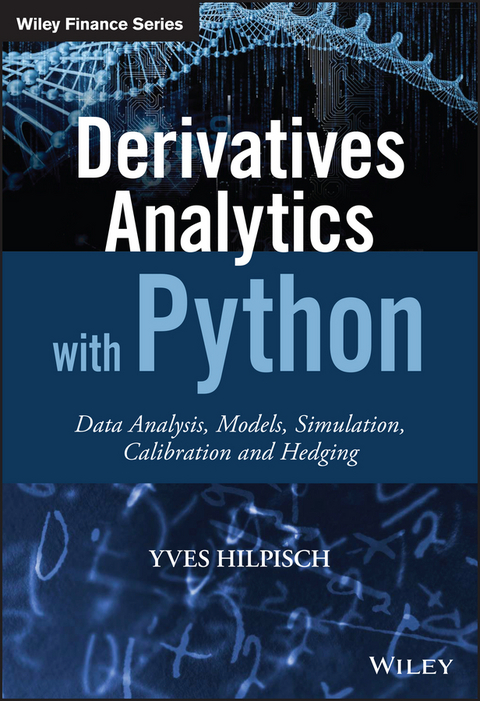
Derivatives Analytics with Python (eBook)
Derivatives Analytics with Python shows you how to implement market-consistent valuation and hedging approaches using advanced financial models, efficient numerical techniques, and the powerful capabilities of the Python programming language. This unique guide offers detailed explanations of all theory, methods, and processes, giving you the background and tools necessary to value stock index options from a sound foundation. You'll find and use self-contained Python scripts and modules and learn how to apply Python to advanced data and derivatives analytics as you benefit from the 5,000+ lines of code that are provided to help you reproduce the results and graphics presented. Coverage includes market data analysis, risk-neutral valuation, Monte Carlo simulation, model calibration, valuation, and dynamic hedging, with models that exhibit stochastic volatility, jump components, stochastic short rates, and more. The companion website features all code and IPython Notebooks for immediate execution and automation.
Python is gaining ground in the derivatives analytics space, allowing institutions to quickly and efficiently deliver portfolio, trading, and risk management results. This book is the finance professional's guide to exploiting Python's capabilities for efficient and performing derivatives analytics.
- Reproduce major stylized facts of equity and options markets yourself
- Apply Fourier transform techniques and advanced Monte Carlo pricing
- Calibrate advanced option pricing models to market data
- Integrate advanced models and numeric methods to dynamically hedge options
Recent developments in the Python ecosystem enable analysts to implement analytics tasks as performing as with C or C++, but using only about one-tenth of the code or even less. Derivatives Analytics with Python - Data Analysis, Models, Simulation, Calibration and Hedging shows you what you need to know to supercharge your derivatives and risk analytics efforts.
YVES HILPISCH is founder and Managing Partner of The Python Quants, a group that focuses on Python & Open Source Software for Quantitative Finance. Yves is also a Computational Finance Lecturer on the CQF Program. He works with clients in the financial industry around the globe and has ten years of experience with Python. Yves is the organizer of Python and Open Source for Quant Finance conferences and meetup groups in Frankfurt, London and New York City.
Supercharge options analytics and hedging using the power of Python Derivatives Analytics with Python shows you how to implement market-consistent valuation and hedging approaches using advanced financial models, efficient numerical techniques, and the powerful capabilities of the Python programming language. This unique guide offers detailed explanations of all theory, methods, and processes, giving you the background and tools necessary to value stock index options from a sound foundation. You'll find and use self-contained Python scripts and modules and learn how to apply Python to advanced data and derivatives analytics as you benefit from the 5,000+ lines of code that are provided to help you reproduce the results and graphics presented. Coverage includes market data analysis, risk-neutral valuation, Monte Carlo simulation, model calibration, valuation, and dynamic hedging, with models that exhibit stochastic volatility, jump components, stochastic short rates, and more. The companion website features all code and IPython Notebooks for immediate execution and automation. Python is gaining ground in the derivatives analytics space, allowing institutions to quickly and efficiently deliver portfolio, trading, and risk management results. This book is the finance professional's guide to exploiting Python's capabilities for efficient and performing derivatives analytics. Reproduce major stylized facts of equity and options markets yourself Apply Fourier transform techniques and advanced Monte Carlo pricing Calibrate advanced option pricing models to market data Integrate advanced models and numeric methods to dynamically hedge options Recent developments in the Python ecosystem enable analysts to implement analytics tasks as performing as with C or C++, but using only about one-tenth of the code or even less. Derivatives Analytics with Python Data Analysis, Models, Simulation, Calibration and Hedging shows you what you need to know to supercharge your derivatives and risk analytics efforts.
YVES HILPISCH is founder and Managing Partner of The Python Quants, a group that focuses on Python & Open Source Software for Quantitative Finance. Yves is also a Computational Finance Lecturer on the CQF Program. He works with clients in the financial industry around the globe and has ten years of experience with Python. Yves is the organizer of Python and Open Source for Quant Finance conferences and meetup groups in Frankfurt, London and New York City.
CHAPTER 1
A Quick Tour
1.1 Market-Based Valuation
This book is about the market-based valuation of (stock) index options. In the domain of derivatives analytics this is an important task which every major investment bank and buy-side decision maker in the financial market is concerned with on a daily basis. While theoretical valuation approaches develop a model, parametrize it and then derive values for options, the market-based approach works the other way round. Prices from liquidly traded options are taken as given (i.e. they are inputs instead of outputs) and one tries to parametrize a market model in a way that replicates the observed option prices as well as possible. This activity is generally referred to as model calibration. Being equipped with a calibrated model, one then proceeds with the task at hand, be it valuation, trading, investing, hedging or risk management. A bit more specifically, one might be interested in pricing and hedging an exotic derivative instrument with such a model—hoping that the results are in line with the overall market (i.e. arbitrage-free and even “fair”) due to the previous calibration to more simple, vanilla instruments.
To accomplish a market-based valuation, four areas have to be covered:
- market: knowledge about market realities is a conditio sine qua non for any sincere attempt to develop market-consistent models and to accomplish market-based valuation
- theory: every valuation must be grounded on a sound market model, ensuring, for example, the absence of arbitrage opportunities and providing means to derive option values from observed quantities
- numerics: one cannot hope to work with analytical results only; numerical techniques, like Monte Carlo simulation, are generally required in different steps of a market-based valuation process
- technology: to implement numerical techniques efficiently, one is dependent on appropriate technology (hard- and software)
This book covers all of these areas in an integrated manner. It uses equity index options as the prime example for derivative instruments throughout. This, among others, allows to abstract from dividend related issues.
1.2 Structure of the Book
The book is divided into three parts. The first part is concerned with market-based valuation as a process and empirical findings about market realities. The second part covers a number of topics for the theoretical valuation of options and derivatives. It also develops tools much needed during a market-based valuation. The third part finally covers the major aspects related to a market-based valuation and also hedging strategies in such a context.
Part I “The Market” comprises two chapters:
- Chapter 2: this chapter contains a discussion of topics related to market-based valuation, like risks affecting the value of equity index options
- Chapter 3: this chapter documents empirical and anecdotal facts about stocks, stock indices and in particular volatility (e.g. stochasticity, clustering, smiles) as well as about interest rates
Part II “Theoretical Valuation” comprises four chapters:
- Chapter 4: this chapter covers arbitrage pricing theory and risk-neutral valuation in discrete time (in some detail) and continuous time (on a higher level) according to the Harrison-Kreps-Pliska paradigm (cf. Harrison and Kreps (1979) and Harrison and Pliska (1981))
- Chapter 5: the topic of this chapter is the complete market models of Black-Scholes-Merton (BSM, cf. Black and Scholes (1973), Merton (1973)) and Cox-Ross-Rubinstein (CRR, cf. Cox et al. (1979)) that are generally considered benchmarks for option valuation
- Chapter 6: Fourier-based approaches allow us to derive semi-analytical valuation formulas for European options in market models more complex and realistic than the BSM/CRR models; this chapter introduces the two popular methods of Carr-Madan (cf. Carr and Madan (1999)) and Lewis (cf. Lewis (2001))
- Chapter 7: the valuation of American options is more involved than with European options; this chapter analyzes the respective problem and introduces algorithms for American option valution via binomial trees and Monte Carlo simulation; at the center stands the Least-Squares Monte Carlo algorithm of Longstaff-Schwartz (cf. Longstaff and Schwartz (2001))
Finally, Part III “Market-Based Valuation” has seven chapters:
- Chapter 8: before going into details, this chapter illustrates the whole process of a market-based valuation effort in the simple, but nevertheless still useful, setting of Merton’s jump-diffusion model (cf. Merton (1976))
- Chapter 9: this chapter introduces the general market model used henceforth, which is from Bakshi-Cao-Chen (cf. Bakshi et al. (1997)) and which accounts for stochastic volatility, jumps and stochastic short rates
- Chapter 10: Monte Carlo simulation is generally the method of choice for the valuation of exotic/complex index options and derivatives; this chapter therefore discusses in some detail the discretization and simulation of the stochastic volatility model by Heston (cf. Heston (1993)) with constant as well as stochastic short rates according to Cox-Ingersoll-Ross (cf. Cox et al. (1985))
- Chapter 11: model calibration stays at the center of market-based valuation; the chapter considers several general aspects associated with this topic and then proceeds with the numerical calibration of the general market model to real market data
- Chapter 12: this chapter combines the results from the previous two to value European and American index options via Monte Carlo simulation in the calibrated general market model
- Chapter 13: this chapter analyzes dynamic delta hedging strategies for American options by Monte Carlo simulation in different settings, from a simple one to the calibrated market model
- Chapter 14: this brief chapter provides a concise summary of central aspects related to the market-based valuation of index options
In addition, the book has an Appendix with one chapter:
- Appendix A: the appendix introduces some of the most important Python concepts and libraries in a nutshell; the selection of topics is clearly influenced by the requirements of the rest of the book; those not familiar with Python or looking for details should consult the more comprehensive treatment of all relevant topics by the same author (cf. Hilpisch (2014))
1.3 Why Python?
Although Python has established itself in the financial industry as a powerful programming language with an elaborate ecosystem of tools and libraries, it is still not often used for financial, derivatives or risk analytics purposes. Languages like C++, C, C#, VBA or Java and toolboxes like Matlab or domain-specific languages like R often dominate this area. However, we see a number of good reasons to choose Python even for computationally demanding analytics tasks; the following are the most important ones we want to mention, in no particular order, (see also chapter 1 in Hilpisch (2014)):
- open source: Python and the majority of available libraries are completely open source; this allows an entry to this technology at no cost, something particularly important for students, academics or other individuals
- syntax: Python programming is easy to learn, the code is quite compact and in general highly readable; at universities it is increasingly used as an introduction to programming in general; when it comes to numerical or financial algorithm implementation, the syntax is pretty close to the mathematics in general (e.g. due to code vectorization approaches)
- multi-paradigm: Python is as good for procedural programming (which suffices for the purposes of this book) as well as at object-oriented programming (which is necessary in more complex/professional contexts); it also has some functional programming features to offer
- interpreted: Python is an interpreted language which makes rapid prototyping and development in general a bit more convenient, especially for beginners; tools like IPython Notebook and libraries like pandas for time series analysis allow for efficient and productive interactive analytics workflows
- libraries: nowadays, there is a wealth of powerful libraries available and the supply grows steadily; there is hardly a problem that cannot be easily tackled with an existing library, be it a numerical problem, a graphical one or a data-related problem
- speed: a common prejudice with regard to interpreted languages—compared to compiled ones like C++ or C—is the slow speed of code execution; however, financial applications are more or less all about matrix and array manipulations and operations which can be done at the speed of C code with the essential Python library NumPy for array-based computing; other performance libraries, like Numba for dynamic code compiling, can also be used to improve performance
- market: in the London area (mainly financial services) the number of Python developer contract offerings was 485 in the third quarter of 2012;...
| Erscheint lt. Verlag | 15.6.2015 |
|---|---|
| Reihe/Serie | The Wiley Finance Series |
| Wiley Finance Series | Wiley Finance Series |
| Sprache | englisch |
| Themenwelt | Recht / Steuern ► Wirtschaftsrecht |
| Wirtschaft ► Betriebswirtschaft / Management ► Finanzierung | |
| Schlagworte | advanced options modeling • Derivatives Analytics with Python — Data Analysis, Models, Simulation, Calibration and Hedging • dynamic hedging • Finance & Investments • finance data analysis • Financial Engineering • financial modeling • Finanztechnik • Finanz- u. Anlagewesen • Fourier transform • Learning Python • market-based stock index option valuation • Monte-Carlo Simulation • option analysis • options model calibration • Options Pricing • options valuation • practical options pricing • python analytics • python for finance • python for quants • Python guide • Python Scripts • Python valuation • risk-neutral pricing • The Python Quants GmbH • Yves Hilpisch |
| ISBN-13 | 9781119038009 / 9781119038009 |
| Informationen gemäß Produktsicherheitsverordnung (GPSR) | |
| Haben Sie eine Frage zum Produkt? |
 EPUB (Adobe DRM)
Kopierschutz: Adobe-DRM
Adobe-DRM ist ein Kopierschutz, der das eBook vor Mißbrauch schützen soll. Dabei wird das eBook bereits beim Download auf Ihre persönliche Adobe-ID autorisiert. Lesen können Sie das eBook dann nur auf den Geräten, welche ebenfalls auf Ihre Adobe-ID registriert sind.
Details zum Adobe-DRM
Dateiformat: EPUB (Electronic Publication)
EPUB ist ein offener Standard für eBooks und eignet sich besonders zur Darstellung von Belletristik und Sachbüchern. Der Fließtext wird dynamisch an die Display- und Schriftgröße angepasst. Auch für mobile Lesegeräte ist EPUB daher gut geeignet.
Systemvoraussetzungen:
PC/Mac: Mit einem PC oder Mac können Sie dieses eBook lesen. Sie benötigen eine
eReader: Dieses eBook kann mit (fast) allen eBook-Readern gelesen werden. Mit dem amazon-Kindle ist es aber nicht kompatibel.
Smartphone/Tablet: Egal ob Apple oder Android, dieses eBook können Sie lesen. Sie benötigen eine
Geräteliste und zusätzliche Hinweise
Buying eBooks from abroad
For tax law reasons we can sell eBooks just within Germany and Switzerland. Regrettably we cannot fulfill eBook-orders from other countries.
aus dem Bereich