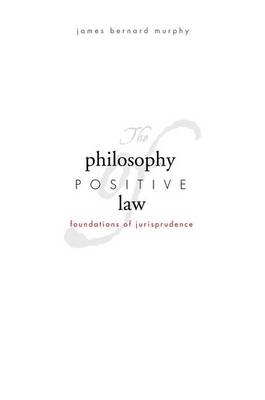
Philosophy of Positive Law (eBook)
256 Seiten
Yale University Press (Verlag)
978-0-300-13801-6 (ISBN)
In this first book-length study of positive law, James Bernard Murphy rewrites central chapters in the history of jurisprudence by uncovering a fundamental continuity among four great legal philosophers: Plato, Thomas Aquinas, Thomas Hobbes, and John Austin. In their theories of positive law, Murphy argues, these thinkers represent successive chapters in a single fascinating story. That story revolves around a fundamental ambiguity: is law positive because it is deliberately imposed (as opposed to customary law) or because it lacks moral necessity (as opposed to natural law)? These two senses of positive law are not coextensive yet the discourse of positive law oscillates unstably between them. What, then, is the relation between being deliberately imposed and lacking moral necessity? Murphy demonstrates how the discourse of positive law incorporates both normative and descriptive dimensions of law, and he discusses the relation of positive law not only to jurisprudence but also to the philosophy of language, ethics, theories of social order, and biblical law.
In this first book-length study of positive law, James Bernard Murphy rewrites central chapters in the history of jurisprudence by uncovering a fundamental continuity among four great legal philosophers: Plato, Thomas Aquinas, Thomas Hobbes, and John Austin. In their theories of positive law, Murphy argues, these thinkers represent successive chapters in a single fascinating story. That story revolves around a fundamental ambiguity: is law positive because it is deliberately imposed (as opposed to customary law) or because it lacks moral necessity (as opposed to natural law)? These two senses of positive law are not coextensive yet the discourse of positive law oscillates unstably between them. What, then, is the relation between being deliberately imposed and lacking moral necessity? Murphy demonstrates how the discourse of positive law incorporates both normative and descriptive dimensions of law, and he discusses the relation of positive law not only to jurisprudence but also to the philosophy of language, ethics, theories of social order, and biblical law.
| Erscheint lt. Verlag | 1.10.2008 |
|---|---|
| Sprache | englisch |
| Themenwelt | Recht / Steuern ► Allgemeines / Lexika |
| Recht / Steuern ► EU / Internationales Recht | |
| ISBN-10 | 0-300-13801-6 / 0300138016 |
| ISBN-13 | 978-0-300-13801-6 / 9780300138016 |
| Informationen gemäß Produktsicherheitsverordnung (GPSR) | |
| Haben Sie eine Frage zum Produkt? |
 EPUB (Adobe DRM)
Kopierschutz: Adobe-DRM
Adobe-DRM ist ein Kopierschutz, der das eBook vor Mißbrauch schützen soll. Dabei wird das eBook bereits beim Download auf Ihre persönliche Adobe-ID autorisiert. Lesen können Sie das eBook dann nur auf den Geräten, welche ebenfalls auf Ihre Adobe-ID registriert sind.
Details zum Adobe-DRM
Dateiformat: EPUB (Electronic Publication)
EPUB ist ein offener Standard für eBooks und eignet sich besonders zur Darstellung von Belletristik und Sachbüchern. Der Fließtext wird dynamisch an die Display- und Schriftgröße angepasst. Auch für mobile Lesegeräte ist EPUB daher gut geeignet.
Systemvoraussetzungen:
PC/Mac: Mit einem PC oder Mac können Sie dieses eBook lesen. Sie benötigen eine
eReader: Dieses eBook kann mit (fast) allen eBook-Readern gelesen werden. Mit dem amazon-Kindle ist es aber nicht kompatibel.
Smartphone/Tablet: Egal ob Apple oder Android, dieses eBook können Sie lesen. Sie benötigen eine
Geräteliste und zusätzliche Hinweise
Buying eBooks from abroad
For tax law reasons we can sell eBooks just within Germany and Switzerland. Regrettably we cannot fulfill eBook-orders from other countries.
aus dem Bereich