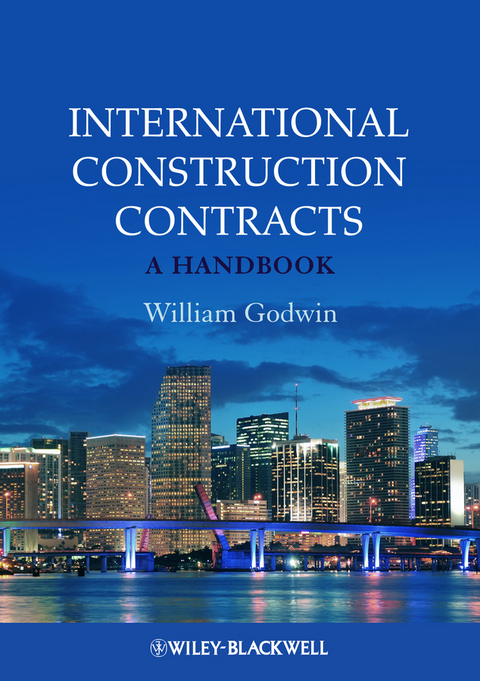
International Construction Contracts (eBook)
John Wiley & Sons (Verlag)
978-1-118-49847-7 (ISBN)
International Construction Contracts provides concise and practical guidance to those involved in the negotiation and management of international construction and engineering contracts. It sets out in clear, straightforward language the main features of construction contracts and international dispute resolution procedures. It ensures the reader is aware of the issues that might arise on the contractual side of their project so that they may better protect their party's interests. Many of the features and points discussed are illustrated by reference to the popular FIDIC contracts and the book includes a commentary on the two most widely used FIDIC design-build forms, the Yellow and Silver Books. Also included in the book is a fully worked example of a typical ICC arbitration from start to finish, with 'pleadings', a detailed case narrative and commentary on events, and an example arbitration award. The ICC and SIAC arbitration rules are also provided.
Written for construction professionals, the book will be of great interest to engineers, architects, project managers, quantity surveyors, contract managers and contract administrators working on international projects.
William Godwin is a barrister specialising in construction, engineering, energy and infrastructure projects and has over twenty years' experience of international construction acting for contractors, employers, developers and consultants in projects of all kinds. A regular speaker at the FIDIC international users' conferences, William conducts accredited training in the FIDIC contracts through Matrix Seminars, is an arbitration panel member of the China International Economic and Trade Arbitration Commission and the Dubai International Arbitration Centre, and an approved adjudicator of the English Technology and Construction Bar Association.
Many large construction projects, such as those in the Middle East or Asia Pacific, are international in scope with a range of contractors and subcontractors signing contracts for delivery of specified work or services. The contractual situation in these instances may be complex and potentially includes a range of standard and bespoke contractual arrangements. In addition, the parties to these contracts may be based in different parts of the world, and are often working to different legal systems and understandings. This can lead to confusion in the understanding, interpretation and execution of a given contract. International Construction Contracts provides concise and practical guidance to those involved in the negotiation and management of international construction and engineering contracts. It sets out in clear, straightforward language the main features of construction contracts and international dispute resolution procedures. It ensures the reader is aware of the issues that might arise on the contractual side of their project so that they may better protect their party's interests. Many of the features and points discussed are illustrated by reference to the popular FIDIC contracts and the book includes a commentary on the two most widely used FIDIC design-build forms, the Yellow and Silver Books. Also included in the book is a fully worked example of a typical ICC arbitration from start to finish, with "e;pleadings"e;, a detailed case narrative and commentary on events, and an example arbitration award. The ICC and SIAC arbitration rules are also provided. Written for construction professionals, the book will be of great interest to engineers, architects, project managers, quantity surveyors, contract managers and contract administrators working on international projects.
William Godwin is a barrister specialising in construction, engineering, energy and infrastructure projects and has over twenty years' experience of international construction acting for contractors, employers, developers and consultants in projects of all kinds. A regular speaker at the FIDIC international users' conferences, William conducts accredited training in the FIDIC contracts through Matrix Seminars, is an arbitration panel member of the China International Economic and Trade Arbitration Commission and the Dubai International Arbitration Centre, and an approved adjudicator of the English Technology and Construction Bar Association.
International Construction Contracts: A Handbook 5
Copyright 6
Contents 9
Preface 15
Foreword 17
Acknowledgements 19
About the Author 21
Part I 23
1 Contract 25
1.1 What is a contract? 25
1.2 Agreement 26
1.3 Do contracts need to be in writing? 27
1.4 Other elements of a contract 27
1.5 Capacity and authority 28
1.6 Importance of a written contract 30
1.6.1Clarity and certainty 30
1.6.2Procedures 31
1.6.3Risk allocation 31
1.7 What should a properly written construction contract cover? 32
1.7.1 FIDIC contracts 33
1.7.2Programme 34
1.7.3Delays and extensions of time 34
1.7.4Delay damages 35
1.8 Tailoring the contract 36
2 Risk 37
2.1 How risk may be allocated 37
2.2 The ‘traditional’ approach to risk 38
2.3 EPC/turnkey projects 40
2.4 BOT-type projects 40
2.4.1 Parties to a BOT-type project 40
2.4.2 Contracts involved in a BOT-type project 42
2.5 The FIDIC Silver Book 44
2.6 Particular risks: The unforeseen and design 46
2.6.1Unforeseeable physical conditions 46
2.6.2Design responsibility 46
3 Types of Construction Contract 49
3.1 Lump sum contracts 49
3.2 Prime cost or reimbursable contracts 50
3.3 Unit price contracts 50
3.4 Target contracts 51
3.5 Which contract? 51
Part II 53
4 The FIDIC Design-Build Contracts 55
4.1 Some key general provisions 56
4.1.1 Communications: Clause 1.3 56
4.1.2 The law and the language of the contract: Clause 1.4 57
4.1.3 The priority of documents: Clause 1.5 57
4.1.4 Compliance with laws: Clause 1.13 58
4.2 The Employer 59
4.2.1 The right of access to, and possession of, the site: Clause 2.1 59
4.2.2 Evidence of the Employer’s financial arrangements: Clause 2.4 59
4.2.3 Employer’s claims against the Contractor: Clause 2.5 60
4.3 Contract administration: Clause 3 61
4.3.1 The role of the Engineer 61
4.3.2 ‘Determinations’ in the Yellow and Silver Books 62
4.3.3 Employer’s Representative in the Silver Book 63
4.3.4 The giving of instructions 63
4.4 The Contractor 63
4.4.1 The Contractor’s general obligation: Clause 4.1 63
4.4.2 ‘The works’ which must fit the intended purpose: Clause 4.1 65
4.4.3 Securing performance: Clause 4.2 65
4.4.4 Contractor’s Representative: Clause 4.3 66
4.4.5 Subcontracting: Clauses 4.4 and 4.5 66
4.4.6 Setting out: Clause 4.7 66
4.4.7 Sufficiency of the Contract Price (Silver Book) or Accepted Contract Amount (Yellow Book): Clause 4.11 67
4.4.8 Unforeseeable difficulties/physical conditions: Clause 4.12 67
4.4.9 Progress reports: Clause 4.21 67
4.5 Design 68
4.5.1 The Contractor’s general design obligations (Yellow and Silver Books): Clause 5.1 68
4.5.2 Contractor’s documents: Clause 5.2 68
4.5.3 Contractor’s undertaking: Clause 5.3 69
4.6 Staff and labour: Clause 6 69
4.7 Plant, materials and workmanship 70
4.7.1 Executing the works: Clause 7.1 70
4.7.2 Samples: Clause 7.2 70
4.7.3 Inspections: Clause 7.3 70
4.7.4 Testing: Clause 7.4 71
4.7.5 Rejection and remedial work: Clauses 7.5 and 7.6 71
4.7.6 Ownership: Clause 7.7 72
4.8 Time: commencement, delays and suspension of the works 72
4.8.1 Commencement and time for completion of the works: Clauses 8.1 and 8.2 72
4.8.2 Programme: Clause 8.3 72
4.8.3 Delays and extensions of time: Clause 8.4 74
4.8.4 Suspension of the works: Clauses 8.8 to 8.10 74
4.8.5 Prolonged suspension: Clause 8.11 75
4.9 Tests on completion 75
4.9.1 Contractor’s obligations: Clause 9.1 75
4.9.2 Delayed tests: Clause 9.2 76
4.9.3 Re-testing: Clauses 9.3 and 9.4 76
4.10 Employer’s taking over 76
4.10.1 Taking over of the works: Clause 10.1 76
4.10.2 Taking over of part of the works: Clause 10.2 77
4.11 Defects liability 78
4.11.1 The Defects Notification Period: Clauses 11.1 to 11.3 78
4.11.2 Failure to remedy defects: Clause 11.4 78
4.11.3 Extending the DNP: Clause 11.3 79
4.11.4 Further tests: Clause 11.6 79
4.11.5 The Performance Certificate: Clause 11.9 79
4.11.6 Unfulfilled obligations: Clause 11.10 80
4.12 Tests after completion 80
4.13 Variations and adjustments to the contract price 80
4.13.1 Right to vary: Clause 13.1 80
4.13.2 Variation procedure and value engineering: Clauses 13.2 and 13.3 81
4.13.3 Changes in legislation: Clause 13.7 81
4.13.4 Cost fluctuations: Clause 13.8 82
4.14 Payment 82
4.14.1 Interim payments: Clause 14.3 82
4.14.2 Timing of interim payments: Clause 14.7 83
4.14.3 Advance payment: Clause 14.2 83
4.14.4 Retention money: Clauses 14.3 and 14.9 83
4.14.5 Delayed payment and the right to financing charges: Clause 14.8 84
4.14.6 Financial steps after Taking Over: Clauses 14.10 to 14.13 85
4.14.7 Cessation of Employer’s liability: Clause 14.14 86
4.15 Termination by the Employer 86
4.15.1 Termination for Contractor default: Clause 15.2 87
4.15.2 Valuation for works executed at date of termination: Clause 15.3 88
4.15.3 Payments after termination: Clause 15.4 88
4.15.4 Termination for convenience: Clause 15.5 88
4.16 Suspension and termination by the Contractor 88
4.16.1 Suspension: Clause 16.1 88
4.16.2 Termination: Clause 16.2 89
4.16.3 Events after termination: Clause 16.3 89
4.16.4 Payment on termination: Clause 16.4 89
4.17 Risk and responsibility 90
4.17.1 Indemnities: Clause 17.1 90
4.17.2 Contractor’s care of the works: Clause 17.2 91
4.17.3 Specific Employer’s risks: Clauses 17.3 and 17.4 91
4.17.4 Limitation of liability: Clause 17.6 92
4.18 Insurance 93
4.19 Force majeure 93
4.19.1 Meaning of ‘force majeure’: Clause 19.1 93
4.19.2 Notice: Clause 19.2 94
4.19.3 Minimising delay and the consequences of force majeure: Clauses 19.3 and 19.4 94
4.19.4 Prolonged force majeure: Clause 19.6 95
4.19.5 Release from performance under the law: Clause 19.7 95
4.20 Contractor’s claims, disputes and arbitration 96
4.20.1 Contractor’s claims: Clause 20.1 96
Part III 99
5 Disputes and How to Resolve Them 101
5.1 Introduction 101
5.2 Legal aspects of a construction project 101
5.2.1The terms of the construction contract 102
5.2.2The law which governs the construction contract 102
5.2.3 The terms of the construction contract relating to the resolution of disputes between the parties 102
5.2.4The law of the process for resolving a dispute 103
5.2.5 Rights and liabilities that might arise independently of any contract 103
5.2.6The law which applies to a project by virtue of its location 104
5.3 Kinds of claim 104
5.3.1Claims for which the contract specifically provides 104
5.3.2Claims for which the contract does not specifically provide 105
5.4 Making a claim 106
5.4.1Do I have a claim? 106
5.4.2If I have a claim, when do I make it? 107
5.4.3How do I make my claim? 107
5.4.4Summary 108
5.5 Who decides whether to accept a claim? 108
5.6 The FIDIC Dispute Adjudication Board 109
5.6.1Scope 110
5.6.2 Appointment of the DAB 110
5.6.3Referring a dispute 111
5.6.4Reaching a decision 111
5.6.5Informal opinion? 111
5.6.6Arbitration? 112
5.7 Methods of dispute resolution 112
5.7.1Final methods of dispute resolution 112
5.7.2Informal methods of dispute resolution 114
5.7.3Arbitration or litigation? 115
5.8 Arbitration 116
5.8.1The arbitration agreement 117
5.8.2The place of arbitration 117
5.8.3Arbitration institutions 117
5.8.4Commencement of an arbitration 118
5.8.5Conduct of the arbitration 118
5.8.6The arbitration award and challenges to the award 119
5.8.7Enforcement of arbitral awards 120
5.9 How are international arbitrations conducted? 121
5.9.1The traditional arbitration centres 121
5.9.2 ICC arbitration 123
APPENDIX I Yugo Design Company v Sino Industries Corporation: An International Chamber of Commerce Arbitration 127
APPENDIX IIA Rules of Arbitration of the International Chamber of Commerce 159
APPENDIX IIB Rules of Arbitration of the Singapore International Arbitration Centre 199
Index 219
"Written for construction professionals, the book will be
of great interest to engineers, architects, project managers,
quantity surveyors, contract managers and contract administrators
working on international projects." (Construction
Management and Economics, 2 June 2014)
| Erscheint lt. Verlag | 6.12.2012 |
|---|---|
| Sprache | englisch |
| Themenwelt | Recht / Steuern ► Allgemeines / Lexika |
| Recht / Steuern ► EU / Internationales Recht | |
| Recht / Steuern ► Öffentliches Recht | |
| Recht / Steuern ► Privatrecht / Bürgerliches Recht ► Baurecht (privat) | |
| Technik ► Bauwesen | |
| Schlagworte | Addition • Baubetrieb • Bauingenieur- u. Bauwesen • Baurecht • bespoke • Civil Engineering & Construction • construction law • Construction Management • Contractors • Contracts • contractual • Delivery • Different • different legal • East • instances • international • Middle • Parties • Parts • potentially • Range • Scope • Signing • Situation • Standard • subcontractors • Work • World |
| ISBN-10 | 1-118-49847-X / 111849847X |
| ISBN-13 | 978-1-118-49847-7 / 9781118498477 |
| Informationen gemäß Produktsicherheitsverordnung (GPSR) | |
| Haben Sie eine Frage zum Produkt? |
 PDF (Adobe DRM)
Kopierschutz: Adobe-DRM
Adobe-DRM ist ein Kopierschutz, der das eBook vor Mißbrauch schützen soll. Dabei wird das eBook bereits beim Download auf Ihre persönliche Adobe-ID autorisiert. Lesen können Sie das eBook dann nur auf den Geräten, welche ebenfalls auf Ihre Adobe-ID registriert sind.
Details zum Adobe-DRM
Dateiformat: PDF (Portable Document Format)
Mit einem festen Seitenlayout eignet sich die PDF besonders für Fachbücher mit Spalten, Tabellen und Abbildungen. Eine PDF kann auf fast allen Geräten angezeigt werden, ist aber für kleine Displays (Smartphone, eReader) nur eingeschränkt geeignet.
Systemvoraussetzungen:
PC/Mac: Mit einem PC oder Mac können Sie dieses eBook lesen. Sie benötigen eine
eReader: Dieses eBook kann mit (fast) allen eBook-Readern gelesen werden. Mit dem amazon-Kindle ist es aber nicht kompatibel.
Smartphone/Tablet: Egal ob Apple oder Android, dieses eBook können Sie lesen. Sie benötigen eine
Geräteliste und zusätzliche Hinweise
Buying eBooks from abroad
For tax law reasons we can sell eBooks just within Germany and Switzerland. Regrettably we cannot fulfill eBook-orders from other countries.
aus dem Bereich