


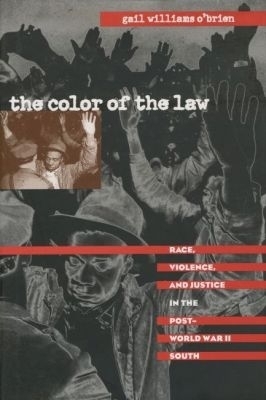
The Color of the Law
Race, Violence, and Justice in the Post-World War II South
Seiten
1999
|
New edition
The University of North Carolina Press (Verlag)
978-0-8078-4802-9 (ISBN)
The University of North Carolina Press (Verlag)
978-0-8078-4802-9 (ISBN)
Drawing on oral interviews and an array of written sources, this is the dramatic story of the 1946 Columbia ""race riot"", the national attention it drew, and its surprising legal aftermath. It illuminates the effects of World War II on race relations and the criminal justice system in the USA.
On February 25, 1946, African Americans in Columbia, Tennessee, averted the lynching of James Stephenson, a nineteen-year-old, black Navy veteran accused of attacking a white radio repairman at a local department store. That night, after Stephenson was safely out of town, four of Columbia's police officers were shot and wounded when they tried to enter the town's black business district. The next morning, the Tennessee Highway Patrol invaded the district, wrecking establishments and beating men as they arrested them. By day's end, more than one hundred African Americans had been jailed. Two days later, highway patrolmen killed two of the arrestees while they were awaiting release from jail. Drawing on oral interviews and a rich array of written sources, Gail Williams O'Brien tells the dramatic story of the Columbia ""race riot,"" the national attention it drew, and its surprising legal aftermath. In the process, she illuminates the effects of World War II on race relations and the criminal justice system in the United States. O'Brien argues that the Columbia events are emblematic of a nationwide shift during the 1940s from mob violence against African Americans to increased confrontations between blacks and the police and courts. As such, they reveal the history behind such contemporary conflicts as the Rodney King and O. J. Simpson cases. |Exploring the famous 1956 race riot in Columbia, Tennessee, this book reveals the roots of black distrust and conflict with the criminal justice system. The Columbia events are viewed as emblematic of the nation's postwar shift from mob violence against blacks to increased confrontations between blacks and the police and the courts.
On February 25, 1946, African Americans in Columbia, Tennessee, averted the lynching of James Stephenson, a nineteen-year-old, black Navy veteran accused of attacking a white radio repairman at a local department store. That night, after Stephenson was safely out of town, four of Columbia's police officers were shot and wounded when they tried to enter the town's black business district. The next morning, the Tennessee Highway Patrol invaded the district, wrecking establishments and beating men as they arrested them. By day's end, more than one hundred African Americans had been jailed. Two days later, highway patrolmen killed two of the arrestees while they were awaiting release from jail. Drawing on oral interviews and a rich array of written sources, Gail Williams O'Brien tells the dramatic story of the Columbia ""race riot,"" the national attention it drew, and its surprising legal aftermath. In the process, she illuminates the effects of World War II on race relations and the criminal justice system in the United States. O'Brien argues that the Columbia events are emblematic of a nationwide shift during the 1940s from mob violence against African Americans to increased confrontations between blacks and the police and courts. As such, they reveal the history behind such contemporary conflicts as the Rodney King and O. J. Simpson cases. |Exploring the famous 1956 race riot in Columbia, Tennessee, this book reveals the roots of black distrust and conflict with the criminal justice system. The Columbia events are viewed as emblematic of the nation's postwar shift from mob violence against blacks to increased confrontations between blacks and the police and the courts.
Gail Williams O'Brien is professor of history and associate dean for graduate studies, planning, and faculty affairs in the College of Humanities and Social Sciences at North Carolina State University in Raleigh.
| Erscheint lt. Verlag | 31.5.1999 |
|---|---|
| Reihe/Serie | The John Hope Franklin Series in African American History and Culture |
| Verlagsort | Chapel Hill |
| Sprache | englisch |
| Maße | 156 x 234 mm |
| Gewicht | 592 g |
| Themenwelt | Geschichte ► Allgemeine Geschichte ► Zeitgeschichte |
| Geisteswissenschaften ► Geschichte ► Regional- / Ländergeschichte | |
| Geschichte ► Teilgebiete der Geschichte ► Kulturgeschichte | |
| Recht / Steuern ► EU / Internationales Recht | |
| Sozialwissenschaften ► Ethnologie | |
| Sozialwissenschaften ► Soziologie | |
| ISBN-10 | 0-8078-4802-6 / 0807848026 |
| ISBN-13 | 978-0-8078-4802-9 / 9780807848029 |
| Zustand | Neuware |
| Informationen gemäß Produktsicherheitsverordnung (GPSR) | |
| Haben Sie eine Frage zum Produkt? |
Mehr entdecken
aus dem Bereich



aus dem Bereich
die großen Jahre der Soziologie 1949-1969
Buch | Hardcover (2025)
Klett-Cotta (Verlag)
CHF 39,20
eine Deutschlandreise im Jahr 1958
Buch | Hardcover (2024)
C.H.Beck (Verlag)
CHF 29,90


