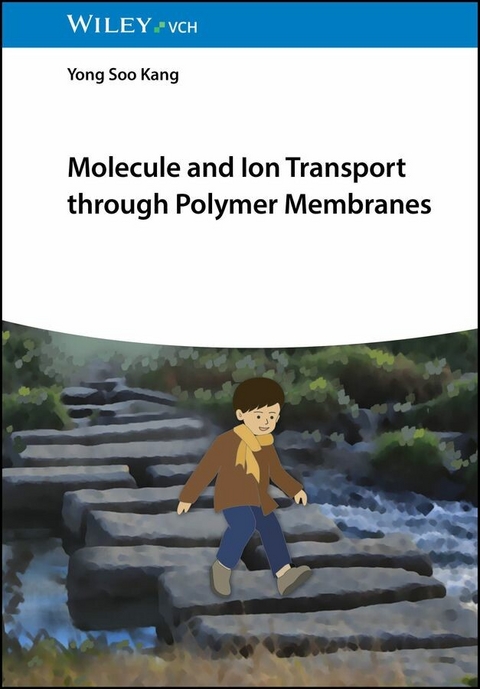
Molecule and Ion Transport through Polymer Membranes (eBook)
400 Seiten
Wiley-VCH (Verlag)
978-3-527-84698-6 (ISBN)
An accurate and up-to-date exploration of molecular and ionic transport phenomena through polymeric membranes
In Molecule and Ion Transport through Polymer Membranes, distinguished researcher Yong Soo Kang delivers an authoritative and organized resource about polymeric membrane technology. The book introduces the fundamentals of the transport phenomena of neutral molecules and ions as well as the underlying common principles between the two.
The author establishes a foundation for designing new polymeric materials using basic principles, like Fick's law, and to introduce a variety of fundamental theories and concepts about polymer structure and permeation properties. Readers will also find:
- A thorough introduction to the underlying principles and experimental techniques necessary to study molecular and ionic transport processes
- Comprehensive explorations of the separation and transportation of small molecules and ions by membranes
- Practical discussions of the transport properties of neutral molecules and ions
- Complete treatments of fundamental principles and theories relevant to mass transport through polymeric membranes
Perfect for polymer chemists, process engineers, electrochemists, membrane scientists, and materials scientists, Molecule and Ion Transport through Polymer Membranes will also benefit mechanical and chemical engineers.
Yong Soo Kang is Professor Emeritus and former Distinguished Professor in the Department of Energy Engineering at Hanyang University, Seoul, Republic of Korea. His research is focused on the transport of neutral molecules and ions through polymer membranes and the relationship between the structure and transport properties of polymers.
Chapter 1
Overview of Molecule and Ion Transport Through Polymer Membranes
Energy and environmental issues have become increasingly important on a global scale, as they are often interconnected. For example, hydrogen fuel cells, which generate electricity with minimal CO2 emissions, offer an energy-efficient solution that addresses both environmental and energy concerns. To tackle these challenges, industries such as electrochemical energy conversion and storage as well as petrochemicals are focusing on more energy-efficient processes to generate fuels such as hydrogen. Among the key technologies supporting these efforts is membrane-based separation, which plays a growing key role in both academic research and industrial applications.
Membrane technologies enable the selective transport of molecules and ions through different mechanisms based on the pore size of the polymeric membrane, as shown in Figure 1.1 [1]. When pores are large, the transport of molecules, for instance, follows Newtonian flow, while smaller pores lead to Knudsen flow or molecular sieving. In nonporous membranes, the solution–diffusion mechanism dominates (Figure 1.1d). This book will focus specifically on diffusional transport of small molecules – gases, vapors, and liquids – and ions, through nonporous polymer membranes based on the solution-diffusion mechanism.
Figure 1.1 Schematic representation of main mechanisms of membrane-based separations: (a) Newtonian flow; (b) Knudsen flow with pore 2–50 nm; (c) sieving mechanism with pore <0.7 nm; and (d) solution–diffusion mechanism without pore.
Source: Adapted from [1].
A solid understanding of molecule and ion transport through polymer membranes is essential for designing efficient materials and optimizing their performance. The solution–diffusion model is represented by Fick’s law for molecule transport and additional Ohm’s law for ion transport, both of which describe how diffusional flux is driven by concentration and electric potential gradients, respectively. Since polymer membranes are widely used in separation processes, understanding these transport mechanisms is crucial for improving membrane efficiency in various applications. This book starts with the “Introduction to Polymeric Materials” and then continues with two parts containing “Molecule Transport Through Polymer Membranes” and “Ion Transport Through Polymer Membranes.” Thus, in this chapter, similarities and differences between molecule and ion transport will be briefly addressed first, followed by overviews of the two parts.
1.1 Molecule Transport
Diffusional transport of molecules can be readily visualized by dropping a black ink droplet into water without any convectional flow. Black-colored ink spreads out through water three-dimensionally by diffusion process (Figure 1.2a). Mass transport through polymeric materials is also evidenced by air transport, both oxygen and nitrogen, through a balloon wall made of rubbery polymers. When a balloon is blown to expand its size with a higher pressure than the outer atmospheric pressure at time zero, the balloon after a certain time (hours) will be shrunk into a smaller or crushed shape because of the mass (oxygen and nitrogen) transport across the balloon wall (Figure 1.2b).
Figure 1.2 Schematics for (a) diffusion of black-colored ink in water and (b) photographs for air transport across the balloon wall with time because .
Source: Y.S. Kang.
Adolph Fick in 1855 wrote that “The transfer of salt and water occurring in a unit of time, between two elements of space filled with differently concentrated solutions of the same salt, must be, caeteris paribus, directly proportional to the difference of concentration, and inversely proportional to the distance of the elements from one another.” In mathematical language, this may be thus expressed as [2]:
where one-dimensional molar flux for direction is proportional to the concentration gradient of species , and the proportionality constant is called diffusion coefficient [2, 3]. Equation (1.1), commonly called as the Fick’s first law, has been conveniently used to describe the diffusional mass transport.
In the case of gases, the pressure gradient is frequently used rather than the concentration one, mostly for convenience:
Here, is called the permeability or permeation coefficient, defined as a product of the diffusion coefficient and the solubility coefficient . The more detailed explanation is available in Section 3.1 of Chapter 3.
However, mass flux is more rigorously expressed by the chemical potential gradient, , rather than the concentration gradient, . The chemical potential, , is given by , where is the chemical activity, defined as with being the activity coefficient and is the standard chemical potential at .
Under ideal conditions with the activity coefficient , is directly related with as:
Substituting Equation (1.3) into (1.1) gives:
Therefore, Equation (1.4) is another expression of Fick’s law in terms of chemical potential gradient.
1.2 Ion Transport
Ion possesses electrical charge in addition to its mass. Therefore, driving forces for ion transport involve two different modes: one for mass and the other for charge. The former is chemical potential gradient, as described previously, and the latter is the electric potential gradient. Therefore, the total driving force can be expressed as electrochemical potential gradient, where it is summation of chemical potential gradient and electrical potential gradient.
Electrochemical potential is the total energy required to move a charged particle (like an ion or electron) from one point to another, combining both its chemical potential (related to concentration) and the electrical potential (related to charge), which is mathematically expressed as:
where the charge number is positive for cation and negative for anion, and is the Faraday constant.
Then, the electrochemical potential gradient can be readily obtained from Equations (1.3) and (1.5) as:
Replacing the chemical potential gradient in Equation (1.4) with electrochemical potential gradient of Equation (1.6) yields:
Equation (1.7) is called the Nernst–Planck electrodiffusion equation contributed from two different transport mechanisms (the first term for diffusion and the second for migration), which will be explained in more detail in Section 8.5 of Chapter 8.
Electron transport across an electronic conductor can be conveniently described by Ohm’s law. It says that the electric current is linearly proportional to applied voltage and inversely proportional to resistance , which can be rearranged to:
where is the current density, is the electric potential gradient and is the conductivity.
Equation (1.8) can be applied to the ion transport associated with the electrochemical potential gradient because the ion contains charges in addition to mass. In real electrolyte solutions containing salts dissolved in a solvent, mass transport always accompanies the charge transport because every ion in the electrolyte has its own charge. Therefore, there will be two different ion transport modes: diffusion due to the concentration gradient and migration or drift due to the electric potential gradient. Such differences must be always recognized as long as you deal with the ion transport.
1.3 Similarities and Differences Between Molecule and Ion Transport
Free volume theory and facilitated transport phenomena help explain how both molecules and ions transport through solid-state polymers, although their driving forces are different. For ion transport, overall electroneutrality should be macroscopically met in any electrochemical devices. This section briefly introduces the key concepts to transport in polymers, including free volume theory, facilitated transport, diffusion, migration, transport parameters, and electroneutrality.
1.3.1 Free Volume Theory
When a molecule dissolved in a polymer finds an empty space or free volume in a polymer matrix, it can move from one position to another by diffusional jump due to its thermal motion at a given temperature. In this case, diffusion process can be determined by the diffusional jump distance and also by the jump frequency , which are mostly determined by the amount of the free volume and its size, as shown in Figure 1.3a.
Figure 1.3 Schematic drawings of diffusional jump with distance of (a) molecule and (b) ion through free volume or empty space among polymer chains.
Source: Y.S. Kang.
The direct relationship between the diffusion coefficient and the amount of the free volume in a given polymer has been observed. One of the most popular models is the free volume theory, suggesting that the diffusion coefficient exponentially increases with the amount of free volume or the size of the free volume:
where is the fractional free volume (FFV) defined as with and being the total specific free...
| Erscheint lt. Verlag | 30.12.2025 |
|---|---|
| Sprache | englisch |
| Themenwelt | Naturwissenschaften ► Chemie |
| ISBN-10 | 3-527-84698-0 / 3527846980 |
| ISBN-13 | 978-3-527-84698-6 / 9783527846986 |
| Informationen gemäß Produktsicherheitsverordnung (GPSR) | |
| Haben Sie eine Frage zum Produkt? |
 EPUB (Adobe DRM)
Größe: 26,6 MB
Kopierschutz: Adobe-DRM
Adobe-DRM ist ein Kopierschutz, der das eBook vor Mißbrauch schützen soll. Dabei wird das eBook bereits beim Download auf Ihre persönliche Adobe-ID autorisiert. Lesen können Sie das eBook dann nur auf den Geräten, welche ebenfalls auf Ihre Adobe-ID registriert sind.
Details zum Adobe-DRM
Dateiformat: EPUB (Electronic Publication)
EPUB ist ein offener Standard für eBooks und eignet sich besonders zur Darstellung von Belletristik und Sachbüchern. Der Fließtext wird dynamisch an die Display- und Schriftgröße angepasst. Auch für mobile Lesegeräte ist EPUB daher gut geeignet.
Systemvoraussetzungen:
PC/Mac: Mit einem PC oder Mac können Sie dieses eBook lesen. Sie benötigen eine
eReader: Dieses eBook kann mit (fast) allen eBook-Readern gelesen werden. Mit dem amazon-Kindle ist es aber nicht kompatibel.
Smartphone/Tablet: Egal ob Apple oder Android, dieses eBook können Sie lesen. Sie benötigen eine
Geräteliste und zusätzliche Hinweise
Buying eBooks from abroad
For tax law reasons we can sell eBooks just within Germany and Switzerland. Regrettably we cannot fulfill eBook-orders from other countries.
aus dem Bereich