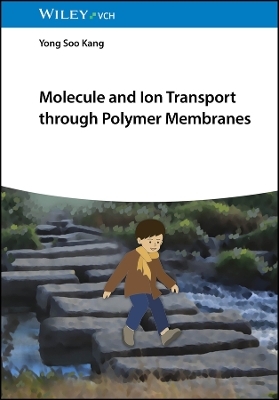
Molecule and Ion Transport through Polymer Membranes
Wiley-VCH (Verlag)
978-3-527-35383-5 (ISBN)
- Noch nicht erschienen (ca. Februar 2026)
- Versandkostenfrei
- Auch auf Rechnung
- Artikel merken
Yong Soo Kang is Professor Emeritus and former Distinguished Professor in the Department of Energy Engineering at Hanyang University, Seoul, Republic of Korea. Professor Kang has built a diverse research portfolio spanning the transport of both neutral molecules and ions through polymer membranes with a particular focus on the relationship between the structure and transport properties of polymers as well as on the facilitated transport.
1. Overview of Mass Transport through Polymeric Materials
1.1 Similarities and Differences between Molecular and Ionic Transport
1.2 Application of Polymeric Membranes
2. Introduction to Polymeric Materials
Part I: Molecular Transport of Gases and Vapors
3. Fundamentals on Gas and Vapor Transport
3.1 Fick's Law and Solution-Diffusion Mechanism
3.2 Sorption and Permeation Features in a Slab
3.3 Diffusion through Polymers
3.4 Statistical View of Diffusion Coefficient
3.5 Free Volume Theory for Diffusion
3.6 Sorption in polymers
3.7 Permeation through Polymers
3.8 Mass Transport Overview: Fickian vs non-Fickian Behavior
4. Facilitated Transport in the Solid State
4. 1 Facilitated Transport in the Liquid State and in the Solid State
4. 2 Facilitated Oxygen Transport
4. 3 Facilitated Olefin Transport
4. 4 Facilitated CO2 Transport
4. 5 Mathematical Models for Facilitated Transport in the Solid State
4. 6 Concentration Fluctuation Model vs Direct Hopping Model
4. 7 Challenges and Prospects
5. Selective Transport and Membrane Applications
5.1 Membrane Separation Process of Gas Mixtures
5.2 Definitions of Permeability and Selectivity
5.3 Separation Performance of Gas Mixtures through Polymeric Materials
5.4 Separation Performance of Facilitated Transport Membranes
5.5 Interrelationship between permeability and selectivity or 'Upper bound Curve'
5.6 Structure and Transport of Composite Membranes
5.7 Application of Gas Transport Membranes (CO2/N2 and olefin/paraffin)
6. Measurement of Molecular Transport Properties
6.1 Definitions of Diffusion, Solubility and Permeation coefficients
6.2 Permeation and Sorption Features in a Slab
6.3 Experimental Methods for Permeation
6.4 Experimental Methods for Sorption
Part II: Ionic Transport
7. Fundamentals on Ionic Transport
7.1 Ionic Concentrations and Electric Potential Profiles
7.2 Concentration Dependency on Electrical Potential: Nernst Equation
7.3 Electrochemical Redox Reactions
7.4 Charge Transfer Kinetics and Electric Current;
The Butler-Volmer Equation
7.5 Interfacial Charge Transfer through Electrical Double Layer
7.6 Generalized Mass and Charge Transport
7.7 Definitions of Ion Conductivity, Transport and Transference Number
8. Ion Transport through Polymer Electrolytes
8.1 Formation of Polymer Electrolyte to Generate Charge Carriers
8.2 Structure of Polymer Electrolytes
8.3 Changes in Chain Mobility and Glass Transition Temperature
8.4 Ionic Conductivity through Polymer Electrolytes
8.5 Temperature Dependence of Ionic Transport or Conduction
8.6 Mechanism of Ionic Transport or Conduction
8.7 Interfacial Charge Transfer between Solid Polymer Electrolyte and Solid Electrode
8.8 Interrelationship between conductivity and selectivity
8.9 Applications of Polymer Electrolyte Membranes for Secondary Battery and Sensitized Solar Cells
9. Ion Transport through Ion Exchange Membranes
9.1 Definition of Ion Conductivity
9.2 Ion Transport through Water and Heterocycles
9.3 Ion Transport Mechanism through Water
9.4 Structure of Ion Exchange Membranes: CEM, AEM and BPM
9.5 Ion Transport through Ion Exchange Membranes
9.6 Temperature-Dependent Ion Conductivity
9.7 Selective Transport through Ion Exchange Membranes
9.8 Interrelationship between conductivity and selectivity
9.9 Transport Mechanisms of Ions
9.10 Applications of Ion Exchange Membranes for Fuel Cells and H2 Generation
10. Measurement of Ionic Transport Properties
10.1 Theoretical backgrounds for measurement of transport properties
10.2 Definitions of ionic transport properties such as ionic conductivity, transport umber and charge transfer resistance
10.3 Electrochemical impedance spectroscopy
10.4 Chronopotentiometry
10.5 Chronoamperometry
| Erscheint lt. Verlag | 11.2.2026 |
|---|---|
| Verlagsort | Weinheim |
| Sprache | englisch |
| Maße | 170 x 244 mm |
| Themenwelt | Naturwissenschaften ► Chemie ► Physikalische Chemie |
| Schlagworte | Chemie • Chemistry • Energie • Energy • Hydrogen, Batteries & Fuel Cells • Physical Chemistry • Physikalische Chemie • Polymer Science & Technology • Polymerwissenschaft u. -technologie • Wasserstoff, Batterien u. Brennstoffzellen |
| ISBN-10 | 3-527-35383-6 / 3527353836 |
| ISBN-13 | 978-3-527-35383-5 / 9783527353835 |
| Zustand | Neuware |
| Informationen gemäß Produktsicherheitsverordnung (GPSR) | |
| Haben Sie eine Frage zum Produkt? |
aus dem Bereich