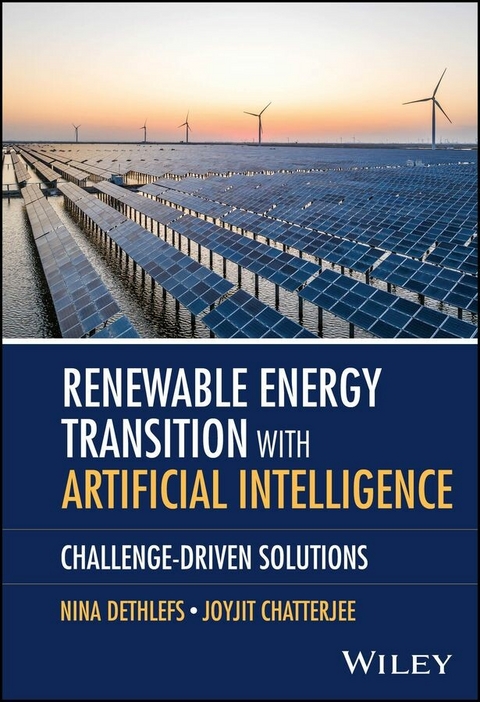
Renewable Energy Transition with Artificial Intelligence (eBook)
272 Seiten
Wiley (Verlag)
978-1-394-30004-4 (ISBN)
Explores harnessing AI to overcome strategic and operational challenges in renewable energy transition
The urgent need to decarbonize global energy systems has propelled renewable energy into a position of unprecedented importance, yet this shift presents major technical, economic, and policy challenges. Increasing reliance on intermittent energy sources such as solar and wind demands more effective forecasting, grid coordination, and flexibility. Artificial Intelligence (AI) offers powerful tools to meet these challenges by learning from data, modeling complex interactions, and enabling real-time optimization across generation, transmission, and consumption.
Renewable Energy Transition with Artificial Intelligence: Challenge-driven Solutions highlights successful pathways of knowledge transfer between academia and industry through case studies drawn from wind, solar, and emerging energy sources. Focusing on challenge-driven problem solving, the authors showcase transferable strategies that overcome pressing obstacles such as the lack of open datasets, the reluctance to adopt opaque predictive models, and insufficient performance benchmarks.
Contributions by leading experts emphasize explainable AI, collaborative innovation, and the vital role of shared infrastructures for data and knowledge exchange. The book also draws from the authors' international workshop with diverse stakeholders, underscoring the importance of cross-sector cooperation in ensuring sustainable and scalable impact.
Adopting a challenge-driven framework linking AI innovation with renewable energy adoption, this title:
- Integrates perspectives from academia, industry, and the public sector to identify scalable solutions
- Demonstrates methods for bridging the 'black box' problem in neural network-based energy forecasting
- Addresses data scarcity by proposing solutions for open access, standardization, and benchmarking in renewables AI
- Provides practical insights for distributed generation, storage, and demand-response management
- Explores future directions for explainable AI in energy system integration and resilience
Both a roadmap and a reference point for integrating AI into renewable systems to accelerate global decarbonization, this book is designed for advanced students, researchers, and practitioners in engineering, computer science, and renewable energy. It is suitable for courses such as Renewable Energy Systems, Artificial Intelligence Applications in Engineering, and Energy Policy and Technology within graduate and postgraduate degree programs in engineering, data science, and environmental studies.
NINA DETHLEFS is Professor of Computer Science (Artificial Intelligence) at Loughborough University, where she leads the Language and Data Research Group and contributes to UK-based doctoral training in offshore wind energy. Her research lies at the intersection of AI, natural language processing, and sustainability, with a focus on developing ethical, interpretable, and data-efficient methods to address climate resilience and renewable energy challenges. She has published widely on applying AI to environmental and energy domains.
JOYJIT CHATTERJEE is Lead Data Scientist at EPAM Systems, UK, and an invited visiting academic at Loughborough and Hull universities. His expertise bridges academic and industrial applications of AI in sustainability, manufacturing, and energy. His work has been featured in global outlets such as Forbes and the World Economic Forum, and he frequently engages with Fortune 500 leaders, European Commission projects, and international energy agencies on the future of AI-enabled renewables.
Chapter 1
AI for Renewables: Addressing Operational, Engineering, and Socioeconomic Adoption Challenges
Joyjit Chatterjee1,2* and Nina Dethlefs2
1EPAM Systems, London, UK
2Department of Computer Science, Loughborough University, Loughborough, Leicestershire, UK
*Corresponding author: Joyjit Chatterjee; joyjit_chatterjee@epam.com
1.1 Introduction
With the growing global push toward decarbonization and aspiration toward net-zero targets, there has been a rapid rise in the adoption of renewable energy sources such as solar, wind, hydropower, etc. Despite their immense promise as non-conventional sources of energy, the inherent nature of such resources introduces significant variability and complexity into the domain of energy systems, which calls for systematic planning and Operations and Maintenance (O&M) strategies. There has been tremendous growth in the renewables industry in recent times, with the renewable energy market estimated to jump from USD 1.34 trillion in 2024 to an almost 4x market value of 5.62 trillion by 2033 (Shuliak, 2025), with AI being an integral force driving this scale-up.
Over the last few years, AI has transitioned from just being a buzzword in the renewables community to playing a game-changing role in data-driven decision support by helping optimize generation, managing energy demand, and enhancing reliability of such intermittent sources of energy. This has largely been driven by the Industry 4.0 era, including advances in Internet of Things (IoT) and high-quality sensors (e.g. from Supervisory Control & Data Acquisition – SCADA system) that can capture high-frequency temporal data (Qays et al., 2022; Ziane et al., 2022). The multitude of recent advances in AI, in particular Generative AI (GenAI) and Large Language Models (LLMs), have shown promise for tackling sector-specific challenges. This has been exhibited through multiple research publications in academia as well as proof of concepts in industry. The vast and complex nature of this domain is highlighted in Figure 1.1 – ranging from application of (i) algorithm-centered AI techniques like XGBoost, CatBoost, LSTM, reinforcement learning, meta-heuristic techniques such as gray-wolf optimization, etc., (ii) an operational cluster of aspects like microgrids, MPPT, HVDC, predictive maintenance, and several system-level technical terms, and (iii) socioeconomic connections to energy trading, sustainability, carbon emissions, GDP, etc. This showcases that the overall landscape is not just growing in the application of computational techniques, but also already has a broad focus on system engineering and financial as well as operational impacts.
Figure 1.1 Network visualization in VOSviewer for term co-occurrence (2021–2025).
However, the deployment of AI in real-world scenarios in production comes with several challenges, which range from the need for trust and explainability in model decisions to optimal performance across widely varying regions and conditions. By selectively analyzing Web of Science for 7200 conference and journal articles between 2021 and 2025 that specifically focus on AI in the renewables domain, we can see a rapid rise in their volume (CAGR 42% up to 2024 – note that indexing for the current year 2025 is not yet complete at the time of writing this chapter). Figure 1.2a relates to the number of papers involving AI and OSW since 2021. Figure 1.2b shows the top 10 venues of publication, clearly highlighting high-impact energy/AI-focused outlets. Figure 1.2c enunciates the most frequent WoS subject categories, affirming the continued focus on renewables + AI.
Figure 1.2 Scientometric insights excluding network visualization.
This chapter provides an introduction to the various ways AI is contributing to the renewable energy transition through challenge-driven solutions. We discuss prominent use-cases and challenges uncovered through foundational research across industry and academia over the years, highlighting explainable AI (XAI) and transferable models, GenAI for efficient energy planning, and methods that facilitate grounding AI models with domain-specific knowledge across energy sources. The chapter also discusses emerging applications – like AI-augmented smart grids, predictive maintenance, energy forecasting, and climate-resilient infrastructure planning, whilst also identifying critical areas that warrant further R&D. We aim to address with this accessible yet technically grounded overview the current gap that hinders adoption of AI more widely in the renewables sector, by bringing together subject-matter experts, engineers and technicians in renewables, AI specialists, researchers, and industry leaders on the same page regarding the present and future direction of AI for facilitating a smoother transition to renewable energy.
1.2 Opportunities and Challenges
AI is being widely applied in the renewables domain for processing massive streams of big data and supporting timely decisions in complex, safety-critical systems (Alsaigh et al., 2023). Machine Learning (ML) models play an integral role these days in forecasting renewable power generation, predictive maintenance, optimizing grid operations and stability, and facilitating control of distributed resources (Mousavi et al., 2025; Carroll et al., 2016; Chatterjee and Dethlefs, 2021a). For instance, in the wind industry, deep learning models, e.g. Long Short-Term Memory (LSTM), networks have become a de facto standard for short-term forecasting of wind power, exhibiting their unique capability to capture nonlinear weather-power associations significantly better than traditional statistical techniques (Yassen et al., 2025). The industry has also witnessed some notable breakthroughs that have been in the limelight – such as a collaboration between DeepMind and the UK’s National Grid in using AI to optimize wind energy production that led to 20% higher output than traditional methods; also IBM Research’s demonstration of AI for improved solar power forecasting, more efficient grid management, and end-to-end integration, etc. (Ukoba et al., 2024).
There is growing interest in utilities and grid operators for leveraging AI to improve smart grid management – including balancing supply and demand in real-time, more efficient integration of distributed energy resources, and better accuracy in fault detection and response to outages. A plethora of techniques have been leveraged already in the industry to tackle the intermittent nature of renewable energy systems, such as Gaussian Process Regression, Support Vector Regression, Artificial Neural Networks, etc. (Ukoba et al., 2024). There are a plethora of benefits that AI brings to the table: reduced downtimes and enhanced operational efficiency, lower costs in O&M, and higher reliability for renewable energy systems. According to domain experts, AI has immense potential in reducing the costs and accelerating the processes associated with designing, licensing, deploying, operating, and maintaining energy infrastructure, with savings that could span hundreds of billions of dollars (Kooei, 2024).
While such opportunities are undoubtedly evident, there are several key challenges that come as barriers that prevent AI from realizing its transformative potential in the energy sector. One of the most critical issues is the black-box nature of most modern AI models, particularly deep learners. While neural nets often achieve high accuracy owing to the inherently complex and nonlinear nature of the data in this domain, the multiple variables and the dynamic interactions between them make accurate and reliable modeling challenging. In the energy sector, stakeholders (operators, engineers/technicians, and regulators) are often reluctant to adopt such complex models, which cannot offer clear explanations behind their decisions (Alsaigh et al., 2023). Another key challenge is the lack of transferability – ML models trained with knowledge from a specific context often struggle to generalize to other new, unseen contexts that can arise due to differences in geography, varying climatic conditions, unique grid configurations, etc. This raises the pivotal need for addressing model transferability, scalability, and the ability to generalize across varying system configurations and regions.
Lack of sufficient data for training ML models is another practical challenge, e.g. for new solar or wind farm developments that have little to no historical data in place to train reliable models. Additionally, incomplete or inaccurate data (e.g. anomalous values from SCADA sensors in a turbine, missing power generation metrics in a solar panel, etc.) can produce models that learn sub-optimally and predict with limited accuracy, which undermines their utility in real-world deployment. Whilst strategies like transfer learning (TL) and domain adaptation have become popular in the last few years to tackle this concern (Cheng et al., 2025), they come with their own set of complexities that hinder the ability to ensure that adapted models remain accurate and unbiased in new scenarios. Additionally, the latest advances in GenAI and LLMs, while promising, come with an inevitable need for grounding the foundation models in domain-specific knowledge without which the models cannot be trusted to generate valid and useful outputs in the renewables industry. Without any physical constraints or system-specific expertise, these powerful models may provide fluent and plausible-sounding...
| Erscheint lt. Verlag | 30.12.2025 |
|---|---|
| Sprache | englisch |
| Themenwelt | Naturwissenschaften ► Physik / Astronomie |
| ISBN-10 | 1-394-30004-2 / 1394300042 |
| ISBN-13 | 978-1-394-30004-4 / 9781394300044 |
| Informationen gemäß Produktsicherheitsverordnung (GPSR) | |
| Haben Sie eine Frage zum Produkt? |
 EPUB (Adobe DRM)
Größe: 10,4 MB
Kopierschutz: Adobe-DRM
Adobe-DRM ist ein Kopierschutz, der das eBook vor Mißbrauch schützen soll. Dabei wird das eBook bereits beim Download auf Ihre persönliche Adobe-ID autorisiert. Lesen können Sie das eBook dann nur auf den Geräten, welche ebenfalls auf Ihre Adobe-ID registriert sind.
Details zum Adobe-DRM
Dateiformat: EPUB (Electronic Publication)
EPUB ist ein offener Standard für eBooks und eignet sich besonders zur Darstellung von Belletristik und Sachbüchern. Der Fließtext wird dynamisch an die Display- und Schriftgröße angepasst. Auch für mobile Lesegeräte ist EPUB daher gut geeignet.
Systemvoraussetzungen:
PC/Mac: Mit einem PC oder Mac können Sie dieses eBook lesen. Sie benötigen eine
eReader: Dieses eBook kann mit (fast) allen eBook-Readern gelesen werden. Mit dem amazon-Kindle ist es aber nicht kompatibel.
Smartphone/Tablet: Egal ob Apple oder Android, dieses eBook können Sie lesen. Sie benötigen eine
Geräteliste und zusätzliche Hinweise
Buying eBooks from abroad
For tax law reasons we can sell eBooks just within Germany and Switzerland. Regrettably we cannot fulfill eBook-orders from other countries.
aus dem Bereich