Field-Flow Fractionation (eBook)
399 Seiten
Wiley-VCH (Verlag)
978-3-527-69808-0 (ISBN)
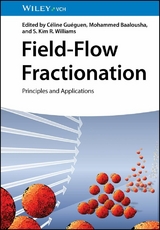
Comprehensive, up-to-date, and user-centered one-stop reference on the principles and applications of Field-Flow Fractionation (FFF), a highly versatile separation technology
Field-Flow Fractionation: Principles and Applications offers a comprehensive and topical one-stop reference on Field-Flow Fractionation (FFF), an important separation technique which has been proven successful in the analysis of natural and engineered nanoparticles, pharmaceuticals, proteins, polymers, soils, and food.
After introductory chapters on theory, principles, and instrumentation, a tutorial-style user guide addresses typical users' questions and problems. In the application part, the separation of all relevant particle classes is discussed by international experts.
Sample topics covered in Field-Flow Fractionation: Principles and Applications include:
- Historical perspectives of the technique, normal versus steric versus hyperlayer modes, retention resolution, and fractionation power
- FFF techniques, including flow (asymmetric, frit inlet, and outlet), sedimentation, thermal, electric, and other novel techniques such as 2D
- How to determine if FFF is the correct choice and if it is being implemented correctly, along with general optimization strategies including carrier fluid, calibration, and reproducibility
- Sample overloading and recovery, detector selection, troubleshooting, and performance of other fractionation techniques
Both beginners and experienced chemists and researchers can confidently rely on Field-Flow Fractionation: Principles and Applications to confirm their own understanding and to improve their FFF methods and interpretation of their results.
Céline Guéguen, PhD, is Full Professor of Chemistry at the Université de Sherbrooke, Québec, Canada.
Mohammed Baalousha, PhD, is Professor of Environmental Nanoscience and director of the Environmental Nanoscience & Analytics Laboratory at the University of South Carolina, Columbia, South Carolina, United States.
S. Kim R. Williams is a Professor of Chemistry at the Colorado School of Mines, Golden, Colorado, United States
1
Field-Flow Fractionation Techniques
P. Stephen Williams
Cambrian Technologies Inc., 1772 Saratoga Avenue, Cleveland, OH, 44109, USA
1.1 Introduction
Field-flow fractionation (FFF) comprises several related techniques for the separation and characterization of macromolecular, colloidal, and particulate materials. All of the FFF techniques have in common the requirement of a non-uniform, laminar flow of a carrier fluid and a means of inducing different sample species to be distributed differently within the flow, resulting in their different migration velocities and thereby their separation. Non-uniform laminar fluid velocity profiles are easily obtained when fluid flows under the influence of pressure through thin parallel-plate, annular, or tubular channels. Fluid velocity approaches zero at the stationary walls due to viscous drag and approaches a maximum velocity farthest from the walls. The transport of sample species across the velocity profiles in such channels, perpendicular to the direction of flow, can be accomplished in a number of different ways, each giving rise to a different member of the FFF family.
The transport of macromolecular and colloidal species toward the accumulation wall causes an increase in concentration adjacent to the wall, which, for these submicron species, is opposed by diffusion. This results in a steady-state distribution next to the wall, the thickness of which is a function of the species properties and the applied field. Diffusion is negligible for supramicron species, and their transport to the accumulation wall is opposed by hydrodynamic lift forces within the shear flow close to the wall (Caldwell et al. 1979; Williams et al. 1992, 1994, 1996b). In either case, species that differ in their rate of transverse transport to the wall and/or in their rate of opposing transport, or that differ in the position-dependent transverse forces they experience, quickly approach different steady-state concentration distributions within the shear flow close to the accumulation wall. This results in their different mean migration velocities along the channel. The rapid Brownian exchange of positions of identical particles within a thin particle distribution results in their migration as a coherent zone. Different species are consequently separated as they migrate along the length of the channel, and a detector at the channel outlet can be used to observe their elution as a function of time. The theoretical underpinnings of the separation mechanisms of FFF are not the focus of this chapter. These have been discussed in earlier works by Martin and Williams (1992), Martin (1998), and Williams (2022).
The transport of species across the channel thickness can be achieved by various means. For example, a field that interacts with some material property of the sample species may be applied transversely across the channel thickness. Fields such as the Earth’s gravitational field or a centrifugal field induce the sedimentation of species that are denser than the carrier fluid. This type of field is used in the gravitational FFF (GrFFF) and sedimentation FFF (SdFFF) (also known as centrifugal FFF or CF3) techniques, respectively. Electric, dielectric, and magnetic fields have been employed in electrical FFF (ElFFF), dielectrical or dielectrophoretic FFF (DEP-FFF), and magnetic FFF (MgFFF). A temperature gradient maintained across the channel thickness can induce the transport of macromolecules and colloids, generally toward the colder wall. This temperature-gradient-induced transport is known as thermal diffusion or thermophoresis, the mechanisms of which continue to be investigated. Such a thermal gradient is used in thermal FFF (ThFFF).
A technique of FFF that does not make use of a field or gradient to drive species to the accumulation wall is known as flow FFF (FlFFF). This form employs a secondary component of flow through a semipermeable accumulation wall (permeable only to the fluid) that carries all species to the wall at the same rate by entrainment in this transverse component of fluid flow. The rate of transport is non-selective and does not depend on the size or on any material properties of the sample species. It is only differences in the opposing rates of diffusional transport or in hydrodynamic lift forces that give rise to different distributions in the non-uniform component of flow along the channel length and hence different elution times.
Table 1.1 lists the equations for the retention parameter λ for submicron species (approximately equal to the ratio of mean distribution thickness to the channel thickness) for the different FFF techniques considered in this chapter, along with the different physicochemical sample properties that influence the parameter and therefore retention. In each case, the measurement of retention time can potentially allow the calculation of the respective retention parameter, and hence the determination of a listed sample property, given knowledge of all other relevant parameters.
Other types of fields have been proposed for use in FFF, such as acoustic, photophoretic, etc., but these are not presently in common use and will not be discussed in this chapter.
Table 1.1 FFF Techniques with Respective Retention Parameter Equations and the Sample Physicochemical Properties that Control Retention. (The explanation of symbols may be obtained in the respective sections of the chapter.)
| Sample properties |
|---|
| AsFlFFF, HF-FFF λ0=DV0V˙cw2=kTV0fV˙cw2=kTV03πηdhV˙cw2D,f,dh |
| GrFFF, SdFFF λ=kTVpΔρGw=6kTπd3ΔρGwVp,Δρ,ρp |
| ThFFF λ=DDT(dT/dx)w=Tα(dT/dx)wD,DT,α |
| ElFFF λ=DμeEeffw=kT3πηdhμeEeffwD,μe,dh |
| MgFFF λ=μ0kTVmΔχB∇Bw=kTVmM∇Bw=6kTπdm3M∇BwVm,Δχ,M,dm |
1.2 Flow Field-Flow Fractionation
Parallel-plate channel flow FFF (FlFFF) was introduced in 1976 (Giddings et al. 1976c; Giddings et al. 1976d; Lee and Lightfoot 1976). It was originally implemented using channels having two permeable frit walls. A semipermeable ultrafiltration membrane covering one of the walls served as the accumulation wall. The membrane is permeable to the fluid but not to the sample materials. It was pushed into contact with the supporting frit due to its hydraulic resistance to the flow passing through it. An equal flow was introduced to the channel via the permeable depletion frit wall. It was assumed that the cross-flow velocity component was constant throughout the channel and that the sample species were eluted along the length of the channel under the influence of a constant volumetric channel flow rate. However, actual conditions in the channel may deviate from this ideal model. The hydraulic resistance of the membrane is likely to be sufficiently high that the pressure drop along the channel length would not significantly influence the local flux through the membrane. This may not be the case for the depletion frit wall, however, and there is a possibility that the pressure drop along the channel may influence the local flow through the depletion wall. The frit porosity may also vary along its length or its breadth. These effects may cause the mean channel flow velocity to vary along the channel length, with a deviation of void time and elution times from those predicted from theory based upon the assumption of ideal conditions (Martin and Hoyos 2011). Although this design was used with success for many years, it has now been largely superseded by asymmetrical FlFFF (AsFlFFF or AF4).
AsFlFFF was proposed independently by Granger et al. (1986) and by Wahlund and Giddings (1987), with much of the subsequent early development being carried out by Wahlund and co-workers. In this form of FlFFF, the permeable depletion wall is replaced by an impermeable wall, such as a plane glass plate, which eliminates the uncertainties associated with the frit flow. A fraction of the fluid entering the channel inlet exits through the accumulation wall and the remainder via the channel outlet. The gradual loss in volumetric flow along the length of the channel is partially compensated by a reduction in the channel breadth from inlet to outlet. This reduction in channel breadth is typically linear (Litzén and Wahlund 1991; Litzén 1993) or, less commonly, exponential (Ahn et al. 2010; Williams 1997). The purpose is to avoid the situation where mean fluid velocity falls to such a low level close to the channel outlet that sample immobilization on the membrane might occur (Wahlund et al. 1986; Williams 2000b). An exploded view of an AsFlFFF channel is shown in Figure 1.1.
Channels are typically between 25 and 35 cm long, 2.5–3.0 cm wide close to the inlet, and less than 1.0 cm wide close to the outlet. Spacer thicknesses of 250–350 μm are commonly used. Smaller channels, having lengths of less than 10 cm and widths of less than 1.0 cm at the inlet narrowing to less than 0.2 cm at the outlet, are also in use. Their advantages and disadvantages have been compared (You et al. 2017). As in all forms of FFF, the carrier fluid composition must minimize...
| Erscheint lt. Verlag | 16.12.2025 |
|---|---|
| Sprache | englisch |
| Themenwelt | Naturwissenschaften ► Chemie |
| Schlagworte | carrier fluid • fff calibration • fff detector selection • fff performance • fff reproducibility • fff troubleshooting • fractionation power • hyperlayer modes • Normal Modes • retention resolution • sample overloading • steric modes |
| ISBN-10 | 3-527-69808-6 / 3527698086 |
| ISBN-13 | 978-3-527-69808-0 / 9783527698080 |
| Informationen gemäß Produktsicherheitsverordnung (GPSR) | |
| Haben Sie eine Frage zum Produkt? |
 EPUB (Adobe DRM)
Kopierschutz: Adobe-DRM
Adobe-DRM ist ein Kopierschutz, der das eBook vor Mißbrauch schützen soll. Dabei wird das eBook bereits beim Download auf Ihre persönliche Adobe-ID autorisiert. Lesen können Sie das eBook dann nur auf den Geräten, welche ebenfalls auf Ihre Adobe-ID registriert sind.
Details zum Adobe-DRM
Dateiformat: EPUB (Electronic Publication)
EPUB ist ein offener Standard für eBooks und eignet sich besonders zur Darstellung von Belletristik und Sachbüchern. Der Fließtext wird dynamisch an die Display- und Schriftgröße angepasst. Auch für mobile Lesegeräte ist EPUB daher gut geeignet.
Systemvoraussetzungen:
PC/Mac: Mit einem PC oder Mac können Sie dieses eBook lesen. Sie benötigen eine
eReader: Dieses eBook kann mit (fast) allen eBook-Readern gelesen werden. Mit dem amazon-Kindle ist es aber nicht kompatibel.
Smartphone/Tablet: Egal ob Apple oder Android, dieses eBook können Sie lesen. Sie benötigen eine
Geräteliste und zusätzliche Hinweise
Buying eBooks from abroad
For tax law reasons we can sell eBooks just within Germany and Switzerland. Regrettably we cannot fulfill eBook-orders from other countries.
aus dem Bereich